There is a moment in every new job when a person has stopped imagining the work and begun arranging the rest of a life around it.
It is not during the interview.
The interview has a chair, a glass of water, and a small mutual agreement to behave as though nobody has ever been late for anything.
The moment arrives later.
It arrives when the schedule appears.
There it is.
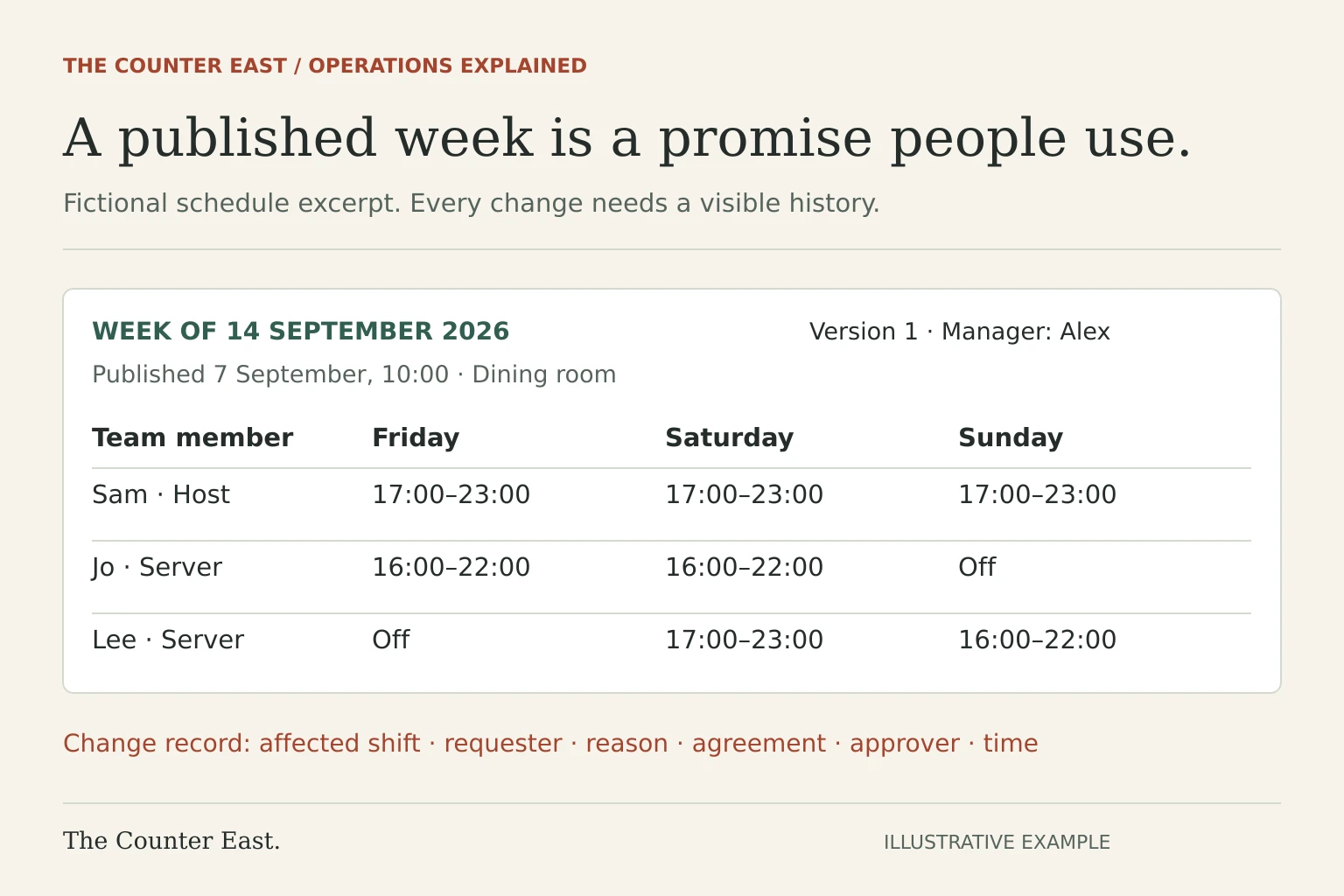
Friday through Sunday, five until eleven.
Laid out in a little grid with all the authority of a maritime chart.
Now a Life Can Be Arranged Around It
Somebody can tell a sibling when they can drive them somewhere.
Somebody can tell a landlord what will be coming in.
Somebody can work out whether two closings a week are actually possible.
Rather than admiring the brave general idea of being flexible.
This is the part of the job offer that too many restaurants leave wandering around outside in the rain.
Pay is a promise.
The role is a promise.
The timetable is also a promise.
Not an eternal one.
Restaurants are not monasteries.
The dining room may fill up.
A person may be ill.
A delivery may choose drama.
The practical universe reserves the right to knock over a chair.
But your first schedule tells a new employee whether you understand that hours are made of actual evenings.
Know What the Vacancy Is Before You Advertise It
Not “we need a people person.”
That is the sort of sentence that has launched many bad Tuesdays.
A real opening has a role, a place, dayparts, an effective date, a manager, the way pay works, expected weekly hours, and a reason.
“Replace one Friday to Sunday host, evenings, from the end of the month” isn’t poetry.
It is better.
It can be held up against the last four weeks of schedules.
Perhaps you need a replacement.
Perhaps you need cover for a temporary absence.
Perhaps you have scheduled yourself into a decorative corner and would like a new human being to repair the wallpaper.
The distinction matters.
Nobody should be recruited as a ceremonial apology for a schedule nobody examined.
Then the Advertisement, Standing at the Edge of the Internet in a Clean Shirt
It should say when the work happens.
The actual window.
The cash wage or the salary.
Whether tips or a pool are involved.
The recurring availability you need, the location, the route in, and when an answer is likely.
Those details are not a sales pitch with the tedious bits attached.
They are the offer.
The Useful Interview Questions Are Wonderfully Unromantic
Can this person work the two closing shifts?
Which dates in the next month are unavailable?
Can they say back to you how the pay works?
That is not a trapdoor.
It is a small bridge, built before anybody has to cross a river in restaurant shoes.
Twenty-five minutes holds all of it.
Those questions, a guest problem, a handoff, and the candidate’s own questions.
And an urgent opening doesn’t require you to become a travelling circus.
You can compress ten days into two without deleting the wage explanation, the real shift conditions, or the reason for the decision.
An offer may only have a couple of days to live when the gap is pressing.
Your calendar is allowed to be urgent.
The truth is not.
And Then, at Last, the Grid
A week’s schedule needs a version number, a publication time, a named manager, and a view the employee can actually see.
Without those, your schedule becomes a village legend.
Somebody says the Tuesday close changed.
Somebody else says it was always Wednesday.
The phone begins producing archaeological layers of messages, each slightly more authoritative than the last.
Nobody wins the excavation.
The quiet solution is not to forbid change.
It is to make change legible.
Who asked.
Why.
Which shift.
Who replaces whom.
Whether the affected person agreed, where that is needed.
Who approved it.
And when.
That isn’t bureaucracy wearing a lanyard.
It is the difference between a plan and a rumour.
Let the Published Week Meet the Worked Week
At the end of it, they will have things to discuss.
Did the role, the start, the end, or the location change?
Was it a manager change, a swap, a cancellation, an open shift, a late addition, or that most theatrical of arrangements, the close followed quickly by the open?
Fifty scheduled shifts with five manager changes gives you a manager-change rate.
It does not give you an absence rate.
Numbers should not be made to wear the wrong nametag.
Nor should five changes made five days ahead be allowed to tuck one change made two hours ahead into a reassuring average.
The tiny notice belongs in the story.
It is often the whole story.
A Name on a Schedule Is Not Capacity
Here the old temptation returns.
The person has accepted a job.
They have not necessarily learned the station, found the current menu, met the trainer, or discovered whom to ask when the room begins doing its room thing.
A schedule is an invitation to begin.
It is not a magic wand with an apron.
So before the first shift, one person should own the training map.
The schedule. The checklist. The trainers. The access. And the decision about readiness.
Otherwise your new employee gets a menu fact from one person, a screen instruction from another, and a haunted shrug from somebody else.
The first ninety minutes should answer the practical questions.
Who leads the shift.
Where guests need help.
Which part of the room is being learned.
Where the current answers live.
And where uncertainty goes.
Then give the person one small task and watch it happen.
A host trainee greets three arrivals beside the trainer.
Three real people.
Three chances for the room to become less theoretical.
Learning Makes Four Passes
Somebody shows the work and says why.
The newcomer follows and calls the next move.
The newcomer does it while somebody watches.
Then comes the reversal.
Explain what happens next, once the pleasant little script has met a real question.
Watching is not the same as knowing.
Knowing is not the same as doing.
And doing at a quiet moment is not the same as doing while an interruption has entered the room wearing a hat.
Which is why nobody is released until the work has been seen in two conditions.
Ordinary pace.
And a spell of interruptions or volume.
The result is not an ornamental gold star.
It is one of three useful things.
Ready to work the station alone.
Able to do specified routine work beside a named experienced person.
Or not ready yet, with a different assignment and a plan.
None of those is a verdict on the soul.
They are instructions for Tuesday.
But Do Not Turn Stability Into a Shrine
That is the counter-failure, and it is easy to recognise once it has taken over the office.
The posted grid gets defended against a genuine absence, a changed demand pattern, or a person with a real conflict.
Until the schedule is very stable and the service is very strange.
Then changes come back in through the side door.
Private messages. Favours. Resentments. And a shift that nobody quite owns.
The answer is not to make people carry the original schedule like a sacred tablet.
It is to give the change a fair path, record it, and let the next version tell the truth again.
Look Back Without Turning Anybody Into a Percentage
At a month, at two, at three.
Did they reach a first shift?
Did the pay work as advertised?
Did published shifts keep becoming different shifts?
Did the role hold, or have you opened another vacancy for the same missing evening?
And after release, the first couple of independent shifts deserve a look with the lead.
Not a grand tribunal.
Just the new employee, the real room, and a correction made while it can still be small.
Later there may be five minutes before a shift.
One changed menu item.
One new phrase.
One handoff that needs its edges put back on.
That is training’s proper job.
To make a promised shift inhabitable once it arrives.
It cannot repair the surprise of discovering that the promise was never a promise.
Merely a Restaurant Keeping a Date
The best schedule does not congratulate itself for being published.
The best training does not congratulate itself for being completed.
The employee sees a shift.
Arrives for it.
Learns what the work is.
And knows who is nearby when it becomes interesting.
Then, at the end of the evening, they go home with the rest of the week still where it said it would be.
Which is not a miracle.