Delivery demand becomes an operational failure when the channel continues to accept orders after the kitchen can no longer make the promise attached to them.
The guest sees a listed item, availability, a delivery area, and an estimated time before food exists.
After payment, the kitchen has to convert that display into a correctly made, packed, ready, and collected order.
The goal is not to suppress demand. It is to make displayed availability reflect the kitchen’s actual capacity before an order enters production, while preserving a clear path for orders already accepted.
For a delivery-only operation, that is the point at which ghost-kitchen demand and restaurant technology meet: acceptance must be an active gate, not a passive printer event.
The need is material.
Most restaurant traffic is now off premises, and a substantial share of full-service operators report that off-premises sales make up more of their business than they did before the pandemic.
A ghost kitchen has no walk-in channel to absorb a false online promise.
Its listing is the service entrance.
Assign capacity ownership before opening a channel
Acceptance releases ingredients, line capacity, packaging, and a place on the ready shelf.
The accepted order becomes a production object with an identifier, promised time, brand, item list, modifiers, paid status, fulfilment method, and customer-contact route.
The capacity owner therefore needs authority to stop or restrict a channel before the queue is beyond recovery.
That owner should be the restaurant operating owner for the shift, not an unnamed marketplace setting.
Restaurant technology has three ownership layers: restaurant business owner, restaurant operating owner, and technology or vendor owner.
A vendor may operate the service, but only the restaurant can decide whether a location can make another meal now. The acknowledgement owner should also be named.
An automatic channel can remove a single-person acknowledgement during a rush, but it can release demand when the restaurant is unavailable.
The procedure should distinguish capacity from ordinary workflow pressure.
A kitchen may be constrained by fry capacity, oven, assembly bench, cold hold, packer, or courier arrival rather than its ticket count alone. The production queue should follow its actual constraint.
A kitchen that starts every item immediately can make hot food wait for a driver; a kitchen that waits too long for a courier signal can miss the promised time.
Capacity ownership makes that trade-off deliberate.
Test availability as four separate states
An item is not simply available or unavailable. It may be configured in the restaurant catalogue, published to a channel, sellable at the location, and actually producible right now.
These four states need separate checks.
A station outage, stockout, labour gap, unsafe question, missing label, or capacity hold can change the last state without changing the first three.
Before acceptance, every listed item should map to a current recipe, ingredient position, packaging requirement, and sale status at the production location.
If stock, staffing, equipment, or an allergen answer makes fulfilment unsafe, the item should be removed before an order is accepted.
A substitution after payment may solve a single ticket, but it does not establish whether the item was unavailable, incorrectly mapped, or deliberately substituted.
The channel state may have more than one source. A marketplace can make a store unavailable through more than one setting, including its service-availability window and its accept-orders state.
A guest-visible closed label is therefore not a diagnosis. The operating record should show the authoritative value in each system, the local physical condition, and the person who changed the state.
Use an acceptance gate with a traceable disposition
The acceptance gate needs a clear outcome: accept, deny, or hold for an identified exception. It also needs an owner, timestamp, and order identifier.
One marketplace workflow requires retrieval of order details before accept or deny, and cancels the order if staff do not accept it within a set number of minutes.
The exact deadline is platform-specific.
The operating rule is not to wait out that deadline. It is: give every incoming order a named acknowledgement owner and a traceable disposition before the applicable deadline.
The gate should not be treated as a price or marketing tool. Its purpose is to prevent a channel from releasing work that the kitchen cannot receive and fulfil.
A kitchen can use it to pause an affected item, brand, or channel while a block is assessed.
The block record should state whether the cause is stockout, equipment failure, missing information, labour gap, or capacity hold, and who owns its resolution.
Return the states that the next owner needs
Delivery technology should be assessed by integration depth, not by the number of logos in a directory.
The relevant connection supports four exchanges: publish master data, receive new work, return status, and reconcile exceptions. Receiving the order is only one exchange.
If staff cannot return an out-of-stock resolution, ready-time change, cancellation, or completion state, the restaurant must create a manual second workflow just when the kitchen is busiest.
There are also four kinds of latency between a decision and its visible state: human entry, local screen update, cross-system delivery, and physical confirmation.
A cook can mark an order ready immediately; the marketplace can receive that update later; a courier can collect it later still.
A guest-facing estimate should not imply that every one of those events happened at the same time.
The working surfaces matter.
The relevant surfaces can include a kitchen station, expo, pickup shelf, staff-held device, and manager back office.
Each additional surface needs three design elements: a role definition, an authoritative state, and an outage fallback.
A manager dashboard can be suitable for exceptions, while a cook needs a direct view of priority and completion. More screens do not automatically produce more control.
Preserve the accepted order during a failure
An integration failure begins when at least two systems disagree about a material state: acceptance, whether preparation should begin, availability, ready time, courier arrival, or cancellation.
A red error banner may be evidence, but it is not the definition.
Before retrying, staff should preserve source IDs, timestamps, location mapping, event payload or audit log, and the current physical status.
Blind re-submission is especially risky.
A marketplace may have accepted an order that the kitchen did not receive, so resending creates duplicate production.
The kitchen may have prepared an order that the marketplace cancelled, so cooking it again fixes nothing.
If an item was removed internally but remains sellable externally, closing the store may be safer than improvised substitutions until the menu state is reconciled.
The documented degraded workflow should cover four states: internet loss, device loss, upstream-channel outage, and stale or conflicting data.
For each, it identifies the last trusted record, a temporary recording method, the person allowed to decide capacity, and the reconciliation path after restoration.
A system with no recorded fallback cannot establish what was accepted, prepared, or received.
The restart test is whether a manager can reconcile events without resending every order, double-counting stock, or silently overwriting a later change.
Protect contribution as well as quoted time
Throttling is a pacing control, but it is also an economic control. Marketplace commission is generally a percentage of order subtotal.
Published tiers differ sharply between delivery and pickup.
A rate card is one platform’s arrangement rather than an industry average, but it illustrates why a larger order queue is not automatically a better queue.
Contribution begins with the completed order’s food and beverage subtotal, not the guest’s whole checkout amount.
It then accounts for food, direct production labour, packaging, commission, merchant-funded promotion, refunds or adjustments, and other order-specific costs.
The operation has two thresholds: contribution per completed order remains positive, and aggregate contribution covers fixed or step-fixed capacity commitments.
Those costs fall into two buckets.
Fixed or step-fixed costs include base rent, minimum facility fee, manager, equipment lease, insurance, software subscription, and required staffing floor.
Variable costs include ingredients, packaging, per-order commissions, merchant-funded discounts, payment costs, and hourly production labour when it actually scales.
A channel that brings orders only by adding peak labour, delaying ready orders, or displacing higher-contribution work may worsen both guest experience and contribution.
Keep the throttle proportionate and visible in its effects
The counter-failure is important.
Throttling becomes the problem when it is used to conceal chronic understaffing, leaves accepted guests uninformed, or gives channels unexplained unequal treatment.
A pause can protect a real capacity constraint. It cannot substitute for capacity planning, staffing, repair, mapping stewardship, or an outage procedure.
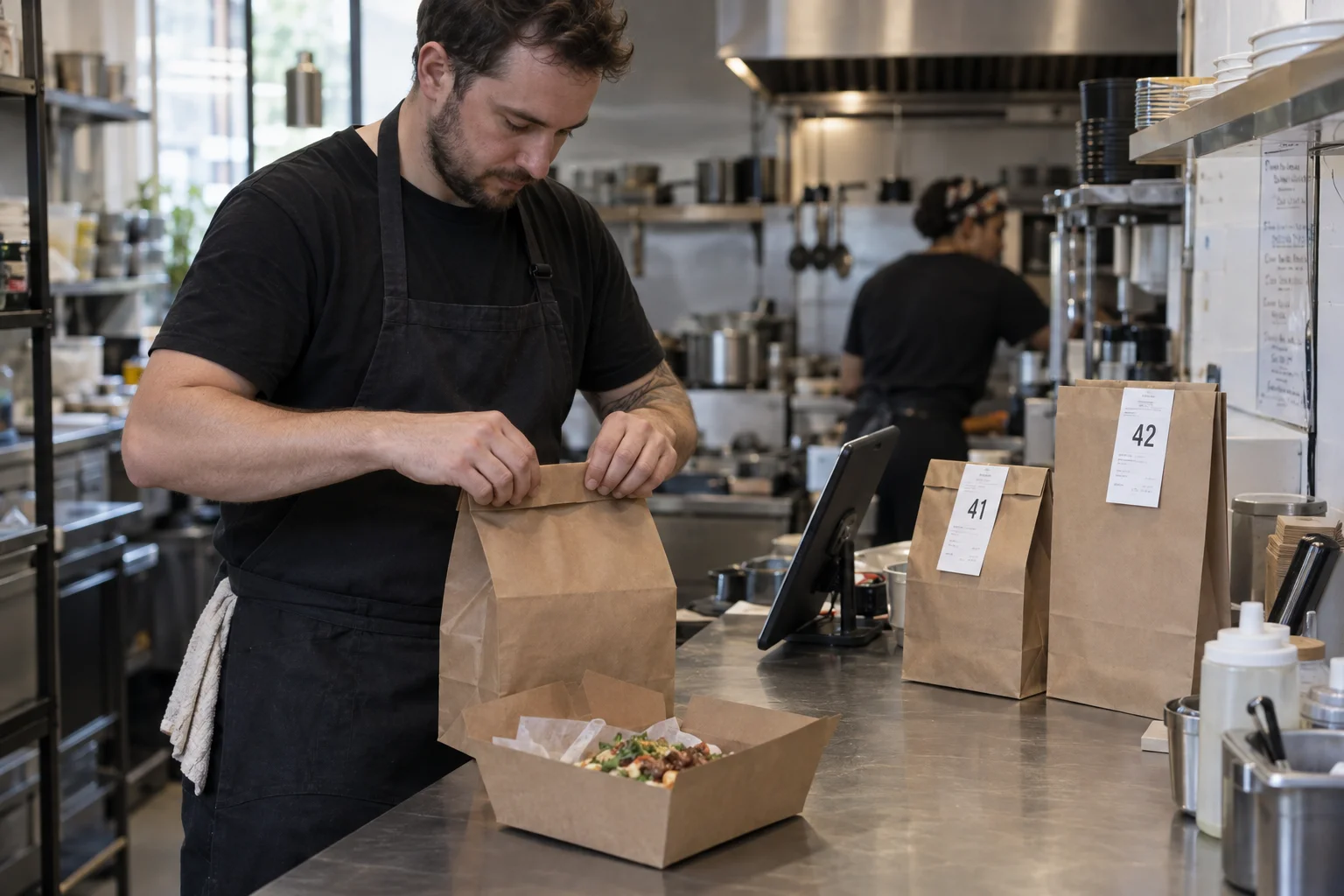
Accepted guests still need a credible status. Prepared is not ready: an order can still lack a drink, utensil, allergen note, receipt label, second bag, or matchable identifier.
Ready means complete, correctly identified, and authorized for pickup. Collection is the later custody-transfer state, when the courier confirms the identifier, receives the counted bags, and the system records the handoff.
These states protect both the screen’s promise and the bag at the shelf.
The measures are straightforward:
- assign capacity and acknowledgement ownership before service;
- test configuration, publication, local sellability, and current producibility separately;
- record an accept, deny, or exception disposition for every incoming order;
- return status and reconcile exceptions across the integration;
- use a documented fallback record before retrying a failed exchange; and
- evaluate incremental delivery volume against contribution and committed capacity.
The strongest throttle is largely invisible to the guest. The channel shows what the kitchen can actually accept. Cooks work the orders they have actually received.
When capacity changes, the operating record identifies the state, the owner, and the recovery path before the screen becomes a promise it cannot keep.