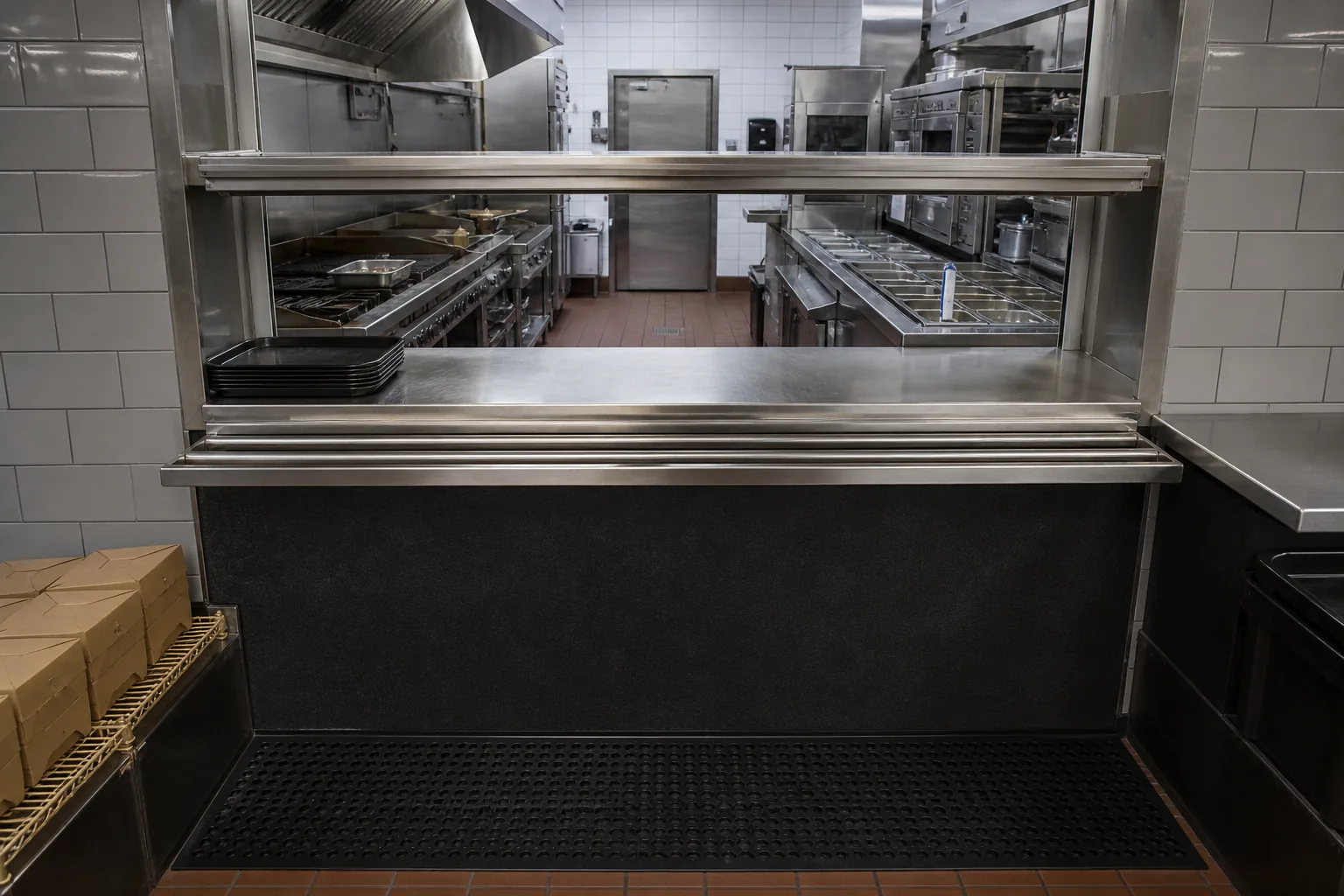
There is a moment on a cooking line when a person discovers that the nearest spoon is not where the next action says it should be.
The spoon is somewhere else.
It has gone to live in a small republic beyond the reach of the cook who needs it.
So the cook turns.
Crosses behind somebody.
Opens a drawer.
Discovers a ladle that belongs to a previous era.
Turns back.
And arrives just in time for the plate to require a different thing.
This Is Not a Failure of Character
It is what a room asks a body to do.
During a rush, nobody has time for a philosophical inquiry into the location of the spoon.
The hand goes where it has gone before.
The feet take the path that is nearest, most visible, and least likely to make somebody else wait.
That path becomes your kitchen’s constitution.
It may be a very good constitution.
Or it may be a constitution written by a drawer full of miscellaneous tongs.
So the useful question isn’t whether your cooks can move faster in every direction.
They cannot.
The useful question is whether an ordinary plate has a route so obvious that it never has to hold a committee meeting.
Begin With One Actual Plate
Not the heroic plate that turns up in your staff meeting with all its components shining politely.
The plate that leaves on a busy night.
While somebody is hunting a clean utensil and somebody else is asking whether the sauce is ready.
Its route has six plain moves.
Receive. Interpret. Retrieve. Transform. Assemble. Release.
Walk that route for ten plates in a row.
Put the result on one page.
The next cook should be able to see where an order first becomes readable and where it is finally let go.
The crossings matter.
The turns matter.
The little expedition to the printer matters.
The search for a lid has apparently become a minor campaign, and it matters too.
Your aim is not to catch one cook taking seven steps where another takes five.
It is to find out why a bowl sometimes needs nineteen before it is allowed to leave the country.
Watch fifteen finished plates at one station and the room gives itself away.
Count the steps and the body turns.
Count the reaches past the ordinary work area.
Count the crossings, the searches, and the interruptions.
Then give each one a name.
Required by the food.
Required by replenishment.
Required by a control.
Or required only because the useful object has emigrated.
Seven steps a bowl, with a worst case near twenty, isn’t a sermon about effort.
It is a map with several tiny landslides on it.
Bring the Next Action Close Enough
Before the rush, twenty minutes is enough to confirm your tools and labels.
Your landing places.
Your order display.
And the person who will receive the finished plate.
That also means deciding where one person’s work ends.
A station needs one main output.
Its handful of inputs.
Somewhere to put the work when it is ready.
And a person or place that receives it.
“Everybody handles whatever happens” sounds generous.
Until a plate reaches your pass and nobody is sure whose sauce it is.
The fried sides belong to one place.
The final plate belongs to another.
Between them sits a landing spot.
A modest little border crossing, with clear signage and no customs officer.
When relief arrives, give them half a minute.
What is down. What is unusual. What comes next.
That beats a heroic hand signal from across the room.
Sharing a pair of tongs isn’t forbidden.
It just needs a rule about who gets them first and where they go back.
Otherwise your tongs become a travelling public utility.
Admired by all, available to no one.
The Order Needs the Same Mercy
When it arrives, whoever calls it reads four facts.
Where it belongs.
What course it is in.
What it contains, how many, and what has been changed.
And which component takes the longest dependable time.
Then the call follows one ordinary order.
Identifier, quantity, item, qualification, course.
“Table twelve, order: two burgers medium, one no cheese; hold entrées.”
That sentence is not poetry.
It is better than poetry.
It lets the grill hear what is wanted and what is meant to happen next.
Every affected station answers, by voice or by a visible sign.
If a call vanishes into the general clatter, name the station and say it again.
A printer has many gifts.
Being an acknowledgement is not one of them.
Those first fifteen seconds are where a mistaken change can still be corrected as information rather than becoming a replacement plate.
Five Rooms, Not One
An order that exists is not yet an order a named cook has accepted.
An order in a pan is not automatically ready for another person to trust.
Received. Accepted. In production. Ready for assembly. Released.
A fire clock at zero has witnessed an event.
It has not witnessed dinner.
Plan Backward From the Pickup
Which is the rare household activity made more sensible by a cooking line.
A steak that needs twelve minutes, fries that need five, sauce that needs two.
The steak starts first.
The fries and the sauce do not feel insulted.
They enter later, so everything arrives together instead of taking turns becoming lonely under a lamp.
Resting belongs to the time.
Draining belongs to the time.
Garnish and getting the plate into the right hands belong to the time.
Leave a three-minute rest out of your arithmetic and you have not become more efficient.
You have lost custody of three minutes.
Assembly Is a Short Ceremony
Not a second kitchen built out of panic.
The caller asks for the whole order.
The stations answer with something unambiguous.
Up. One minute. Whatever your local equivalent is, as long as nobody mistakes it for weather.
Then comes your fixed half-minute.
Count and changes.
Hot and cold pieces where they belong.
The sauce and finish that cannot sit around.
The edge of the plate. The vessel. The order identity.
Release.
The person at the pass sees the whole party.
Each station sees its own charming child.
Which is why the finished order is the thing that counts, rather than a row of nearly finished plates.
Four plates nearly done and one plate wrong is not a completed table.
It is a small neighbourhood of disappointment.
When the Board Becomes an Argument With Paper
This is where an honest default path is worth the most.
Every couple of minutes, the pass glances at four things.
The oldest order.
The crowded station.
The partly built plates.
And the next large or altered order.
A station parked at its limit for a quarter of an hour is making a clear argument.
One that merely touches four pans on the way through is not.
Not a meeting.
A weather report.
And a station earns the title bottleneck only with evidence.
A growing queue in front of it.
Near-continuous use.
A next station that cannot get past it.
All three, seen more than once.
“Fryer: five baskets waiting, oldest six minutes; assembly holding four plates” is a useful sentence.
So is a packing bench finishing twenty bags in the time twenty-four arrive.
That supplies the missing arithmetic without anybody having to blame the bags.
“The fryer is having a day” is a feeling.
And the fryer has heard quite enough about its attitude.
Weeded Is Not Solved by Speed
When the line is properly weeded, the answer is not to throw every ticket in the air and call that urgency.
Three actions, in order.
Stop speculative starts.
Get each station’s real count and longest remaining time.
Name the next few complete pickups.
Then two priorities inside them.
Protect whatever has passed the point of no return.
Finish whole tables instead of founding a large museum of partial ones.
Once the next few pickups are stable, ordinary calls can resume.
A ten-minute note either side keeps the recovery honest.
Oldest fire age. Live orders. Complete pickups. Partial tables. Replacement plates. Exceptions.
But Do Not Let the Path Become a Small Tyrant
A cook must still be able to stop a bad plate.
An unusual need must still be said out loud and owned by somebody.
A replacement plate. An unavailable item. A late change. A returned plate.
None of them should be tucked into your next cheerful count as though it were a garnish.
It gets its own call, its own condition, and confirmation that the new work has actually begun.
No path is so elegant that it can make a real exception disappear.
Nor Is a Faster-Looking Room a Better One
A change earns its keep across at least two comparable services.
No new defects.
No new needless crossings.
No control that quietly vanished and was recorded as saved motion.
Put your first fifteen tickets after a change beside the fifteen before it.
Otherwise a shorter queue gets mistaken for a better one.
Nobody Needs a Plaque
The line does not need to feel managed.
The cook does not need a notice explaining that the sauce now lives beside the plate it will meet.
The caller gives the order once.
The answer comes back.
The plate takes the short route.
And a person who might have spent the evening negotiating with a ladle has enough time to put the parsley where it belongs.