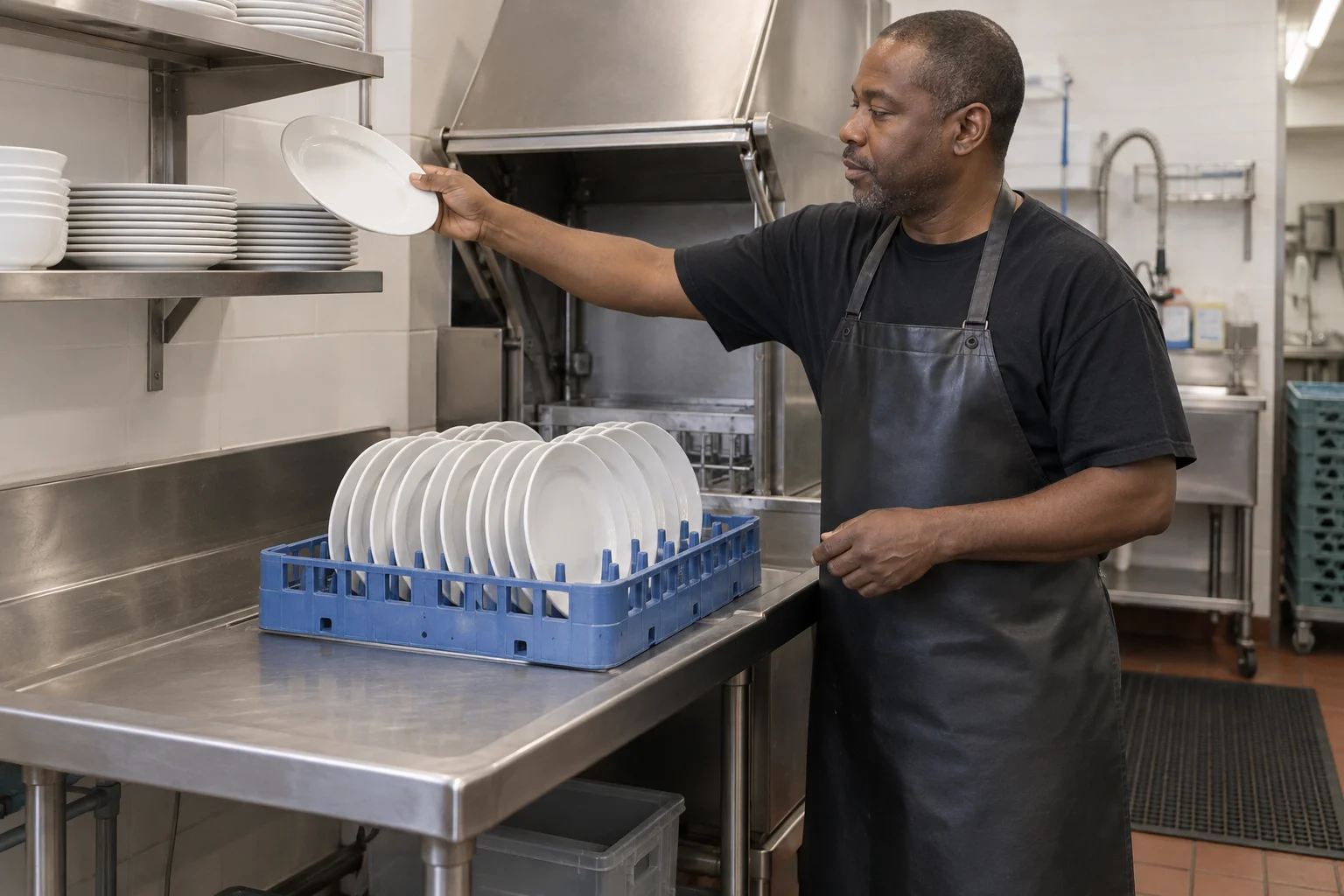
There is a moment in every dining room when the plates begin coming back with the confidence of a returning army.
They have done their work.
They have held lasagna.
They have been politely abandoned beside a lemon wedge.
They have listened to an entire first date.
Now they want only to go home.
Unfortunately, home is a small room with water in it.
Two Territories, One Damp Patch of Steel
Your room has a return rack, a machine, some waiting racks, some draining racks.
And, if it was designed in the generous daylight of an opening meeting, two clearly different territories.
One is where the old meal arrives.
One is where the next meal begins.
During the rush, however, every flat surface develops a powerful political argument for becoming both.
A stack of glasses arrives first.
Then plates.
Then a tub that appears to contain, among other things, the previous century.
The nearest open counter gets summoned.
It does not matter that the counter was meant for clean cups.
It is open now.
That’s how an orderly route becomes a small nation with disputed borders.
Nobody has been careless.
Everyone is trying to keep dinner moving.
A Clean Plate Is Not Yet a Useful Plate
It has to drain.
It has to land somewhere that is not receiving the remains of a sandwich.
It has to be findable by the person who needs it.
And that person is not you. It is whoever reaches for it next.
Only then is it back in the world.
The machine, naturally, is innocent-looking.
It flashes a light.
It hums.
It closes its door with the grave confidence of an appliance that has read a manual.
But your undercounter machine may offer a short cycle, a medium one, and a long one, and produce a very different number of racks an hour for each.
Those are not three ways of being fast.
They are three different treaties with time.
Another machine will publish one figure for light racks, another for normal, another for heavy, and change all three when somebody fits a second-level kit.
Your machine has opinions about what it has been asked to wash.
So should the little room around it.
Count the Racks That Finish the Pilgrimage
The important number is not how many times the door shuts.
It is how many racks make the whole journey.
Loaded properly. Taken through the full cycle. Checked. Drained. Released into the clean world.
Take fifteen minutes in the thick of service and count those.
Not the rack whose door has just closed.
Not the rack waiting for a second ride.
And not the rack that has emerged clean enough to admire but is now standing wet beside a dirty return, because the only available counter changed sides in the conflict.
Twenty completed racks in half an hour offers you forty an hour.
Your floor plan may decline the offer.
If clean ware has nowhere to drain, the extra twenty are not soldiers.
They are refugees with dinner plates.
The Route Matters Before the First Plate Gets Dramatic
Your dirty returns need a landing place.
Somewhere leftovers depart, cutlery takes its own separate little journey, and plates, glasses, and awkward pans go onto the kind of rack that actually suits them.
Your clean racks need their own landing place, where water can leave without the rack having to negotiate with a bus tub.
Between them is the machine, doing its narrow, useful work.
The two sides don’t need a treaty lawyer.
They need enough room to stop pretending that the same damp patch of steel can be two things at once.
Two Families of Machine, Two Different Truths
One settles the question with heat.
The other arrives with its own appointed chemical and a small strip that has been asked to tell the truth.
They are not interchangeable cousins borrowing each other’s sweaters.
One asks whether the final rinse reached the condition the machine requires.
The other asks whether the correct product arrived in the correct amount, and can prove it.
Either way, a rack that has not passed its particular test does not get to wander into clean storage wearing a convincing expression.
It waits.
Then it goes again.
Glamour Is a Very Thin Material at Twenty Past Six
This is not the glamorous part of the restaurant.
The glamorous part is a server lifting a clean plate as though it had always been there.
But a sauté cook with one clean pan left, and two more needed before the next wave, has other concerns.
Three minutes later the dishwasher finds the two requested pans.
Which is much more helpful than discovering them in an unexamined tub, or beneath an unrelated pile of metal archaeology.
The leader names the objects.
Not a general wish for speed.
Two pans.
Specific tongs.
The next thing standing between production and a very expensive mime.
Small Borrowings, Honestly Recorded
A prep cook can spend eight minutes clearing a separate obstruction at the station while the dishwasher returns the priority items.
That is not free help falling from the ceiling.
It is a small borrowing arrangement, with tomorrow’s prep work waiting patiently offstage for its own apology.
A few minutes later, one pan has returned to its clean point.
There are three facts now.
One pan back.
One still travelling.
And a few needless containers no longer occupying the cook’s elbow room.
Three facts are enough for you to make a decision.
They are better than a yell.
A Cleared Queue Is Not a Restored Kitchen
By the time the immediate queue clears, the floor may look less alarming.
That is not the same thing.
The pan has to be where your cook can find it.
The delayed prep has to belong to somebody.
And your shift handoff needs four fields.
What constrained the work.
What happened.
What was delayed.
And who follows up.
Otherwise the next rush receives the same surprise in a different apron.
The Route Gives All of This Somewhere to Happen
Your people clearing tables bring used ware to its named dirty landing area.
Not wherever a square inch is visible.
The dish room turns it through a visible queue.
The clean rack drains, gets its check, and travels to the place where service or the cooks can actually receive it.
The handoff becomes so boring that nobody needs to discuss it.
That is what you are aiming at.
But Do Not Let the Arrow Start Giving Speeches
There is, of course, a way to become ridiculous about this.
Draw a one-way route with enough devotion and eventually somebody will find a spill, a stopped machine, or a room with exactly one counter.
And discover that the sacred arrow is blocking the safest recovery.
Then the arrow has become management.
That will not do.
Your route needs a temporary safe place for the interruption.
A protected place for clean ware.
Somebody who owns the reset.
And the humility to resume the ordinary path once the emergency has stopped being ordinary.
More Plates Is Not Always More Plates
The purpose is not to make the pit look like a tiny airport.
It is to stop clean plates waiting behind dirty work because nobody gave you time to invent a map.
Buying more ware can help you.
Sometimes.
But one missing pan is not always a shortage of pans.
It may be a pan cooling in the wrong place.
Or waiting behind returns.
Or sitting clean on an anonymous counter, with the excellent manners of an invisible guest.
A restaurant that runs out of side plates at one peak may need more plates.
It may also just need a shorter trip home.