There is a time of day when a prep sheet stops being a piece of paper and becomes a small constitutional crisis.
It’s usually quiet for a moment.
Then service is no longer far away.
The list says: sauce.
The cook says: how much sauce?
And the sauce, being sauce, declines to appoint a government.
A Quantity Chosen by Weather
That’s how sensible kitchens end up with an amount decided by memory.
By optimism.
By the size of the nearest pot.
By what happened on a Tuesday when a bus came in unexpectedly.
A useful sheet has already held that meeting.
It has looked a day ahead where a long pull or a long make requires it.
It has separated lunch from dinner, because a day is not one hungry animal with a single stomach.
It’s noticed the booking.
The local event.
The online promise.
The dish already unavailable.
And the one item whose late decision will cost your room its composure.
Then it turns all that nervous looking-ahead into one calm instruction.
Make this batch.
Not “make sauce.”
Not “check sauce.”
Not “we usually need a fair bit of sauce.”
This batch.
First, Find the Sauce You Already Have
Not theoretically have.
Actually have.
The route runs from the station to the backup place.
Then to the things moving toward their next state.
Then to transfers that are genuinely confirmed.
A container with no legible identity is not a reassuring citizen of the count.
Neither is a beautiful container promised to somebody else.
Neither is one that has not yet become available to the station.
The fact that it exists is touching.
It is not the same as being ready.
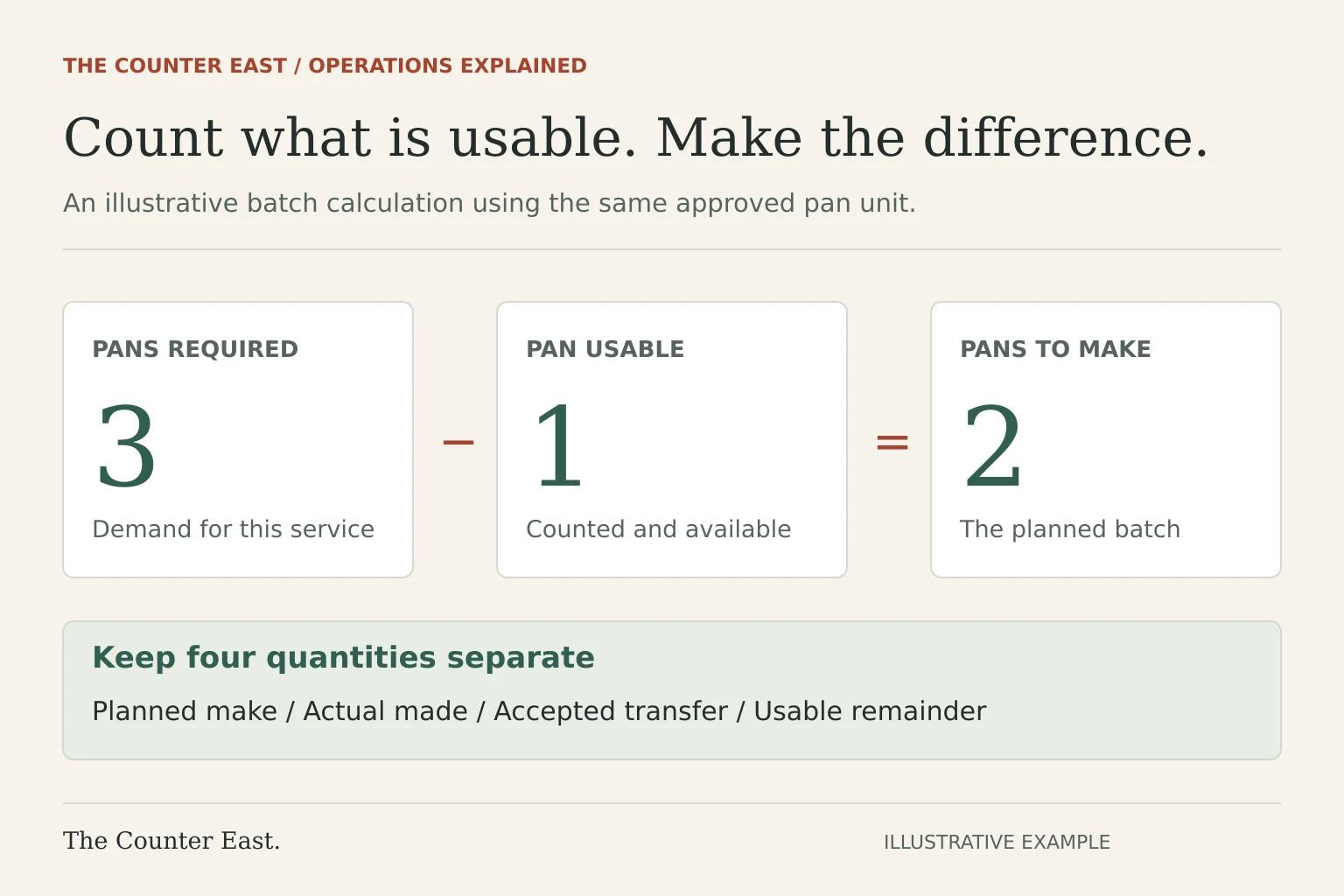
So if your plan calls for three pans and one is fit for service, you make two.
Do not manufacture a fresh three-pan empire because the number three looked authoritative in the morning.
That is the first small miracle of a good sheet.
It lets the containers already waiting in your building have a future.
The Batch Needs a Name and a Shape
Not “the tomato thing.”
The approved recipe currently governing the tomato thing.
That recipe knows how its finished food becomes portions.
By weight, by volume, by count, or by a utensil with a particular little metal face.
Fifty half-cup servings and a number eight scoop belong to the same sentence.
Not because the scoop has a literary soul.
Because yield, portion, and tool are three people trying very hard to leave the same building together.
When they manage it, the sheet can turn expected orders into a batch.
Nobody has to guess how many servings live inside “a medium pot.”
The Equipment Has Opinions Too
Which is inconvenient for anyone who would like a recipe to be a poem.
A formula that behaves in a small saucepan may behave quite differently in a twenty-litre kettle.
Heat, surface, stirring, and reduction all enter the chat, as people now say when nobody is pleased about it.
Cooking for twenty-five or more is where a household formula stops scaling politely.
Sometimes the right large quantity is three or four separate batches.
The point is not to make your cooks fear multiplication.
The point is to make the approved batch unit earn its place on the sheet.
The Work Has to March in Order
The long thing begins before the small finishing thing.
The shared machine gets a named stretch of the day, rather than a surprise visit from four people carrying bowls.
A sheet cannot put tasks in a decorative column and call that a plan.
It has to know what waits for what.
Some work is made for a high-volume counter in an opening batch.
With a later check, and one small task held back for the station.
Some work is only the base, because the last assembly belongs nearer the order.
Some work is made in one kitchen and accepted in another.
It isn’t really present until somebody there has counted it.
“Finished at the first kitchen” is a proud sentence.
It is not yet the same sentence as “available at service.”
A batch finished ten minutes before service is not early merely because the clock has not struck.
It still has to arrive as something the station can use.
Then the Small Ritual That Prevents Telephone Calls
The cook who made the food and the cook who will use it take a walk together.
The first says what is ready and what is unfinished.
Where the backup waits.
What strange thing happened.
The second looks.
The second counts.
The second accepts it, or does not.
Aim for five minutes.
Long enough to find the missing container.
Short enough not to become a second meeting held beside an increasingly anxious pile of onions.
Keep Four Quantities From Becoming One Blur
Planned make.
Actual made.
Accepted transfer.
And usable remainder after service.
They carry different gossip.
Actual made below plan says the work or the capacity failed to arrive.
Accepted transfer below actual made says a batch was made but never joined the station.
Remainder above target says something else again.
Your forecast, your demand mix, or your batch size has been telling a different story.
Give the Yield Three Chances to Explain Itself
Ready-to-cook input.
Finished batch.
Portions issued.
Nine kilograms of ready ingredients becomes under seven of finished food.
The missing couple of kilos is not automatically a scandal.
It may be trim.
Water loss.
Food left in the vessel.
Tasting.
Or an extra ingredient that wandered into the story without signing the guest book.
An approved yield gives that difference a question instead of a shrug.
Comparing what you got against what you should have got is an unfashionable little sum.
It can also reveal a repeated shortfall that a daily total would politely conceal.
A serious yield study wants several samples.
Portioned and counted independently, by more than one person.
That is how an average stops wearing a fake moustache and calling itself a standard.
Portions Need a Witness
Take a five-portion sample at the beginning.
Another during the busy stretch.
Another when a new batch or a new person takes over.
One utensil behaves differently as food settles or warms.
This is not malice.
It is physics with poor timing.
And a twenty-four disher is smaller than a six.
The number counts scoops to the quart. It does not describe anything you can see.
Readiness Can Be Embarrassingly Plain
If a station needs ten containers and nine are in place, that station is not ready.
It isn’t “basically fine,” either.
Not when the missing one is the busy little component on which five other things have placed their hopes.
Two minutes hunting for an item and its backup will tell you whether the neatness is real.
Or merely a convincing costume.
Then Service Begins, and the Number Stops Being Sacred
An hour before the rush, compare the plan with what is actually leaving the station.
If food is disappearing faster, choose.
A controlled extra batch.
A redistribution.
A limit.
Or a changed promise.
Then write down which one happened.
That isn’t a failure of the sheet.
It is the sheet admitting that the dining room has a vote.
And your response time matters more than the written confidence of the target.
A station calls at twenty past six.
It is restored at five to seven.
You have just learned that your replenishment takes thirty-five minutes.
That fact is now part of tomorrow, whether anybody enjoys it or not.
So is the event that added a late forty-cover wave.
So are the five interruptions in one service that asked, “where is it?”
So is the recurring six litres left over every Tuesday.
None of them is an order to change every future quantity at once.
They are clues, which is much kinder and considerably more useful.
Waste Speaks in the Same Voice
Eight kilograms a week means very little on its own.
It has to say where it came from.
A large event batch. An ordinary close-down. A storage failure.
The reason matters.
Trim. Spoilage. Expired prepared stock. Failed batch. Service return. Overproduction.
Your next sheet should inherit that explanation.
Not an ancestral superstition that the kitchen always makes this much.
But Do Not Let the Sheet Become a Tiny Tyrant
It will have exceptionally tidy handwriting.
If a cook can see a demand change and has no way to raise it, the number has stopped helping.
If an obviously bad forecast is hidden behind decimals nobody can reliably observe, the sheet has become theatre.
A count to the tenth of a litre isn’t nobler than a whole-container count.
Not when the rush cannot honestly tell the tenths apart.
And a permanent change made after one strange night is improvisation wearing a clipboard.
So keep a reason field for the unusual thing.
Event. Substitution. Weak forecast. Equipment trouble. Carryover correction.
Keep a revision history when the target changes.
You should be able to trace one batch in about ten minutes.
Forecast, count, production, handoff, remainder.
If you cannot, you have acquired documentation instead of memory.
The Best Version Is Almost Invisible
The cook arrives and finds a quantity already decided.
By the sales expectation.
The edible yield.
The portion.
The stock already in the building.
The deadline.
And the person who will receive it.
Nobody has been asked to divine the day from the mood of a stainless-steel bowl.
Service finds what it needs where it expects it.
The next morning, the sheet is a little wiser.
And somewhere, a cook who once wrote “make sauce” looks at “make two pans” and gets on with it.