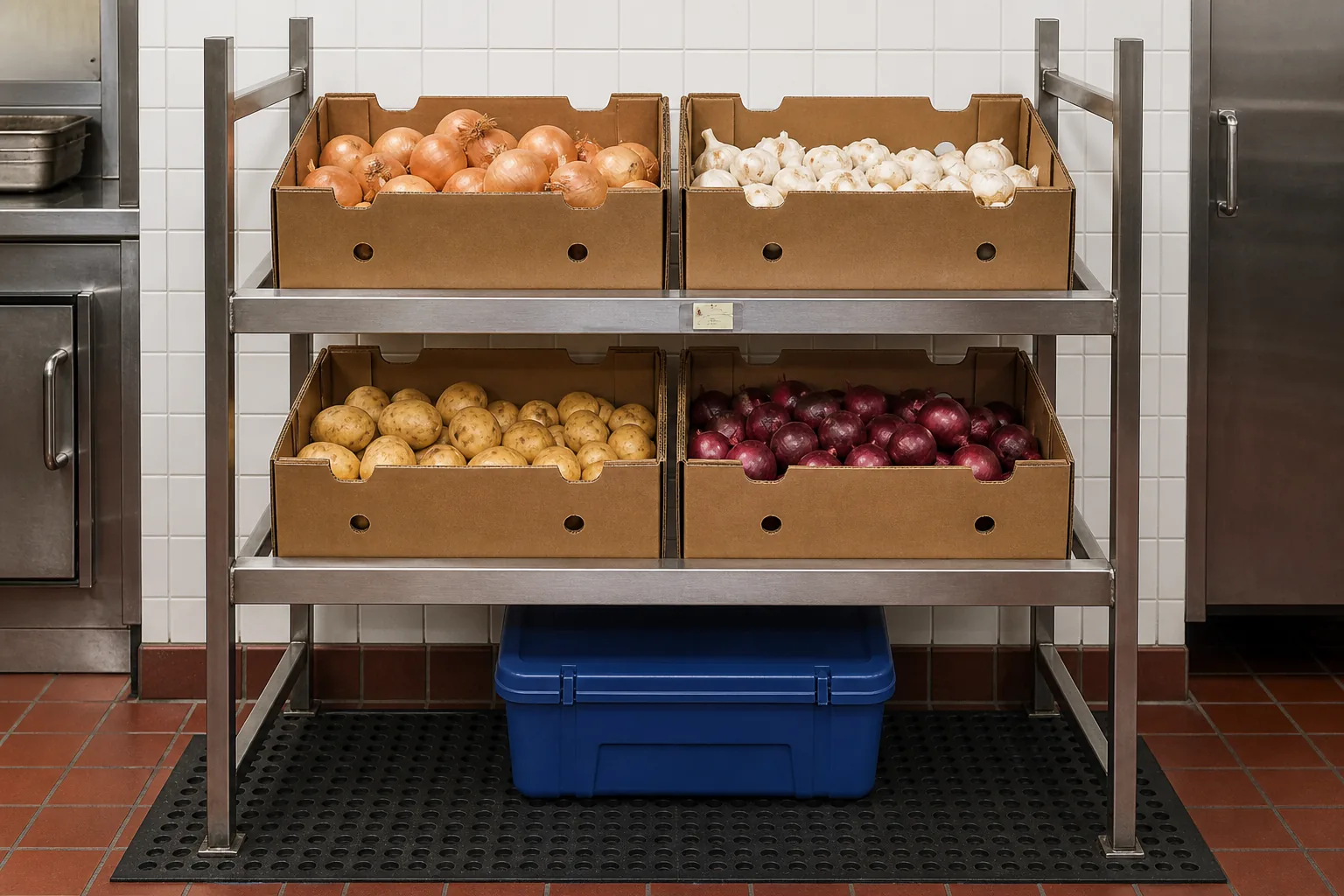
A restaurant can turn a routine shortfall into a recurring argument when the shelf is treated as the evidence and the count is treated as a challenge to someone’s judgment.
Familiar stock is often managed by visual confidence until an item is absent during service.
At that point, the question becomes who should have noticed it, rather than what demand, delivery timing, conversion, or count result should have produced the next order.
The goal of a par is different. It should make a normal reorder ordinary: a recorded stock position reaches a decision point, an approved order is released, and the delivery is checked against that decision.
A count variance should instead open a defined investigation.
These are separate outcomes.
Treating both as a daily debate leaves the shelf carrying a forecast, a lead time, a safety buffer, and an order-guide rule without making any of them visible.
Build pars from a dated demand picture
A par is based on average daily use, lead time, and safety stock. The stock position also needs usable on-hand quantity and confirmed incoming quantity.
A low quantity does not necessarily justify an order if a confirmed delivery is already in transit; conversely, a shelf that appears full may not cover the service requirement before the next replenishment.
Begin each buying cycle with a dated demand picture. It includes on-hand by order-guide unit, scheduled menus, bookings or events, recent sales, known waste, and goods ordered but not yet received.
The buyer converts the next service need into expected usage, then subtracts usable on-hand and confirmed inbound quantity.
This produces a proposed order by item and unit rather than a response to the appearance of a storage area.
The conversion must be visible.
A serving count multiplied by a cooked portion gives edible output, and a tested yield converts that into the quantity to purchase before on-hand inventory is considered.
Those are calculation inputs, not a permanent par for a side dish.
The forecast date, recipe or event assumption, and conversion remain with the order decision so a later shortfall can be traced to demand, yield, count, or delivery information.
Coverage is a useful check alongside a par. A stock position divided by expected daily use gives days of coverage.
Whether that coverage is sufficient depends on delivery timing, review cycle, and the buffer’s stated purpose.
A safety quantity that cannot be connected to an extra delivery day, booked party, uncertain yield, or promotion is not yet a decision rule.
Specify the item before relying on the number
Par arithmetic is only as reliable as the item record. Each active order-guide line needs a current specification version, purchase unit, conversion, source, price basis, substitution status, and owner.
The buyer also verifies the current vendor code or description before release. “Same as last time” cannot resolve a changed pack, product code, recipe, or supplier catalogue.
Guide completeness should be inspected as master-data health.
A guide that is almost complete is not therefore healthy: the missing fields need to be identified, because a missing conversion has more consequence than an empty comment. A physical trace tests the conversion itself.
If a guide states that one case yields a stated number of portions, the received case and its inner units have to support that statement before the number enters a cost model or an order calculation.
This is also where a season or menu change should be made explicit. The culinary owner confirms a different size, seasonal alternative, or temporary 86 before release.
A substitute proposed by a supplier is accepted, rejected, or accepted for a stated quantity and date range.
An unrecorded change in protein grade, portion size, allergen profile, or prepared product is not a routine replenishment merely because the item is available.
Count to a fixed boundary
The count needs one boundary before it can support a par decision: every movement before the cut-off belongs to the current period, and every later movement belongs to the next.
If service continues, the count record identifies start and end time and the sales or issue activity between them.
A count during a rush without a movement log is not a stable on-hand record.
The sheet follows the physical path through storage and records item code, description, count unit, purchase unit, approved conversion, last approved cost, and location.
Where staffing permits, two roles separate the counter calling the physical quantity from the recorder entering it. Sealed cases and eaches are counted in native units before approved conversion.
A line bought as six cases of a stated weight cannot be posted as six kilograms because the invoice displays six cases.
Count cadence follows risk, not familiarity.
A full count covers all inventoried items and locations at period close. A cycle count selects items between full counts for value, turnover, access risk, or a prior unexplained variance.
A published inventory guide gives a fixed number of selected items each week as an example of periodic cycle counting in a high-volume setting.
High-value beverage or protein locations receive tighter custody, including restricted withdrawals and reconciliation of POS sales with documented non-sale activity.
Route the count result to the right decision
An approved count does not have one universal output. It produces three queues: replenish, correct data, and investigate operations.
A replenishment action names the item, unit, target arrival, and approver. A data correction names the recipe, conversion, price, or POS mapping to change and its effective date.
An operational investigation names an owner, evidence to review, due date, and the next observation. This prevents a surprising count from becoming an unrecorded memory between shifts.
Actual use is a physical-balance result; theoretical use is an expectation built from sales and current recipes.
Actual use above theoretical use is a variance, and it can be expressed in weight, in money, and as a share of the theoretical figure.
The result identifies where review is needed. It does not establish waste, theft, poor portions, or an individual’s conduct.
The review follows a reason-code sequence: recount; verify pack and recipe conversion; verify invoices, credits, and transfers; inspect waste, comps, tastings, and staff-meal records; then examine portions, POS reporting, access, or unexplained loss.
If a recount changes the number, both values remain in the record and the first is marked as a counting error.
If the physical result stands, an adjustment carries its date, item, quantity, value, source record, preparer, approver, cause, and evidence.
Release a routine order that can be received
Routine lines use the approved guide and current authorized source. A new item, material spend, new season, expired quoted period, or unusual price movement enters the quote path.
An emergency, outage, or approved menu change enters the exception path.
These are the three buying paths, and they make the reason for a non-routine purchase more visible rather than concealing it in a free-text note.
The purchase order or controlled order record is built from the guide, not an informal cart.
Every line states supplier, item, quantity, unit, expected price or quote reference, date, and substitution or receiver instruction.
It is checked at two scales: units line by line, then the basket for an implausible total, unfamiliar item, duplicate, or unreachable delivery.
An order six times the usual weekly quantity requires confirmation that it is an event requirement rather than a repeated keystroke.
The order record reaches the receiver before delivery. At transfer, the receiver verifies item identity, cases or eaches, catch weight where applicable, packaging condition, date or traceability material, and applicable temperature.
Refrigerated, hot, and shell-egg deliveries each have a receiving temperature under the locally adopted rule, and the receiver checks against that rule rather than against an appearance of coldness.
Close exceptions before changing the par
A delivery exception is handled at the point of transfer where practical: refuse a nonconforming item when safe, segregate questionable product, retain labels and delivery references, note or photograph the condition, notify the buyer, and request a credit, replacement, or decision.
Accepted stock is put away under applicable storage and rotation rules, and on-hand is updated in the guide’s order unit.
Recording one case while shelving ten bags without a conversion creates the next ordering error.
The invoice is not a replacement for receiving. It is matched line by line with order and receipt: ordered quantity and price, accepted quantity and notes, then billed quantity, unit, rate, charges, and credit.
A single line still needs all three documents to distinguish a price difference, a short delivery, and an unrecorded receipt.
A promised credit remains open until the credit or replacement is actually received.
Forecast review changes pars when the evidence changes. Forecast error is actual use minus forecast use, divided by forecast use and reported with its sign.
Signed errors should not be averaged on their own, because an overestimate and an underestimate can cancel while both create operational work.
The review classifies material errors as demand, event information, yield, waste, count, late receipt, delivery, or menu change.
The counter-failure is to preserve a par after its conditions have changed, or to use a count variance as a judgment of the person who counted or held the stock.
That produces overstock, waste, concealed errors, and defensive counts.
The stronger control is quieter: staff count to a known boundary, see the incoming supply, make the ordinary reorder, document the exception, and adjust the rule when demand or supply evidence warrants it.
The measures to retain are:
- Counted lines and locations against the active inventory universe.
- Blind-recount differences in base units, value, and location.
- Usable on-hand plus confirmed inbound quantity against expected demand before replenishment.
- Stockouts, service hours unavailable, emergency purchases, substitutions, and orders below or above the approved target.
- Order-guide completeness, including specification, unit, conversion, source, price basis, substitution status, and owner.
- Forecast error with unit, period, direction, absolute error, and classification.
- Receiving-document completion, exception capture, specification conformance, and closure of credits or replacements.