An alternate supplier is often added after a shortage because a second account appears to solve dependence on one route.
It does not, by itself.
Supply resilience has three distinct failure exposures: product availability, commercial eligibility, and physical fulfilment.
A supplier can have the product but no approved commercial path; it can have an approved item but a delivery day that misses service; or it can promise a route that the restaurant cannot receive.
The goal is to qualify an alternate as a complete service before disruption. That means confirming the product specification, lead time, price mechanism, delivery interval, receiving owner, and substitution authority together.
The test is not whether a salesperson can name the item. It is whether an acceptable item can become usable restaurant inventory when the primary source fails.
Define the real receiving window
Delivery service has two performance dimensions: the promised interval and the supplier’s response when it changes. An early-morning window, a same-day “before noon” estimate, and a route appointment describe different obligations.
An alternate should be compared on order cutoff, lead days, recurring delivery days, minimums, notification channel, appointment rules, and whether the handoff is to a dock, curb, or another defined point.
The restaurant should define its own window separately. It is not merely the period when someone is in the building.
It is the interval when a receiving owner can unlock the designated entrance, count cases, inspect condition, record discrepancies, and put product away without displacing opening prep or service.
Published receiving guidance recommends one designated entrance and a cleared area for offloading, sorting, unboxing, and inspection. Those are restaurant controls, not proof that a supplier promised a particular arrival time.
An appointment does not necessarily guarantee arrival at its first minute. An appointment-only dock may reserve labour, while the distributor supplies a route estimate.
Both the booked interval and the route communication should be recorded.
A late arrival and an unavailable receiving area are separate events with different owners; combining them produces an inaccurate service record and an unhelpful dispute.
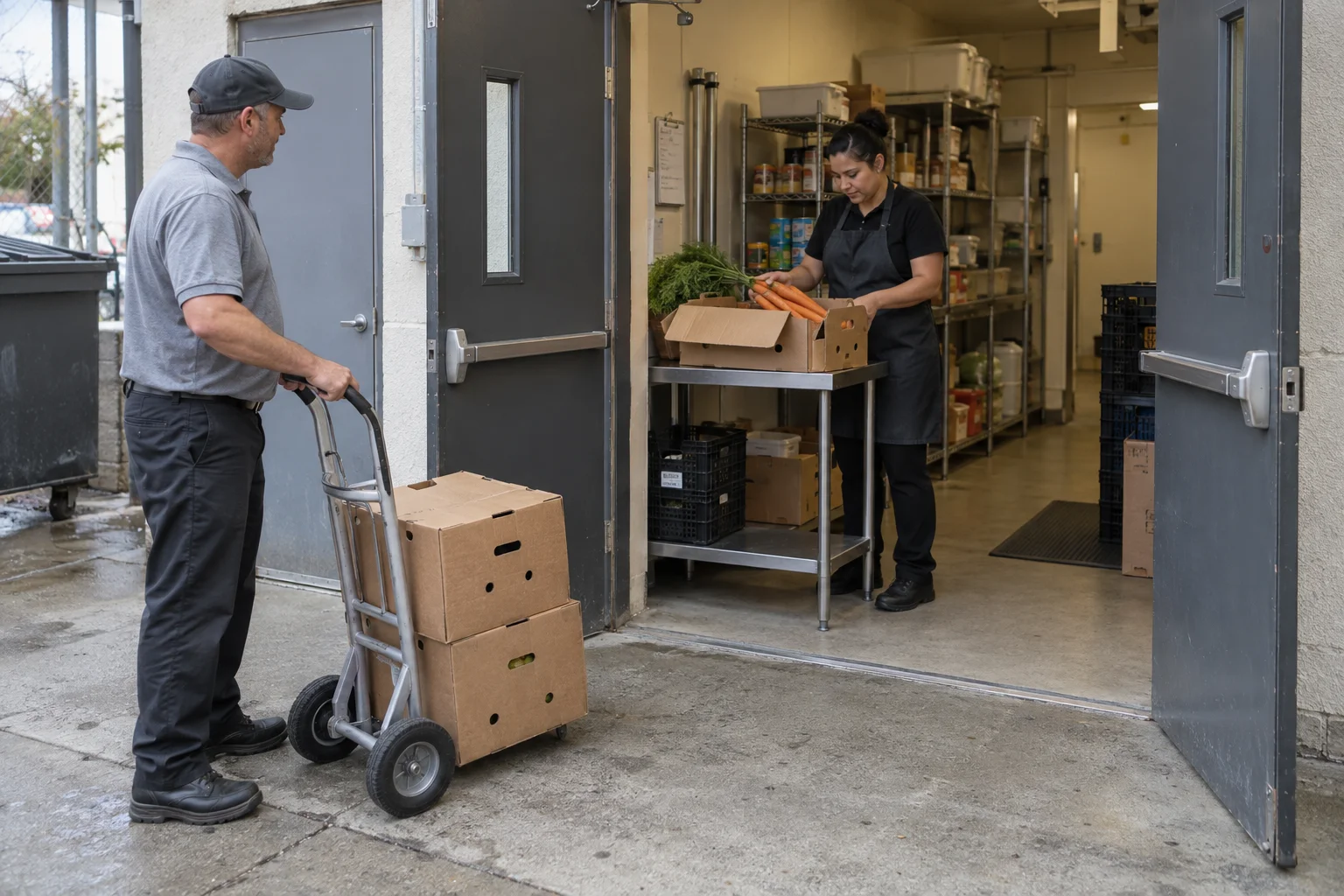
The distinction becomes concrete at the handoff. A truck can arrive during opening prep with acceptance still pending.
The receiver checks the order, condition, and available identity before accepted cases move to the walk-in.
A delivery can therefore meet its route estimate and still fail as usable supply, either because nobody could receive it or because a condition exception was placed into inventory without a decision.
Qualify the product and its handoff
An alternate product needs more than a matching catalogue description. Pack, weight, yield, condition, product identity, and kitchen use all affect whether the substitute performs the intended role.
A case loses weight to trim before it loses any more to cooking, so a lower case price with more damage can be more expensive per usable kilogram.
The comparison should use the usable unit required by the menu, not only the case line.
Pack changes also change the handoff and the work after it.
A dozen small bags may preserve the quantity of one large case while changing storage layout, open-package handling, portioning time, and waste exposure.
If an alternate is selected during a shortage, the restaurant should record the original item, replacement, pack, price, usable quantity, start date, end date, and decision owner.
That record makes substitution authority explicit rather than leaving a receiver to decide during a delivery.
Condition is its own acceptance question.
Published guidance sets a refrigerated and a frozen carriage temperature for suitable conveyance. These figures describe the physical condition a cold route is buying, not the punctuality of its delivery.
A window record cannot prove cold-chain compliance, and a temperature record cannot prove that a delivery arrived when the restaurant could receive it.
The receiver should separate an exception before it disappears into stock.
Where several cases are allocated from a grower, a crushed or wet case is held or rejected before it can mix with the accepted goods.
A bin holding both accepted and held cases has to preserve that distinction. The process protects both use decisions and a possible claim; it does not assume that delivery equals acceptance.
Compare the commercial path as well as the route
An alternate should be compared through four amounts for the same defined item and period: quoted or list price, contracted or deviated invoice price, expected post-purchase rebate, and all-in delivered cost after visible fees and credits.
Pack, weight, yield assumption where relevant, effective date, and quantity threshold belong with those amounts.
A headline saving can otherwise compare a different pack or a later payment with an invoice-time reduction.
A deviation and a rebate should remain separate. A deviation ordinarily changes the eligible price in the distribution transaction.
A rebate is paid or credited after qualifying purchases are reported, calculated, and processed.
A purchasing-group participation form may put the first rebate check many months after purchase data begins. That is an example of account terms, not a universal timing rule.
It nevertheless shows why a later rebate does not finance an emergency delivery in the same way as a verified invoice price.
The commercial path may include more parties than the restaurant sees at the door.
A restaurant member, a purchasing group, a manufacturer, and a distributor can form four parties, with a carrier as a fifth.
A manufacturer program can also reach the restaurant through several distribution layers.
The brand on the case is therefore not evidence of who set the delivery time, applied the price, or owes a credit.
Give each supplier a defined role
A broadline distributor can consolidate several categories into one primary route and invoice. A specialist can add produce processing or meat and seafood cutting, grinding, ageing, and certifications.
Neither label establishes the right alternate.
The useful question is whether the second relationship supplies a stated specification, fabrication, service window, or risk reduction that the first relationship does not.
The time horizon changes that decision.
A one-week emergency-buying decision may reasonably favour on-hand product and a wider pickup window.
A year-long supply design can place more weight on program eligibility, actual delivery history, rebate realization, and relationship management.
Treating both as a generic supplier comparison leaves the restaurant with a directory rather than a failure plan.
The role also needs a boundary.
A duplicate vendor that receives small orders, produces another invoice and delivery appointment, and has no current eligible product or usable route is not resilience.
It can increase spoilage, coordination work, and the chance that staff use an unapproved substitute under pressure.
The counter-failure is not having a second supplier; it is treating every additional account as protection without assigning it a tested purpose.
Measure the route and recovery
Actual deliveries are the evidence for delivery performance. The restaurant should retain the percentage within the stated interval, median lateness, notice lead time, completeness, condition exceptions, and the treatment of credits or emergency alternatives.
Supplier marketing cannot provide the account-specific result. The scale of routed foodservice delivery explains why recovery matters more than precision.
Scale does not excuse a missed window, but it makes an exception process more useful than an unsupported promise of exact timing.
The record should link physical and financial outcomes.
When a case is short, damaged, late, wrong, or questionable, the restaurant may refuse it, accept it at an adjusted price, receive a credit, or dispose of it at its own cost.
A credit should identify the delivery date, item, quantity, condition, and claim reference.
Credits reduce a payable or offset a later purchase; they do not repair a failed menu execution at the moment of service.
The strongest alternate-source arrangement remains unobtrusive during normal operation. The primary supplier continues to carry the regular basket.
The second supplier has an approved product list, a known commercial path, a defined arrival interval, a receiving owner, and a stated recovery contact.
When the primary route fails, the handoff works as a normal receiving task rather than an improvised emergency.
Keep the qualifying measures together
Before relying on an alternate, the restaurant should retain and review:
- product specification, pack, usable quantity, and substitution authority;
- quoted price, deviated invoice price, expected rebate, and all-in delivered cost;
- order cutoff, lead time, recurring delivery day, stated interval, and exception contact;
- receiving entrance, receiving owner, inspection capacity, condition record, and put-away path; and
- actual interval performance, lateness, notice, completeness, condition exceptions, credits, and emergency recovery.
The objective is not to create the largest possible supplier list. It is to make one additional source able to deliver an acceptable product through a handoff the restaurant can actually use.
When those measures are defined before disruption, the second supplier is a working alternate rather than a comforting name in a spreadsheet.