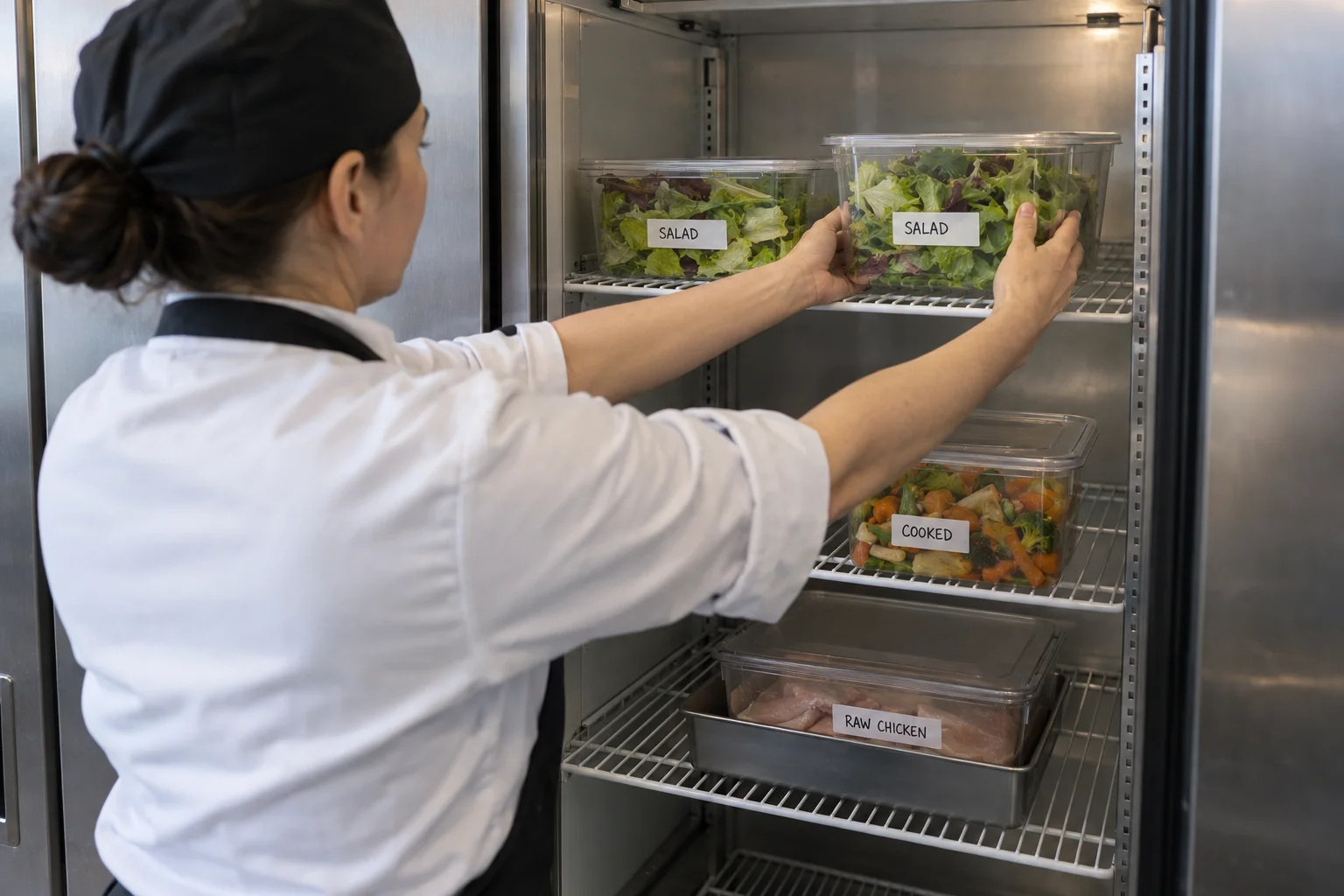
Cold storage fails at put-away long before it fails at the controller. A receiver carrying a perishable case from the dock normally chooses the available space and the shortest next step.
If the correct space is full, hidden, unlabelled, or occupied by product that has no clear status, the room has made an unsafe workaround easier than the intended procedure.
The goal is to make the correct location immediately available and immediately legible: a cold zone with usable capacity, a shelf that preserves separation and airflow, a label that states the product’s controlling date, and a check that leaves the next person a documented decision.
The walk-in and reach-in are therefore part of the storage procedure, not passive boxes that happen to be cold.
Size storage around positions and traffic
A walk-in should be drawn around the units it must actually hold: shelf bays, dunnage, carts, racks, aisles, evaporator throw and return, and door swing or slide.
Capacity begins with usable rack positions and case footprints after clearance, then adds peak on-hand stock and an operational buffer.
Nominal cubic feet do not show whether a case can be rotated, read, or reached without blocking an air path.
Heat load matters because storage capacity and refrigeration capacity are different decisions.
The system must remove the maximum credible load, including transmission, door infiltration, product pull-down, lights, fan motors, people, and special loads.
The first transmission screen combines the insulation value, the exposed area, and the temperature difference across it.
Manufacturer worked examples assume particular wall constructions and outdoor conditions; those are illustration conditions, not universal restaurant assumptions.
The doorway is both a traffic route and a heat-load input.
A general reference rule sizes a doorway only modestly wider than the largest item likely to pass through it, subject to local egress, accessibility, fire, cart, and delivery requirements.
Within the room, a receiver who cannot place a case in a clean, separated location should stop accepting further cases rather than creating an aisle stack that conceals stock and interrupts traffic.
Reach-ins need the same discipline at a smaller scale. Their short door-to-shelf distance supports repeated access, but every opening replaces chilled air with kitchen air.
Prep tables are staged-access equipment, not bulk pull-down or warehouse storage: shallow wells, lids, pan depth, and replenishment pattern must be specified for the busiest service pattern.
A cabinet that reaches its setpoint while empty has not demonstrated loaded recovery.
Decide each case before it becomes stock
Receiving ends in one of three dispositions for each line: accept into stock, hold for a manager or supplier decision, or reject.
Product, quantity, package condition, date information, and purchase-specification conditions are checked while the case can still be connected to its supplier and lot information.
Questionable food stays physically apart from accepted food. A marked hold area needs a reason, time, owner, and next action; it is not an overflow shelf.
For mixed deliveries, accepted perishable lines move first, then frozen lines, then dry goods. This order limits exposure during the handoff.
It also makes cold-space availability a receiving requirement: if the refrigerated or frozen zone cannot receive its intended product without destroying separation or airflow, the delivery process has not reached a safe put-away state.
Give every category a visible zone
Put-away first selects the zone, whether dry, refrigerated, frozen, or a designated exception area, and then the position by vulnerability.
Refrigerated ready-to-eat food belongs away from raw products and potential drips; a shared refrigerator uses three vertical states: protected ready-to-eat food at the top, raw animal food below, and raw products arranged so a drip cannot land on food with a lower final kill step.
Chemicals remain outside food storage.
Allergen-containing ingredients need a dedicated covered position below or away from ingredients intended to remain allergen-free.
The floor boundary is also a storage control. The FDA Food Code model sets a base clearance from the floor, with limited alternatives for appropriate case-lot equipment and specified packaged beverages or waterproof cases.
The practical test is cleanability and protection from moisture, splashes, and contamination; it is not permission to turn a clean-looking floor into a general pantry.
Container choice should preserve identity as well as protection. The four useful states are original intact package, original opened package, transferred working container, and prepared or portioned container.
An intact case may retain the supplier label and handling information that a matching tub would remove.
A transferred container needs a durable food name, while ordinary refrigerated storage needs an adequate cover rather than an overnight exception borrowed from an active cooling process.
Label and rotate while the product is in hand
An internal label is applied when food is removed from its original package, opened under the house dating policy, prepared, portioned, or combined.
It has four decision fields: food name, date event, controlling disposition date, and a preparer or batch reference where the site uses one.
This makes the decision at the point when the food changes history, rather than leaving an end-of-night sweep to reconstruct it.
For refrigerated ready-to-eat food held beyond a stated period, the FDA Food Code model requires a date or day by which it will be consumed, sold, or discarded.
Its maximum model holding period runs from the day of preparation, subject to local adoption, exceptions, the stated cold-holding condition, and any shorter manufacturer safety-based use-by date.
A local policy should therefore use the strictest applicable source and show one unambiguous disposition date.
Combining food does not create a new beginning.
A prepared or opened ingredient carries the earliest applicable date into a combined food, even when a sauce is rewrapped or a small older amount is blended into a fresh one.
Before a new case or pan enters a slot, the existing product is pulled forward and the nearest controlling date is identified.
FIFO works when receipt order is the only meaningful signal; FEFO takes over when a partial case, short-dated delivery, opened package, or prepared pan creates a date spread.
A rack with two pick faces can separate an active unit from sealed reserve stock.
The oldest eligible unit stays at the front of the active face, and newer stock follows only after its controlling date has been checked.
The test is simple: the first unit a cook touches should be the unit that should be used first.
A later rotation day can find a failure, but it cannot give a hurried pick the same advantage as an orderly restock.
Keep airflow and defrost visible
At a cold-holding condition, the evaporator removes heat from room or cabinet air, and the controller observes an air sensor and operates the compressor and fans.
Food temperature changes later, according to product mass, pan depth, airflow, and load.
A displayed cabinet reading is useful, but it is not a substitute for a product-temperature check when food safety is in question.
Airflow is a placement rule.
Cartons against a reach-in back wall, hotel pans stacked above their rim, or a liner covering a return opening can create warm and cold pockets.
In a walk-in, the supply side, return side, product height, and shelf layout matter for the same reason.
The coldest point near a discharge does not establish the condition of a far corner or tightly packed rack.
Frost is another visible capacity loss.
Moisture admitted during openings can freeze on an evaporator, insulate the coil, and narrow the air passages that move heat.
Defrost is a controlled sequence of heat, termination, drainage, and recovery; meltwater that cannot leave can become a drain-pan, floor, or coil problem.
Crowding a cold room until product blocks those paths can therefore defeat the same refrigeration capacity the specification was intended to provide.
Check the route and leave an answer
Use two check points: a zone check before replenishment and an item check before use.
The zone check looks for leaks, unlidded food, food on the floor, incorrect shelf hierarchy, expired or undated containers, pests, package damage, and stock without a usable pick path.
The item check confirms the intended product, controlling date, intact package or adequate cover, and any reason for removal.
Missing information is marked for disposition and escalated rather than guessed from colour, smell, shelf position, or memory.
Temperature verification also needs a defined tolerance and location.
Use a calibrated product probe at representative locations. Cold-holding checks must account for the warmest relevant product and storage locations. During batch cooling, measure the warmest, slowest-cooling part of the food. Air readings and logging sensors can support the assessment, but a cold reading near the evaporator does not establish that the whole load meets its required condition.
The test must reproduce the intended load. A controller alarm and an empty-cabinet test are useful signals, but neither establishes that the stored product meets the approved condition.
At the end of a restock, take one short closure pass through each active zone: no food in an aisle, no held product mixed with saleable stock, labels facing outward, old stock accessible, and any disposal or supplier claim recorded.
Clean an empty shelf or bin before it becomes a hiding place for spills or old labels.
This makes the corrective decision visible to the next shift instead of leaving the next person to reconstruct the last one.
Avoid turning control into obstruction
The counter-failure is a storage system that is technically elaborate but operationally unusable.
Too many labels, an overfull room, zones that disappear under delivery volume, or a shelf map that requires a search can make an unsafe shortcut the quickest path.
The answer is not more signage by itself. It is enough capacity, visible boundaries, a small number of stable pick faces, and a route that still works when the room is full.
The strongest storage controls are quiet.
The receiver can see the correct zone while carrying the case. The cook reaches the correct unit first.
The next shift can read the food and the slot without a reconstruction. No one has to improvise because the cold room has already made the safe choice available.
The operating measures are:
- Size walk-ins and reach-ins around usable positions, traffic, loaded recovery, and clear airflow paths.
- Decide accept, hold, or reject before a case mixes with stock, and keep holds visibly unavailable.
- Zone, label, and date food at put-away; preserve the earliest controlling date in combined food.
- Use FIFO or FEFO according to the date signal, with an accessible active pick face.
- Check zones and items on a defined route, verify temperature at a defined location, and leave corrective decisions recorded.