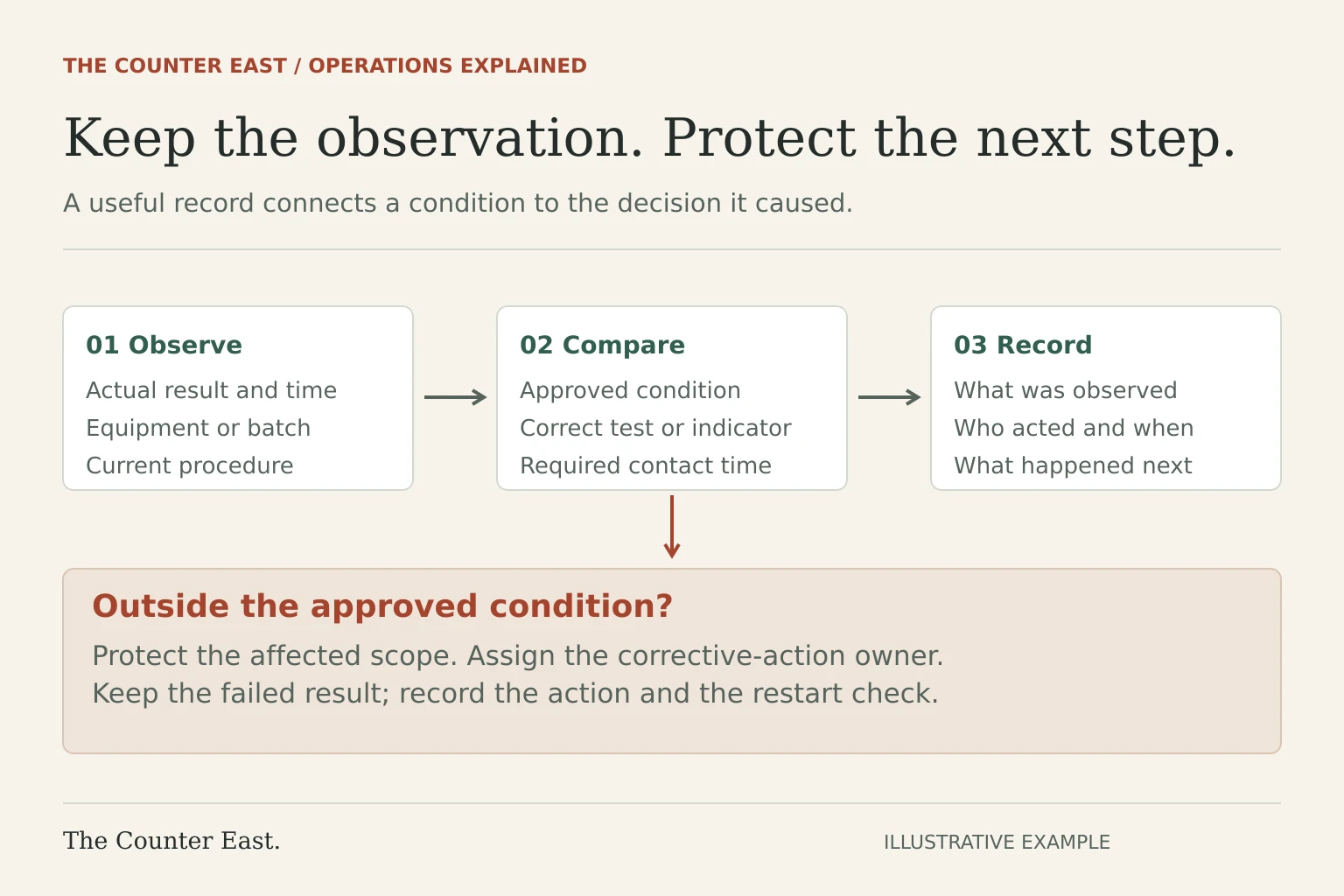
Sanitation records fail when they are designed as proof that someone completed a form rather than as support for the next control decision.
A worker can initial a line after service, while the cleaning solution, the equipment condition, and the opportunity to prevent reuse have all passed.
The record may look complete and still leave the operation unable to say what happened when the condition was observed.
The goal is to turn routine washing and sanitizing into a traceable control loop.
The person at the sink, machine, or fixed equipment needs the current procedure, the approved product information, the right test or indicator, the required contact-time cue, and a named route for a result outside the approved condition.
The later reviewer needs enough evidence to reconstruct that decision without relying on memory.
This is where sanitation meets HACCP.
Good hygiene practices are foundational prerequisite programs in Codex Alimentarius’s General Principles of Food Hygiene, CXC 1-1969; they are not automatically separate critical control points.
HACCP adds the discipline of a defined observation, a boundary, a response, verification, and records when a control is required.
Separate the work before recording it
The procedure begins by placing the work in one of three routes: food-contact surfaces and utensils; nonfood-contact facility surfaces; or pest evidence and infestation.
Each route has a different endpoint.
A cutting board or deli tong requires cleaning, rinsing, sanitizing, protected drying, and protection from recontamination before food contact.
A floor requires soil removal and safe drying, not an automatic food-contact sanitizer application.
That distinction belongs on the point-of-work instruction and record. A vague entry such as “sanitized prep” does not establish the surface type, the approved method, or the release condition.
A useful task card identifies the parts, tools, cleaner, sanitizer, safety precautions, reassembly order, responsible role, and observable state required before an area, utensil, or machine returns to service.
For manual warewashing, the work zones are wash, rinse, and sanitize in that order.
The FDA model Food Code specifies a minimum manual wash-solution temperature unless the cleaner label specifies a different one.
The rinse removes soil and cleaning chemical before sanitizing; omitting it can carry detergent and debris into the sanitizing bath.
The final step does not end at a wet utensil. The procedure requires the surface to remain wet for the required contact time, then to drain and air-dry on a clean rack.
Towel drying can redeposit organisms and fibres, and stacking items before they drain creates a protected wet contact area.
The record should therefore identify the release condition rather than merely mark “sink completed.”
Put the parameters beside the work
The required sanitizer condition is a combination, not a single number copied onto a wall.
For chlorine under the FDA model, the required minimum temperature falls as the concentration rises, and pH changes the answer again.
A weak solution needs hot water; a strong one works cool. These are model-code values, and the registered label and locally adopted rule remain controlling for the site.
An iodine record needs a different test and different conditions: its own concentration band, a minimum temperature, and a maximum pH, or the manufacturer’s stated effective pH.
A quaternary ammonium compound needs a minimum temperature, the concentration on its product label, and a water-hardness limit unless the registered label permits more.
A chlorine strip cannot establish an iodine condition, and a generic quat number does not replace the label.
Contact time must be visible as wet time, not inferred from the moment a bottle is picked up.
Most chemical sanitizer uses under the model require at least thirty seconds, while listed chlorine conditions permit considerably less.
The correct cue is the approved product’s required interval, placed where the worker applies the solution.
Mechanical warewashing needs a record that matches the machine route. Wash-water and final-rinse temperatures differ by machine type in the model, as does final-rinse pressure, which must stay inside the data-plate range.
For a mechanical hot-water operation, an irreversible indicator confirms the utensil surface temperature rather than treating the machine display as proof.
The form should not force staff to enter every possible parameter on every task.
It should expose the parameter that decides whether that route can release the item: the relevant test result, indicator, condition, time, and equipment or solution identity.
A record designed around a real observation is faster to use and harder to complete convincingly without doing the work.
Make monitoring usable during service
Food-contact equipment used with time/temperature-control-for-safety food has a model-code reset interval, subject to specified exceptions.
That interval becomes usable only when the schedule says when replacement utensils arrive, who removes the item from service, where cleaning occurs, and when the cleaned item may return.
“Every four hours” on a form without a service plan invites a late initial rather than a timely reset.
The same principle applies to fixed equipment. The worker needs a reachable procedure for seams, underside edges, gaskets, guards, drains, handles, and removable components.
If a component cannot be reached, a solution is visibly dirty, a chemical container is unlabeled, or the machine cannot deliver its designed cycle, the procedure has reached a stop point.
Extra wiping, stronger mixing, or an undocumented workaround is not a correction.
HACCP turns that stop point into a defined evidence path. Its seven principles are hazard analysis, critical-control-point selection, critical limits, monitoring, corrective action, verification, and documentation.
The usable control row states the process step, hazard, limit or condition, method, frequency, responsible role, record, and the action on a deviation. A frequency described only as “regularly” creates no testable obligation.
Not every sanitation observation is a CCP decision. Established good hygiene practices can control hazards as prerequisite programs where they are adequate.
The important design question is whether the site’s hazard analysis identifies a control that needs HACCP treatment, and whether the observation can be made during ordinary work before the product or equipment moves beyond the site’s control.
Give deviations an owner and a scope
A passing check is routine evidence.
A result outside the approved condition is a deviation, and the first requirement is to preserve the actual result and time.
The worker identifies the affected equipment, area, product, lot, or process interval as the plan requires and alerts the named corrective-action owner.
Replacing the failed reading with a later passing result removes the evidence needed to decide what was affected.
The corrective-action owner follows two tracks.
One determines disposition of material made while control was uncertain; the other restores control and investigates the cause.
The record identifies the hold or other protection decision, the affected scope, what action occurred, who authorized it, cause if known, and what must be checked before restart.
A repair, retraining, supplier change, or plan revision cannot be recorded as the cause before the evidence supports it.
“Corrected” is not a complete disposition.
A brief interruption can involve one discrete lot or a whole production interval.
The decision trail therefore makes the boundary visible: when uncertainty began, what remained under control, what was held, who decided the disposition, and when the release condition was re-established.
Monitoring finds the loss of control; corrective action protects product and restores the immediate condition.
Verify the record against the work
Verification is not another signature at the end of the shift.
It reviews whether checks occurred at the assigned frequency, results and times make sense, affected scope was identified consistently, corrective action followed the approved route, and the procedure matches observed work.
Validation is different: it evaluates whether a properly implemented control design is capable of controlling the hazard.
The record set should let a reviewer connect four classes of HACCP evidence: hazard-analysis rationale, the current HACCP plan, support or validation documentation, and records generated while operating the plan.
The sanitation task card, monitoring entry, deviation record, maintenance evidence, training or calibration evidence where relevant, and product disposition can all be part of that trail.
Version control keeps the trail intelligible.
The controlled document set identifies the effective procedure; the superseded version is retained according to applicable policy, while its routine-use form is removed or visibly retired.
Staff receive the current instruction at the work point. Otherwise one operation can produce compliant-looking records for two incompatible cleaning methods.
An inspector tests the system against both documents and conditions.
A retail inspection workbook selects a handful of record dates and examines whether monitoring was recorded, whether records are accurate and consistent, and whether corrective action was documented when limits were not met.
The review can compare a sanitation observation with the actual sink, machine, product, procedure version, held-material identification, and later corrective action.
Do not turn records into the failure
Documentation becomes the problem when it multiplies initials without improving cleaning, hides an unreadable procedure, or penalises staff for reporting a real deviation.
In that environment, entries migrate away from the work, failed observations disappear, and a record becomes an assertion that cannot protect the next decision.
More fields do not repair a control that the worker cannot observe or act on.
The strongest system is also quiet.
Staff do not need to negotiate a detached form after service because the procedure, test, contact-time cue, and corrective-action route are already at the work point.
The site does not ask staff to choose between maintaining service and reporting a real condition; it gives the condition an owner, a scope, a hold decision, and a next action.
The measures are straightforward:
- Separate food-contact, nonfood-contact, and pest-response work before selecting the procedure.
- Place approved procedures, product conditions, tests, contact-time cues, and release conditions where cleaning occurs.
- Record the actual observation at the assigned frequency, including any result outside the approved condition.
- Assign a corrective-action owner to protect affected scope, determine disposition, restore control, and set the restart condition.
- Verify records against observed work and maintain one controlled current version of every procedure and form.