Food-safety requirements often fail at the point where a person has to act quickly.
A rule may be accurate, a permit may be current, and a policy binder may be complete, but none of those conditions tells a receiver what to do with a damaged delivery or an expeditor what to do with a pan whose history is unclear.
The goal is to make the compliant action the ordinary service route before an inspector, manager, or guest has to ask for it.
That begins with the source of the rule. The FDA Food Code and Retail Program Standards are important common references in the United States, but they are not automatically the operating code at every address.
The enforceable requirement is the code, permit condition, order, or regulation adopted and applied by the authority with jurisdiction.
A model-code temperature becomes a local instruction only after the restaurant confirms that adoption, the relevant version, any local change, and the activity to which it applies.
Identify the authority before naming the control
The first question is not simply what temperature, time, or record appears in a generic manual.
It is which authority regulates this restaurant, which condition applies to this operation, and who can direct a correction.
A health permit connects an operation to inspection and enforcement; it does not transfer the operator’s responsibilities to a federal reference document.
Permit conditions may add a location-specific limitation on service, hours, areas, or activity. Those conditions belong with the procedure used at the affected service point.
This distinction also prevents false confidence in a score. A model inspection standard marks each item as in compliance, out of compliance, not observed, or not applicable.
The useful lesson is that a finding needs a named condition and status. An observed violation, an inspection score, a public grade, and an enforcement action are not interchangeable.
A restaurant should read the actual local report, preserve it, and assign the directed work rather than respond to a public number as though it explains the condition.
The operational translation can be brief.
For each control, name the local source, the responsible role, the product or place to observe, the acceptable condition, the record, and the escalation contact.
A receiver owns acceptance at delivery.
A cook owns the food’s internal result. A cook or expeditor owns a named batch handoff to service.
A manager owns the decision when the observed result does not fit the approved route. A binder supports these roles; it cannot perform them.
Build the safe action into each handoff
Receiving is the first service-point control.
Within a practical receiving window, the receiver checks that the shipment belongs to the order, packages are intact, cold or frozen goods remain in their required condition, and use-by or lot information remains available where relevant.
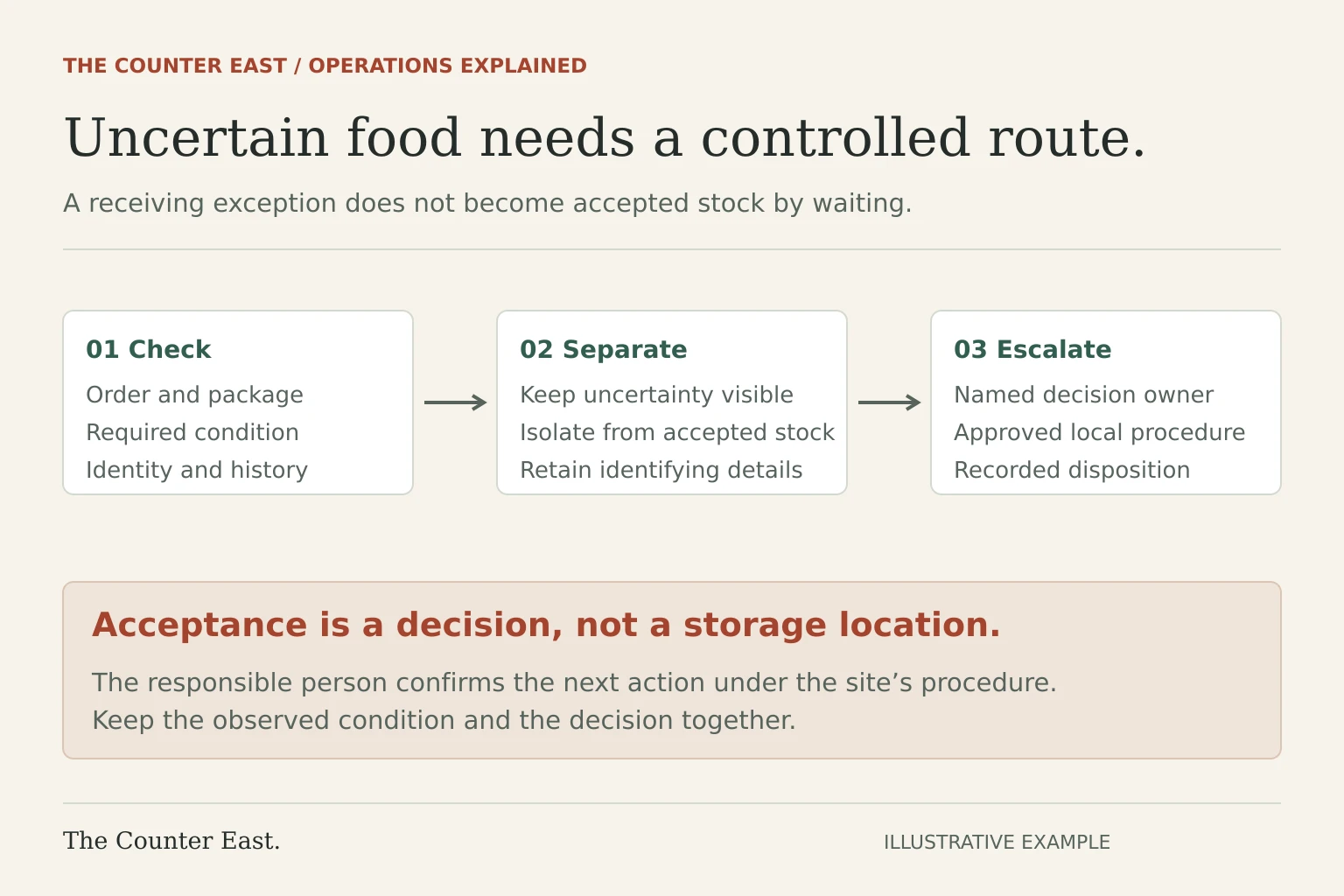
A damaged pack, missing temperature control, unapproved substitution, or delivery that cannot enter safe storage is isolated from accepted stock.
The available choices are more useful than an instruction merely to be careful: reject, return, use under a confirmed safe plan, or discard under local policy.
The prep line likewise needs an intentional route. The food-safety procedure maps three flows: raw inputs, ready-to-eat components, and allergen-managed work.
They may share a room, but they cannot share an uncontrolled sequence.
A cook who trims raw chicken, makes a cooked sauce, and plates a salad crosses safety boundaries; the schedule, tools, and clean direction need to show where that change happens.
Gloves change as tasks change.
They do not make a handle, phone, raw protein, and garnish one clean task.
Allergen work makes the same principle especially visible. Staff translate the guest’s request into an ingredient question and check the item, modifiers, garnish, sauce, garnish oil, fryer or shared equipment, and supplier substitution.
The plate is then identified, made with assigned or freshly prepared tools and ingredients, kept apart from ordinary production, and handed to the person who verifies it.
If the restaurant cannot confirm an answer, the safe route is escalation, not reassurance.
Measure the food rather than the equipment
Holding procedures should tell staff which object to check.
Under the 2022 FDA model Food Code, hot TCS food is held at 57°C (135°F) or above and cold TCS food at 5°C (41°F) or less, subject to listed alternatives.
The controlled object is the food in the pan, not the heat-lamp setting, water bath, refrigerator display, or dashboard.
The restaurant confirms the locally adopted rule, but it still designs its monitoring around the product temperature and the batch’s time path.
Cooking instructions need the same precision.
The 2022 FDA model code uses 74°C (165°F) instantaneously for poultry and stuffed foods.
It lists 63°C (145°F) for 15 seconds for specified fish, whole cuts, and eggs for immediate service. Those are product-class treatments, not interchangeable kitchen shorthand.
The cook checks the coldest plausible point; a thick piece is not validated by its browned surface, and a pan is not validated by one hot spot.
If the result is below the applicable target, the immediate corrective path is to continue cooking and recheck, not to average readings.
The relationship between a pan and its history matters at service. A cook or expeditor identifies each batch, its intended station, and whether it will be served, held, or cooled.
When a partly used pan cannot be distinguished from newly added food, it is replaced rather than topped off. This keeps the food’s time path and identity observable.
During a rush, smaller and more frequent batches can be the safer service default when they preserve the established holding condition and make the handoff clearer.
Define the corrective route before the failure
Cooling shows why a numerical limit alone does not produce control.
FDA’s model procedure calls for food to cool from 57°C (135°F) to 21°C (70°F) in 2 hours, then to 5°C (41°F) or less within 6 hours total.
A full kettle and several shallow pans may contain the same food but have different cooling paths.
Before service ends, the operation selects a method that can meet both checkpoints under actual load: smaller portions, shallow pans, an ice-water bath where suitable, rapid cooling equipment, or another validated route.
The corrective action is designed alongside the monitor.
If cooling misses a checkpoint, if a wrong allergen garnish reaches a plate, if a utensil falls, or if a product cannot be identified, staff stop release and separate the affected food.
The responsible manager then decides its disposition while the facts are still recoverable.
The record should identify the batch or product, the observed condition or measurement, the time, the action taken, the decision-maker, and the final disposition.
This turns a service interruption into a bounded decision rather than a quiet transfer to storage.
Reheating and date marking also depend on the intended route. The FDA model code calls for cooked, cooled TCS food intended for hot holding to reach 74°C (165°F) for 15 seconds within 2 hours.
It calls for refrigerated ready-to-eat TCS food prepared and held beyond a stated period to be date marked, with a maximum holding period at the cold condition above, subject to exceptions.
A restaurant does not carry those model values forward automatically; it verifies local adoption and preserves the earliest applicable date when ready-to-eat foods are combined.
Keep the record close to the decision
Records are useful when they allow the next person to understand the present decision. A holding record belongs at the service point or in the workflow that serves it.
A receiving exception needs the supplier condition, product identity, and disposition before the item is mixed into inventory.
An allergy escalation needs the information checked and the final answer delivered to the guest.
A manager should be able to find the local permit conditions, renewal date, approved plan, authorized roles, and escalation contact without waiting for a corporate office to open.
This is not an argument for documenting every ordinary movement of food.
Paperwork becomes counterproductive when it asks staff to complete a generic form but gives no usable safe action, or when it presents a model-code rule as local law without identifying the authority.
A record that cannot support a real correction adds delay during service and can conceal the fact that nobody owns the decision.
The appropriate control is the smallest one that reliably prevents or detects the failure, with a clear owner and evidence.
The strongest compliance design is ordinarily invisible to the guest and unremarkable to staff.
It is a receiver who knows where an unresolved delivery goes, a cook who knows which food point to check, an expeditor who can name the pan’s route, and a manager who can stop release without debate.
The restaurant is not waiting for inspection to discover its safe path; it is already using that path as normal service.
Use these measures in ordinary service
- Confirm the local authority, adopted requirement, permit condition, and escalation contact before issuing a food-safety instruction.
- Assign a role, observable product condition, record, and immediate corrective action to every service-point control.
- Keep raw, ready-to-eat, and allergen-managed work in three defined flows, with an explicit handoff between them.
- Monitor food at the product and apply locally verified cooking, holding, cooling, reheating, and date-marking requirements to its actual route.
- Stop release, separate questionable food, record the condition and action, and obtain a responsible manager’s disposition before the food returns to service or storage.