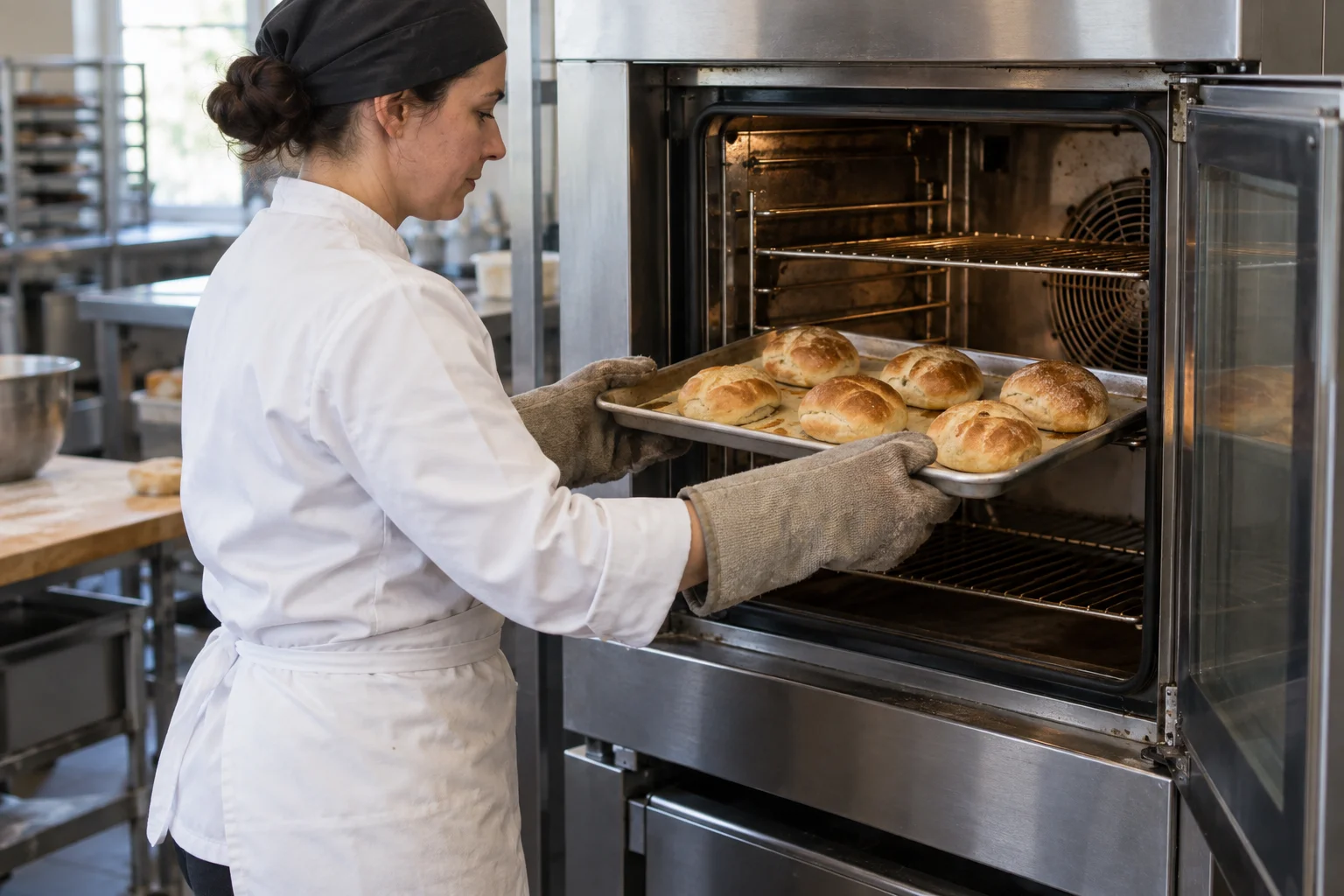
There is a particular sound a kitchen makes when it has decided the oven is larger than it is.
It is not a dramatic sound.
It is the sound of another tray arriving.
Then another.
The door opens, and for a brief interval the entire meal is asked to move into a small hot apartment.
Everyone believes there is room.
The potatoes believe there is room.
The chicken believes there is room.
The very confident tray at the back believes it has been invited to a reception.
It has not.
It is standing in the hallway with its coat on.
The First Rush Acquires a Mythology
There were tickets.
There was heat.
There was, by a strictly architectural reading, an oven.
So why did the last plates come out pale, slow, damp, or otherwise touched by sorrow?
Because your oven was not an empty room.
It was a clock.
And you let service set the clock for you.
The Box Is Doing More Than You Think
Heat reaches food along at least three paths.
Hot walls and a hearth send it across space.
Moving air brings it to whatever surface is exposed.
A pan or a stone passes it up through the patch where the food is sitting down.
That is a great deal of activity for something that has just been asked, very casually, whether it can take one more pan.
A cold load is not a polite visitor.
It arrives and starts borrowing heat immediately.
Your display may be climbing back toward its chosen number with the serene confidence of a person who has not looked under the furniture.
Meanwhile the food is still collecting what it needs.
The screen has news about the air.
The plate has news about dinner.
They are not always the same bulletin.
Every Oven Argues Differently
The old heavy deck understands this in its bones.
Before the dough arrives, its hearth has been standing there storing heat like a brick pension fund.
Each dough piece, its pan, and the water travelling with it take a share.
Five pieces take five shares.
The air may recover with theatrical speed once the door shuts.
The surface underneath may still be negotiating with the previous family of dough.
Which is why the next batch needs a place on the schedule before it develops an urgent personality.
The fan oven has another manner.
Its moving air clears away the cool little blanket beside the food and presses heat across the rack.
Eleven rack positions are not eleven promises.
They are eleven places where a tray can help air move.
Or stand across the corridor with a suitcase and make the whole building late.
Space around the pan is part of the cooking.
So is which shelf receives the first blast.
The combi, having been given both heat and water, is naturally capable of becoming a small weather ministry.
Full steam is a different world from a humid roast.
One tray is uncovered and catches the room’s weather directly.
Another has a lid and has founded its own republic underneath it.
Neither should be counted as a generic pan in an oven.
The conveyor is more candid.
It puts the question on a moving belt and says the answer will arrive at the other end.
That is splendid for a stable product.
But a thicker pizza, a colder portion, a wetter topping, or a changed pan does not become the previous product merely by joining the belt.
The belt will remain calm.
The last pizzas may not.
Ask the Oven a Question It Can Answer
So a production promise has to begin with an event, not a fantasy about empty space.
Forty-eight portions in twenty minutes.
Twelve pizzas, ninety seconds apart.
Three sheet-pan batches in an hour.
The first of those asks for a bit under two and a half portions a minute.
An oven that can hold all forty-eight but needs twenty-five minutes for the loaded cycle has not said yes.
It has merely offered everybody a chair.
That distinction is unfairly important.
Your dining room is not ordering cavity volume.
It is ordering the last good portion in the difficult stretch of time.
And that portion has to leave looking like its earlier relatives.
Not like a cousin retrieved from an attic.
Test the Worst Normal Load
Not a single beautiful tray made while everyone is still hopeful.
Run the load you actually get.
Record the first batch, the middle batch, and the last, for at least three cycles in a row.
For a deck, look at the baking surface as well as the air.
For a combi, write down the humidity you chose and the state of the water.
For a conveyor, keep the belt time beside the result at the exit.
The last batch is a modest, unsentimental witness.
It tells you the truth after the oven has had a chance to get tired.
The Nameplate Does Not Volunteer for This
A rating is an amount of energy arriving at the machine.
It is not a little certificate promising that dinner will emerge on time.
Door openings get a vote.
So do the food, the air, the hot surfaces, the exhaust, and yesterday’s enthusiasm.
Nor does a temperature range settle anything.
Two ovens whose ranges overlap are not allies.
Their heat travels differently.
Their food travels differently.
So their batches have to travel differently too.
Then It Stops Being About Metal and Becomes About Tuesday
Your prep list should read the rush in pieces.
The lunch wave.
The booking.
The online promise.
The event that has wandered in wearing a name badge.
Long work can begin the day before.
Work that belongs safely to the same day begins that morning.
But the important act isn’t starting early enough to make one enormous thing.
It is dividing the demand by the service period before the oven is asked to accept a civic emergency.
There is an opening batch.
There are staggered loads.
There is a smaller finishing job waiting near the people who will need it.
And there is a named moment when the next batch becomes sensible.
That is not withholding food from a guest.
That is refusing to bake the entire evening at five o’clock and then spend the evening wondering why it has developed opinions.
Do Not Let the Oven Impersonate Demand
Keep four quantities apart.
What you planned to make.
What was actually made.
What reached the station ready to use.
And what was still usable after service.
Otherwise a large remainder can impersonate plenty while the station had nothing at the moment it mattered.
Or a short station can blame demand when the oven simply never released the batch.
The handoff needn’t become a parliamentary session.
The prep cook names what is ready, what is not, where the backup is, and what needs attention.
The service cook looks.
That is the useful part.
Looking is how a container stops being a rumour.
Then service watches the plan against the actual pace.
An hour before the peak, ask whether the food is disappearing at the rate it promised to disappear.
If it is not, choose.
A recovery batch.
Moved stock.
A narrower promise.
Or the plain truth about what is left.
But Do Not Let the Schedule Manage the Guest
The oven schedule is not a royal decree.
If a guest needs a small fresh run, and you have the product, the time, and the capacity to make it, the clock does not get to decline on principle.
And if ready food is held back merely because a batch was supposed to appear later, the batch has started managing the guest.
That is backwards.
The point is not a perfect procession of trays.
The point is that nobody has to discover, while hungry people wait, that the oven has been asked to hold a meeting larger than its room.
The Diner Never Sees the Staggered Loads
The best prep list does not say “recovery time” in large letters.
They see a good plate arrive.
Then another good plate.
And somewhere in the kitchen, a tray that might once have tried to enter the oven with nine friends waits a little while.
It turns out to have been invited to the next seating.