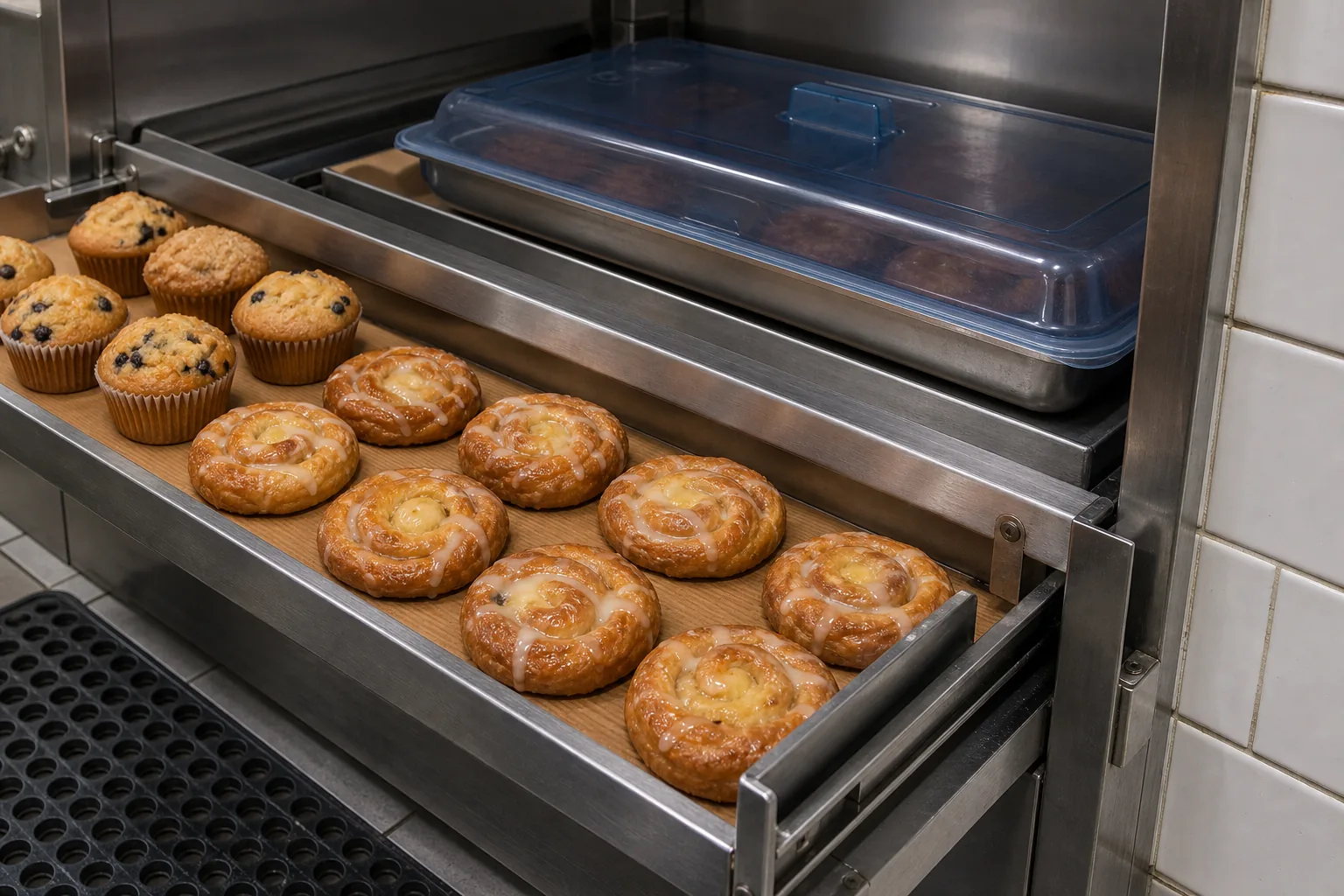
There is a moment at nine o’clock when the bakery case acquires a constitutional duty.
It must look as though the croissants have been expecting everyone.
Not merely the people who arrived at three minutes to nine with a clear plan.
Everyone.
The woman who takes one look at the almond twists and suddenly remembers a meeting that requires an almond twist.
The man who has been loyal to rye since childhood, but sees the country loaf in its little paper sash and feels that destiny has revised the schedule.
The case must say: yes.
Yes, there is bread.
Yes, there are pastries.
Yes, this establishment has mastered the ancient mystery of having something pleasant available before coffee has properly negotiated with the soul.
But the Case Has a Troublesome Cousin
The rack.
The rack knows what the case will not say.
A full-looking morning becomes an evening of abandoned croissants if every possible future customer has already been baked into existence.
Which is why a generous display and a large production release are not the same thing.
They wear similar aprons.
They are not the same person.
Thursday Noon Is a Promise, Not a Mood
Your production lead isn’t deciding how impressive Friday should look from the pavement.
They are making a promise.
The last comparable Friday says one thing, by item and by hour.
The confirmed orders say another.
The regular café order has its own very firm opinions.
So ninety counter loaves, forty pre-orders, and seventy wholesale become two hundred loaves.
Not “make plenty.”
Not “the usual plus a little courage.”
Two hundred.
And each loaf has a destination before it begins its quiet life as dough.
The wholesale bread is promised to somebody who has planned breakfast around it.
The pre-order bread belongs to a name, a time, and usually a person already composing a disappointed email in the imagination.
The retail bread has the harder job.
It has to be ready to look effortless.
The Oven Is Having None of This Romance
Five useful pans with ten loaves on each is fifty positions per load.
Your oven does not, despite its gleaming demeanour, have two hundred loaves by six in the morning merely because everyone has agreed to believe in breakfast.
There is mixing.
There is shaping.
There is the patient waiting that dough insists on, as though holding out for a better contract.
There is cooling.
There is packing.
There is the question of whether a rack can receive the bread without staging a small, floury traffic incident.
A batch that comes out ten minutes before a pickup cannot meet that pickup if packing takes three quarters of an hour after cooling.
The loaf may be baked.
It is not yet capable of keeping its appointment.
Smaller Bakes Earn Their Little Medals Here
Not because a half-filled case is charming.
It is not.
A bare pastry shelf does not communicate restraint.
It communicates that the person who wanted the cardamom bun had better make peace with a muffin.
Your case needs enough product, enough deliberate facings, and enough calm replenishment to make a choice feel safe.
But the schedule can keep later product back in the stages where it still has options.
Cooling bread is not an orphaned loaf.
It is bread with a future.
Count the Café Order Before Anyone Falls in Love With It
Sixty seeded rolls, twenty-four croissants, a dozen loaves.
That order is a small kingdom.
It gets counted, labelled, and moved to its own dispatch territory.
Leave it mingled with the common rack and a perfectly innocent counter sale becomes a wholesale shortfall wearing a croissant-shaped hat.
By seven, the counter is looking at four little countries.
Wholesale dispatched. Pre-orders held. Retail released. And hold or reject.
That last one is unglamorous.
It is also civilization.
The first display is a counted transfer.
Not an expedition by a hopeful staff member with a basket.
Two hundred made, forty held for pre-orders, seventy dispatched, and the remainder is not automatically a public festival of bread.
Some may be cooling.
Some may be waiting for an approved release.
Some may have acquired a reason not to be sold.
When the Display Thins, Ask a Better Question
Not “what can go out so nobody worries?”
Ask whether the product is cooling, protected for a later pickup, held for review, or genuinely ready to replenish.
Sometimes the answer is “sold out until half past ten.”
That isn’t the case failing at theatre.
That is the bakery keeping a promise it already made.
The fuller trick is to let the case do reassurance without making the whole day’s stock audition at opening.
Fresh smaller releases arrive.
The baskets are faced with care.
The person at the till speaks as though another tray is a normal and unsurprising feature of the cosmos.
Nobody needs to know that the croissant has been held back from a very specific fate.
The Afternoon Remainder Is a Conversation
By early afternoon you may have eighteen loaves that are still perfectly sellable and unlikely to meet their original full-price destiny.
Hold them for the later daypart.
Mark them down through an approved route.
Use them internally, donate them through an approved path, or record them as waste.
Decide before the bread stops being suitable.
Not because a loaf enjoys bureaucracy.
No loaf has ever asked to be entered into a disposition record.
But “twelve and a half kilograms of waste” is a very poor witness.
It cannot tell you whether the trouble was demand, quality, overproduction, or a delivery error.
So keep three clues, not one.
Units.
Weight.
Value.
None of them is the boss of the others.
And put the cause beside the count.
Forecast excess.
Quality hold.
Customer no-show.
Damaged display.
Late production.
Wholesale short shipment.
Record error.
Those are not seven varieties of disappointment.
They are seven different instructions for tomorrow.
But Do Not Turn the Shelf Into an Insurance Policy
That is the counter-failure.
You hear “keep the case full” and every shelf becomes overstuffed.
Then abundance is cosmetic, and the evening is asked to eat the morning’s confidence.
The other failure is subtler.
The baskets are arranged with priestly neatness around the fact that the thing people wanted is gone.
That is not abundance either.
It is a little stage set built around disappointment.
The point is not a permanently crowded case.
Nor is it a clever empty one.
It is an honest, generous-looking first release, with more product entering the picture when the schedule says it can.
Then Compare the Day With Its Own Promise
Made. Delivered. Sold at the counter. Disposed of.
Wholesale exact. Pre-orders exact. Counter sales close. A handful marked down late. A dozen discarded.
That is not one sell-through number in a trench coat.
It is a map.
If the retail side misses while wholesale and pre-orders land perfectly, your counter buffer has something to say for itself.
If product reaches the case late, the bottleneck may be cooling or packing rather than the oven.
A quarter of an hour of review is plenty when the day has left proper tracks.
There is a second ledger too, less glamorous than the croissant and considerably harder to charm.
One account works backwards from what you opened with, what arrived, and what remains.
The other works forwards from your recipes and your recorded sales.
They will not agree.
The difference does not announce that the baker made too much.
It clears its throat and points at the places somebody should look.
And the Customer Buys the Almond Twist
That is the quiet arrangement.
The case says there is plenty.
The schedule says not all at once.
The records say what actually happened.
And the customer does not wonder whether the almond twist was the last one on earth.
They leave with exactly the amount of drama a Wednesday morning can support.