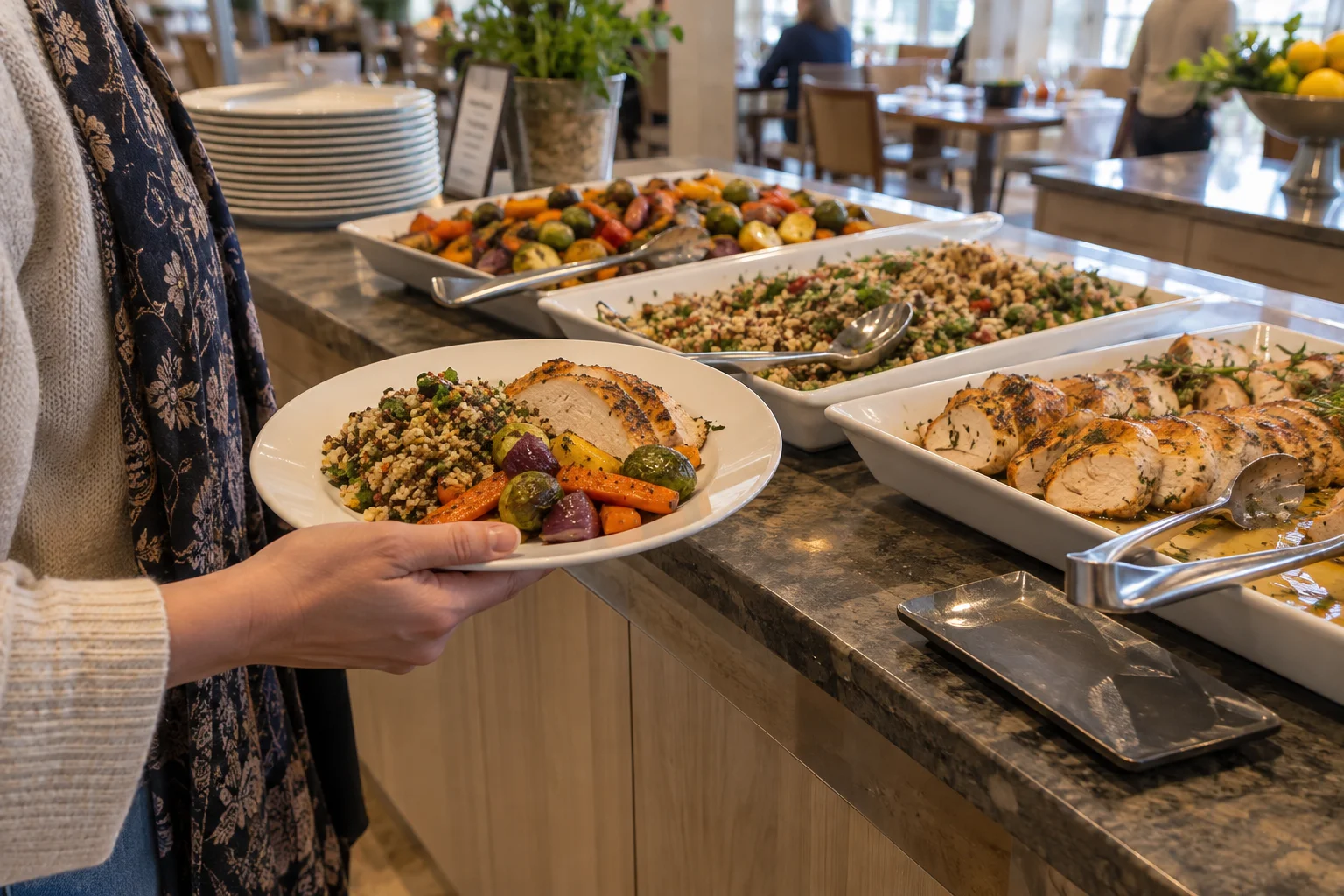
Buffet service can create plate waste before anyone knows how hungry they are. At a large reception, a guest sees a full room, a line, and food that may not still be there on a second visit.
The result is often an insurance portion: food selected against uncertainty rather than appetite. The catering operation remains responsible for availability, presentation, service quality, cleanup, and the food that returns after service.
The goal is not to reduce consumption. It is to make a reasonable first serving the easiest default, keep seconds genuinely available, and use the returns to decide whether that default fits the event.
A large reception cannot rely on each individual first plate to protect the food promised to later guests. It needs a service design that does so without making an individual guest feel observed.
Define the standard before changing the tool
Plate, utensil, and station choices should follow a stated food standard. A buffet side may be intended as a particular finished portion, but the instruction remains incomplete until it names the serving tool, the fill rule, and the serving state.
A scoop of drained beans is not the same thing as a scoop of beans in liquid. A smaller utensil is useful only when it produces the intended serving rather than an arbitrary smaller one.
The same requirement applies to the recipe behind it.
Records should identify whether the food at the station is raw trimmed, cooked drained, thawed, or finished, because a card that specifies a cooked weight while costing a raw one is false even when the line follows it precisely.
For a sauce standard, the record can require a labelled ladle of a stated size or an equivalent weighed portion. The tool then forms part of the serving standard rather than a visual suggestion.
Before an event, staff can calibrate the tool rather than assume it is correct.
A few servings weighed and compared with the standard at the start of a shift can identify a changed fill level, utensil, or build sequence.
Make the first plate complete without closing access
Proportionate plates reduce the empty space that invites an insurance portion. The plate should still hold a normal meal comfortably, and the service language should make clear that another serving is welcome.
A smaller plate is not a declaration that guests should eat less. It separates a normal first decision from a prediction about future hunger.
Utensils should work with that plate.
Rice, pasta, potatoes, vegetables, casseroles, and sauces can look broadly similar by volume while carrying different food values and producing different amounts of plate waste.
A portion-appropriate spoon lets a guest take a first serving without the social pressure of returning an excessive scoop to a shared pan. If the guest wants more, the second trip remains part of the service.
The buffet sequence also changes the first plate. Salads, vegetables, starches, and accompaniments placed before premium protein make a balanced plate more natural before the costly item is reached.
This is not a reason to hide desirable food or to push every guest toward the same meal.
Where a side is regularly returned half-eaten, the vessel as well as the sequence belongs in the test. The main item should arrive alongside the rest of the meal rather than on an empty plate.
Serve premium portions as hospitality
Where the menu and staffing permit it, premium protein can move from self-service to a staffed carving or serving station.
The server provides an initial standard portion, maintains presentation, and sees the consumption rate as it develops.
Another serving remains available on request.
That visibility helps the captain protect later availability without converting the buffet into a rule enforced against a guest.
Staffed and self-service formats require different flow controls. Fewer servers on a buffet does not mean fewer attendants: replenishing, busing, and keeping a station from running down are still somebody’s assigned work.
A staffed premium station has to be designed against peak service work rather than treated as free portion control.
The service promise must remain visible.
Smaller fresh pans, calm replenishment, and a clear invitation to return for seconds reduce the reason to provision a first plate against an uncertain supply.
In a catering flow, the captain compares the planned count with the live room: attendees present, meals served, special meals remaining, beverages issued, table progress, and staff availability.
That observation supports a change in sequence or staff position before a station looks depleted.
Replenishment is not simply a presentation decision. Food should enter the guest-facing buffet near the time it will be served, and the process must operate within the caterer’s established holding plan and the applicable local rule.
A smaller pan does not make a holding process optional.
Read returns as evidence, not as misconduct
Plate waste is a record of a failed match between the service offered and the food consumed. It should not be used to identify or correct individual guests.
Pre-consumer waste can be recorded when it is discarded, while post-consumer waste can be sampled periodically where sorting every plate is impractical.
A sample can record the item, amount, timing, station, and reason. The reason may be a forecast error, overproduction, holding failure, recipe error, contamination, burn, or an interruption in service.
The pattern determines the next question.
If a quantity of prepared potatoes is discarded, the relevant question is not only their food value; it is what made them unsaleable.
Repeatedly untouched bread may indicate too much placed initially. A side regularly returned half-eaten may indicate a default portion or vessel that does not fit the meal.
An item that disappears while another returns largely uneaten may call for a different production estimate or buffet sequence.
Waste should preserve its units.
A costly sauce appearing among the top waste entries for three services is a candidate for a focused test, while an often-returned low-value garnish may be significant by weight without being the same cost priority.
Weight, portions, and dollars describe different decisions. A waste log that retains the item, quantity, cost basis, service point, and discard reason prevents a striking observation from becoming an unsupported conclusion.
Food-cost records add a second account.
Actual food use follows opening amount plus additions minus closing amount; theoretical food use follows recipe standards multiplied by recorded sales.
A total food cost above theoretical warrants segmentation by item group, daypart, station, and available evidence. The difference is a residual, not a direct measurement of plate waste.
It can nominate a portion, yield, production, stock, or data question for investigation, but it cannot identify the cause by itself.
Test the change against hospitality and availability
The portion change should be treated as a test rather than an automatic saving.
Over a pilot of several weeks, compare plate waste per cover, food cost per item, unit sales, guest comments, remakes, contribution dollars, complaints, and food availability with a comparable prior period or an unmodified item.
Lower waste weight is not a success if it accompanies increased complaints, reduced profitable sales, more remakes, or shortage for later guests.
Availability is an equity measure.
Early guests who take substantially more than they consume can leave later guests without reasonable access even where the total prepared quantity should have been sufficient.
The corrective aim is not strict uniformity, because appetites differ. It is to prevent avoidable first-round over-serving from deciding who receives the promised menu.
The counter-failure is just as important.
Smaller plates, smaller tools, and attended stations become the problem when they make a guest feel watched, rationed, or unable to eat enough.
A hovering attendant, a reluctant additional portion, or a buffet that appears not to be replenished changes hospitality into scarcity.
If the pilot shows more complaints, remakes, or shortages, the evidence should revise the intervention rather than justify it.
The strongest design is quiet.
A first plate looks complete.
A premium portion arrives as service.
The buffet shows that more food is coming, and guests are invited to return.
The operation records what comes back, tests the result against waste and service equity, and adjusts the next event. No guest needs to be managed for the system to improve.