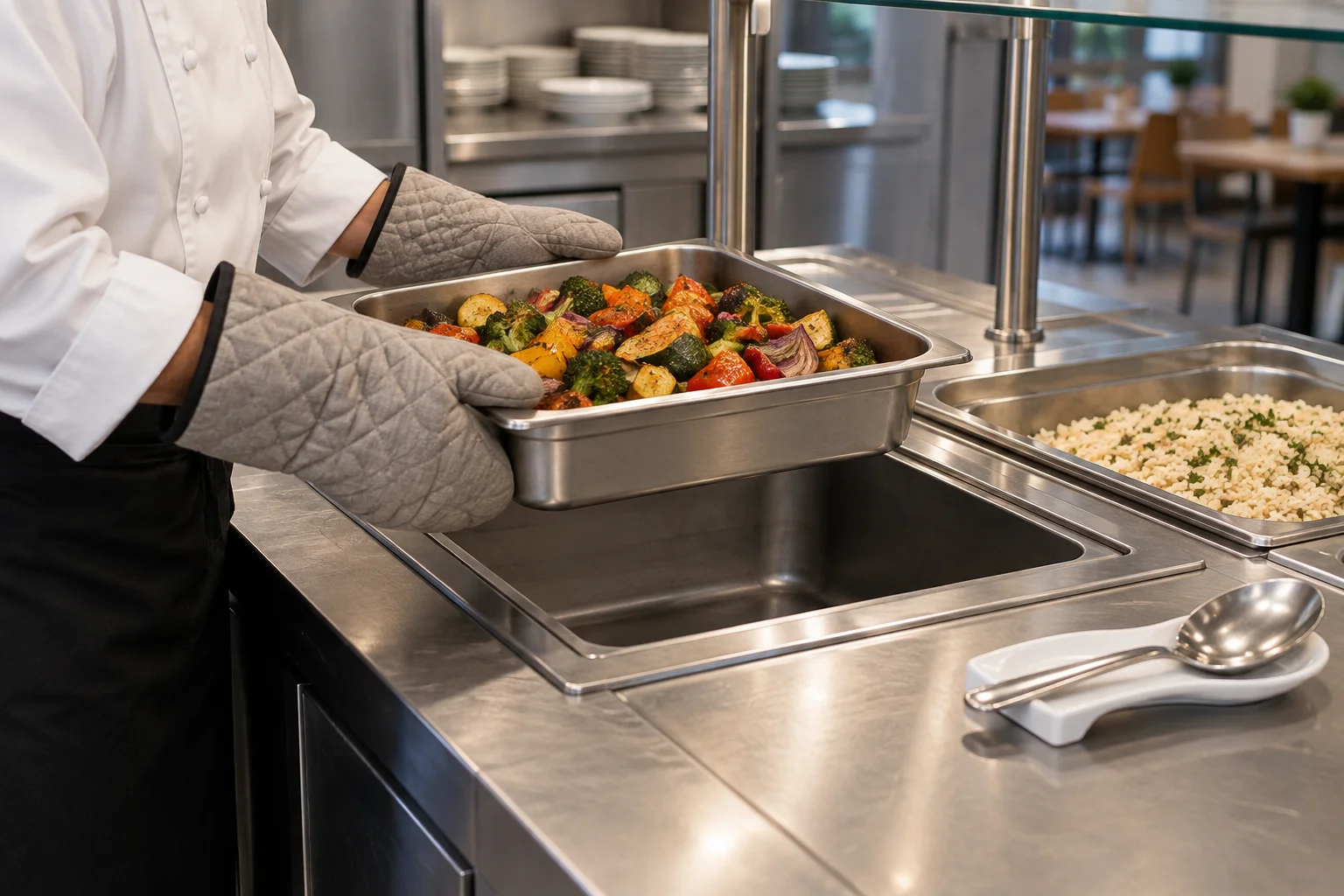
Small-pan replenishment solves a presentation problem only when it also solves the handoff problem.
A buffet stocked once at the beginning can look abundant and still leave food exposed longer than the actual service requires.
A buffet replenished in smaller batches can look current, respond to consumption, and keep a smaller quantity on the line.
The additional pan changes, however, create additional points at which food can lose its identity, its temperature record, or its approved path.
The goal is not to make the buffet appear sparse, nor to make staff move food merely for show.
The goal is to keep the promised menu available while each pan remains identifiable and controlled from kitchen release through service or disposition.
A three-hour service window is not a reason to place every pan out at the start.
It is a reason to plan which food appears when, who monitors it, and what replaces it.
Define the service pattern before food reaches the buffet
The replenishment plan begins with the food, not the chafing dish.
For every item, it identifies the batch or pan, intended station, holding method, monitor, replacement path, and the authority for a corrective action.
Catering containers already need labels that allow a stranger to identify the event, item, dietary status, service point, and handling need.
The same identity must remain legible when a pan becomes guest-facing, otherwise a calm replacement can turn into an untraceable transfer.
For TCS food, the plan also states the required condition.
Under the 2022 FDA Food Code model, hot TCS food is maintained at 57°C (135°F) or above and cold TCS food at 5°C (41°F) or below, subject to listed alternatives and local adoption.
Those are food temperatures.
A heat-lamp setting, refrigerator-air reading, or hot-box display may explain equipment performance, but it does not establish the condition of the food in the pan.
The site is made serviceable before presentation is made attractive.
This begins three hours out, with work routes, sanitation setup as appropriate to the plan, cold and hot holding, and the event lead’s worktable.
Guest-facing serviceware and buffet presentation follow.
Food is placed near the time it will be served. This order protects the control process from the common pressure to open pans early because an unfinished buffet looks incomplete.
The last minutes before a course are also part of the food-quality plan. They are not simply an opportunity to make every vessel look full.
The captain uses the planned count and the live room to decide what needs to be released next: attendees present, meals served, special meals remaining, table progress, and staff availability.
A written cadence can therefore be responsive without becoming improvised: it names the next replacement source and the person responsible for confirming that it is cleared for service.
Assign each pan a controlled handoff
The key service unit is the pan, not the appliance.
When hot food moves to service, the cook or expeditor identifies the batch, intended station, and whether it is being served, held, or cooled.
That one-batch handoff gives the receiving attendant a defined object to monitor. It also separates a deliberate replacement from the vague instruction to keep the buffet looking full.
The monitor records the product, time, measured temperature, equipment, and corrective action where the process requires a record.
The event captain needs a calibrated probe thermometer and authority to quarantine a suspect pan.
This is more useful than a general reassurance that the carrier was preheated or the chafer has fuel.
In a deep container, food at the relevant point can differ from the surrounding air or water bath, and a unit that looks active can still be a poor substitute for a food measurement.
Small pans make this discipline more important, not less. Each replacement should have a known identity before it leaves controlled storage or holding and a known station when it arrives.
A runner should not borrow an unlabelled pan because a display looks low, and an attendant should not exchange utensils between foods to complete a fast change.
Ready-to-eat food remains protected by its route, its utensils, and the ability to identify what has been touched and when.
Replace pans instead of extending unknown histories
A small-pan programme fails when fresh food is added to a partly used pan with no way to separate the old food’s time path from the new food’s.
The food-safety procedure calls this topping off. It obscures the older food’s time and temperature history, which is precisely the information needed to decide whether the pan may remain in service.
Replace the pan when that history cannot be distinguished; do not use a visual improvement to erase a control question.
The removed pan has its own route. It may remain in service only under the established process, or it may be held, cooled, discarded, or referred for a disposition decision.
The replacement pan is not evidence that the old one was safe or unsafe. It is a separate batch with a separate identity.
That distinction allows an operator to maintain the guest-facing message that more food is coming without blending together the records that determine what may still be served.
This is the counter-failure of staged replenishment. Presentation pressure can make a nearly empty pan look like a fault, a full pan look like reassurance, and a quick top-off look efficient.
In fact, an untracked top-off can make a pan’s oldest food impossible to assess. The operational objective is not maximum visual fullness.
It is a buffet that remains generous because staff can reliably replace food that is cleared for service and remove food that is not.
Keep freshness visible and control separate
Guests do not need to see the record to receive its benefit.
Calm tray changes, clean utensils, and a buffet that does not appear abandoned communicate that another serving remains available.
That signal can reduce the impulse to take more than a first plate needs, particularly when guests are uncertain whether a return visit will be possible.
It works only when the signal is true: an identified replacement path must exist behind the visible pan.
The record has a different job.
It says which food is present, when it was measured, what equipment supports it, and what happened if the process failed.
A pan may look freshly replenished while its record says it is not cleared for service; in that case the record governs.
Conversely, a pan may look low while a controlled replacement is ready. The service team should change the pan without creating a guest-facing shortage or an undocumented safety exception.
The captain handles a delay at one station by moving staff or changing the sequence rather than silently asking the entire room to accept a longer line. The same principle applies to a food-control exception.
If a temperature, holding, equipment, or safety exception occurs, the affected pan or service point is isolated, the occurrence is recorded, and the person with authority decides disposition.
Replacement, a different menu item, slower release, or ending service from that unit are possible outcomes; continuing because the pan looks acceptable is not a control.
Give food leaving service a defined route
Replenishment timing also determines what remains after service. Food should not be opened or transferred casually during teardown because a client asks whether it can be packed.
Shortly after the agreed end, the captain checks the client timing and contract scope, directs leftovers under the local rule and written agreement, and begins the return count.
Food returns to inventory only if it can properly re-enter it.
If cooked TCS food enters the FDA model cooling route, it moves from 135°F to 70°F in 2 hours and from 70°F to 41°F or less within the next 4 hours.
Large batches may need to be divided into shallow pans or smaller portions, stirred in an ice-water bath where suitable, rapidly cooled, or positioned for heat transfer.
A small service pan can assist that route, but pan size alone does not prove that a cooling batch has met either checkpoint.
Food intended for later hot holding has another explicit route.
The FDA model Food Code calls for cooked, cooled TCS food to be reheated to 74°C (165°F) for 15 seconds within 2 hours when it will be hot held.
A portion reheated only for immediate service may follow a different route, so the intended use is decided before reheating.
Reheating until food merely feels hot is not a substitute for the applicable process.
Age identity also survives a transfer.
Under the FDA model, refrigerated ready-to-eat TCS food prepared and held for more than 24 hours is date marked and may be held up to 7 days at 5°C (41°F) or less, counting preparation as Day 1, subject to exceptions and local adoption.
A new pan does not create a new microbial history. When ready-to-eat foods are combined or repanned, the earliest applicable date remains part of the item identity.
Maintain the measures that make the pattern safe
Small-pan service is effective when the buffet looks continually available and the food path remains demonstrable.
The measures are straightforward:
- Identify every batch, pan, station, monitor, and replacement source before service.
- Measure TCS food at the product and maintain the applicable hot or cold condition under the locally adopted rule.
- Use a named handoff, replace rather than top off when histories cannot be separated, and keep utensils with their intended food.
- Isolate and record an exception, then obtain an authorized product-disposition decision.
- Route food leaving service through the applicable cooling, reheating, date-marking, inventory, or discard process.
When those measures are in place, a buffet can be replenished quietly. Guests see food arriving as it is needed.
The team maintains the separate record that makes that appearance safe to trust.