Restaurant formats fail at the point where their internal division of work becomes visible to a guest as a missing service.
A counter model can ask a guest to order, pay, find a seat, and collect food.
A table model ordinarily asks staff to interpret the order, deliver it, check back, clear, settle, and recover an exception.
Neither arrangement is inherently more efficient or more hospitable. Each assigns labour, equipment, seating time, and decision rights before the first choice is made.
The goal is to make that assignment clear before commitment, then make the handoff and its predictable exceptions easy to resolve.
A format can be economical because it concentrates work at a station, line, table, or courier shelf.
It does not become economical by leaving a guest to discover an unstated task after payment.
The primary model should therefore be named, its order and pickup conventions stated, and its recovery point made visible.
Classify the primary service model before setting the handoff
Classification should follow the journey that organizes the meal, not furniture or a single helpful gesture.
Counter ordering, payment, an order number, and runner delivery form counter service with table delivery when the counter remains the central transaction point.
The last metre of food movement does not create a table-service relationship. Table service begins when a seated attendant takes the order and owns the ongoing meal relationship.
The same discipline prevents an attended station from being misclassified. A buffet can be self-service, partly attended, or include a cook-to-order station; one line can contain two service modes.
Its primary logic is still line selection and transfer from display or line equipment.
An attended carving station should improve portions, presentation, and recovery without pretending that the guest has entered a different service model.
Family service turns on shared distribution, not the phrase “family restaurant.” A deliberately shared vessel may be a useful boundary test, but one salad bowl or bread basket does not make an otherwise plated meal family-style.
Tasting service similarly depends on a party committing to restaurant-led progression at a stated sitting.
A multi-course option does not redefine every table when other guests choose individual dishes at their own pace.
Takeout, delivery, curbside pickup, and drive-through are handoff channels rather than additional dining-room models.
A delivery intermediary may be classified under a local-delivery industry code while the restaurant retains its own on-premises service model.
The operation should state both facts.
Otherwise a guest and a manager can use the same word, delivery, to describe different responsibilities.
State the two expectation moments
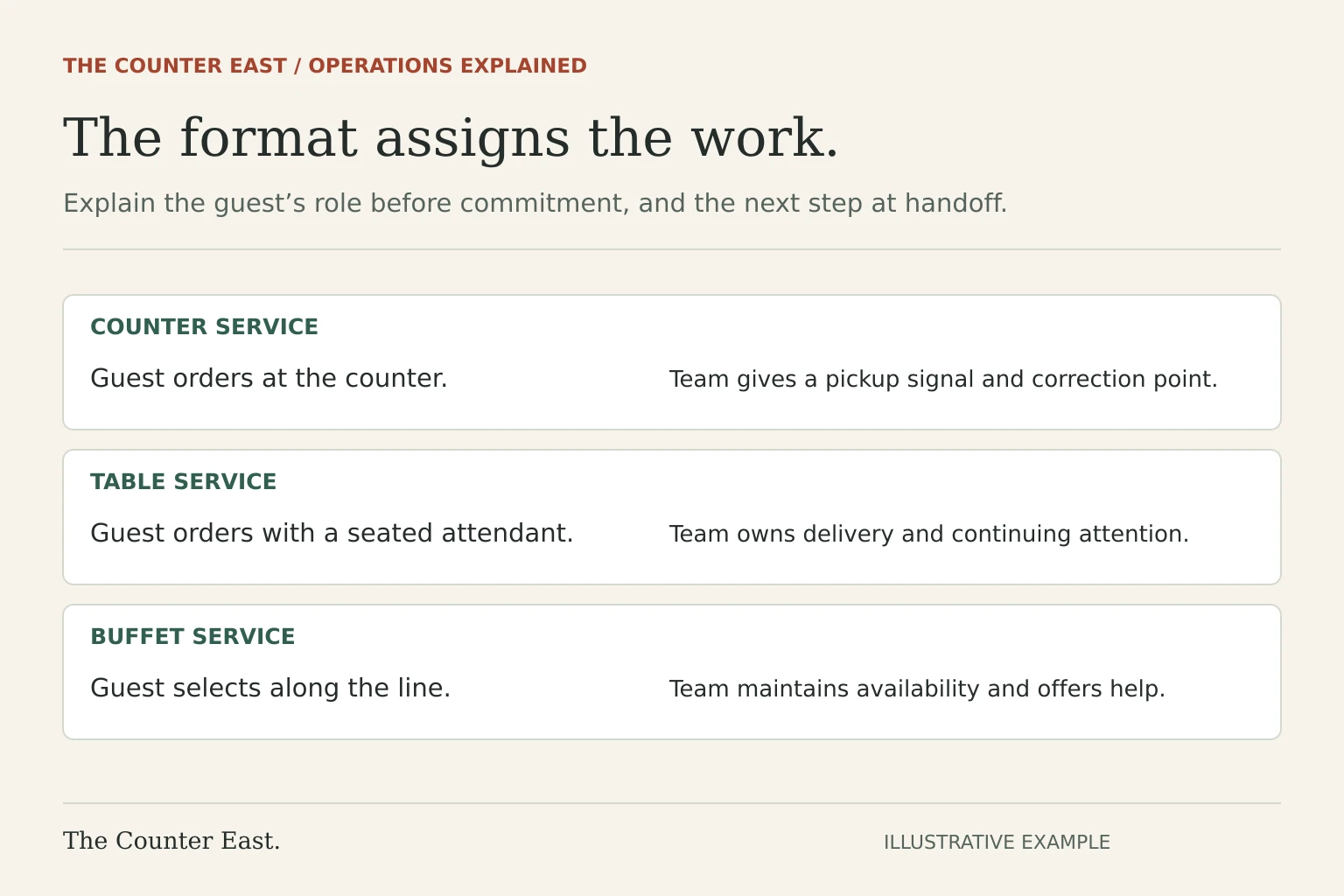
Each model needs two expectation moments: before commitment and after food is ready.
Before commitment, a counter guest needs the ordering and pickup convention; a buffet guest needs to know access and inclusions; a tasting guest needs the menu concept, duration, dietary path, and price logic.
The restaurant should state the work invited from the guest before asking for payment, a place in line, or a reservation commitment.
After food is ready, the promise changes. A table guest expects delivery and continuing attention. A counter guest needs a legible pickup signal.
A buffet guest needs an available, maintained line. A tasting guest needs the next course to feel deliberate rather than forgotten.
The handoff should identify the food, tell the guest what happens next, and make the correction contact point apparent.
This is particularly important where inspection happens late.
A seated diner can correct a missing side before the entrée is cold; a pickup guest can see a wrong name at the shelf; a delivery guest may open a bag after the courier has left.
The later the inspection, the more the order needs an evidence trail: ticket, packed items, handoff time, and contact channel.
A void and a remake can both appear harmless in a sales report, but only the remake consumes food and labour again.
Release work at the actual bottleneck
The business model determines which station can release another promise. A QSR may be constrained by the order point, fryer, beverage station, payment point, drive-through window, or handoff.
Fast casual may be constrained by the slowest ingredient, cook, or payment position in the assembly line.
Casual dining can be constrained by a table, server attention, bar capacity, or course preparation.
Fine dining may deliberately retain time because pacing is part of the product. A vacant chair is not, by itself, available capacity.
Delivery-only moves the constraint into production slots, packing capacity, courier arrival, and digital demand.
Once a restaurant accepts a delivery slot, it has committed cook, pack, and handoff work before the guest appears.
A late burst of orders is not useful demand if it compromises orders already promised. The release point should stop the next accepted order from making the preceding promise unfulfillable.
Use a three-part rate for throughput: completed units, a time window, and the bottleneck location.
A count of guests cleared through a named line in a stated interval identifies a result that can be examined.
“The buffet moved quickly” does not.
Published station capacities are illustrations rather than portable guarantees, and a second accessible side may release a line constraint that another table server cannot.
The denominator must fit the format as well. A casual restaurant can be described through seats, turns per service, and average covers per occupied table.
Counter service is better described as completed transactions per station-hour. Delivery-only needs accepted orders per production interval and courier-handoff interval.
A number of orders is not automatically a number of guests, and an average check is meaningless until its sales numerator and transaction, party, cover, or order denominator are named.
Build recovery around the exception unit
An exception should be designed at the smallest unit it disturbs: one cover, one order, one table, one line position, or one cohort.
A table-service substitution may be isolated to one cover, even when it requires a re-fire. A missing shared dish affects the whole family-style table.
A popular buffet pan can affect a line. A production constraint in one tasting wave can delay every guest waiting for the next coordinated course.
The recovery should match that exposure.
A counter operation needs a correction point that does not automatically send a guest back through the original queue.
Buffet service needs attendants who can replenish and resolve uneven line flow. A table operation needs staff who can interpret a changed pace or missing item.
Tasting service needs a way to keep one accommodation from visibly abandoning the cohort.
The question is not which model “handles dietary needs”; it is which unit absorbs the variation and how it returns to the promised sequence.
Three closeout reconciliations preserve the evidence needed to improve that path: payment received against POS sales, product or comp exceptions against a reason, and channel orders against actual handoffs.
These three reconciliations distinguish a cancelled request, a void, a remake, and a completed handoff. They prevent gross sales from being mistaken for successful service.
Compare the labour and cost promised
Labour comparisons should begin with one labour-hour and the work it buys. A table-service hour can purchase guest interpretation and recovery.
A buffet hour can purchase pan availability and guest-flow attention. A tasting-service hour can purchase coordinated course release.
Counting heads without naming the promise makes one model seem overstaffed merely because its attention is visible at a different point in the meal.
The available format-level data reinforce the need for restraint. Published industry medians put salaries, wages, and benefits at a higher share of sales for full-service respondents than for limited-service ones.
Those figures are management context, not staffing standards, and they do not isolate family or tasting service. The question is what the difference purchases, not how to eliminate contact.
Cost structures also place pressure at different handoffs. Published results for fast-casual chains show food and packaging, labour, occupancy, and other operating expense in broadly similar bands to full service, arranged differently.
Neither set of figures is a target for another restaurant. Both show that a faster transaction still needs equipment, packaging, labour, and a controlled release point.
Casual and fine dining carry another form of scarcity: the seat-hour and the service sequence around it.
A same-restaurant comparison ordinarily excludes the opening ramp by requiring a minimum period of operation.
A higher check can coexist with falling guest count, so price, mix, catering, and covers should be separated before a model change is credited with demand.
The room is not free capacity simply because a table is empty at one moment.
Keep the model clear without withdrawing attention
The counter-failure is over-direction.
A self-service label can become an excuse to remove the staff attention that makes self-service usable: a pickup shelf with no correction point, a buffet line with no replenishment, or a counter order with no accessible way to ask what happens next.
The guest then performs work that was neither explained nor recoverable.
The opposite failure is to add so much human attention that the stated model becomes obscure.
A counter guest should not have to seek a seated attendant for routine pickup. A buffet should not require a conversation for every ordinary selection.
The appropriate control is a clear default and an obvious exception path: staff attention becomes available where the model predictably needs it, rather than being imposed on every step.
The measures are straightforward:
- Name the primary model and any handoff-channel modifier.
- State the guest’s role before commitment and the signal after food is ready.
- Measure completed units, time window, and bottleneck location together.
- Define the smallest exception unit and its recovery contact point.
- Compare labour and costs against the service promise, not against a format label.
- Preserve the evidence of payment, exception, and actual handoff.
When those measures are in place, the service model becomes quiet. A guest orders, carries, waits, asks, or receives help at the point the format has already made natural.
The operation has allocated the work in advance. Nobody needs to feel that an ordinary request has exposed a missing service.