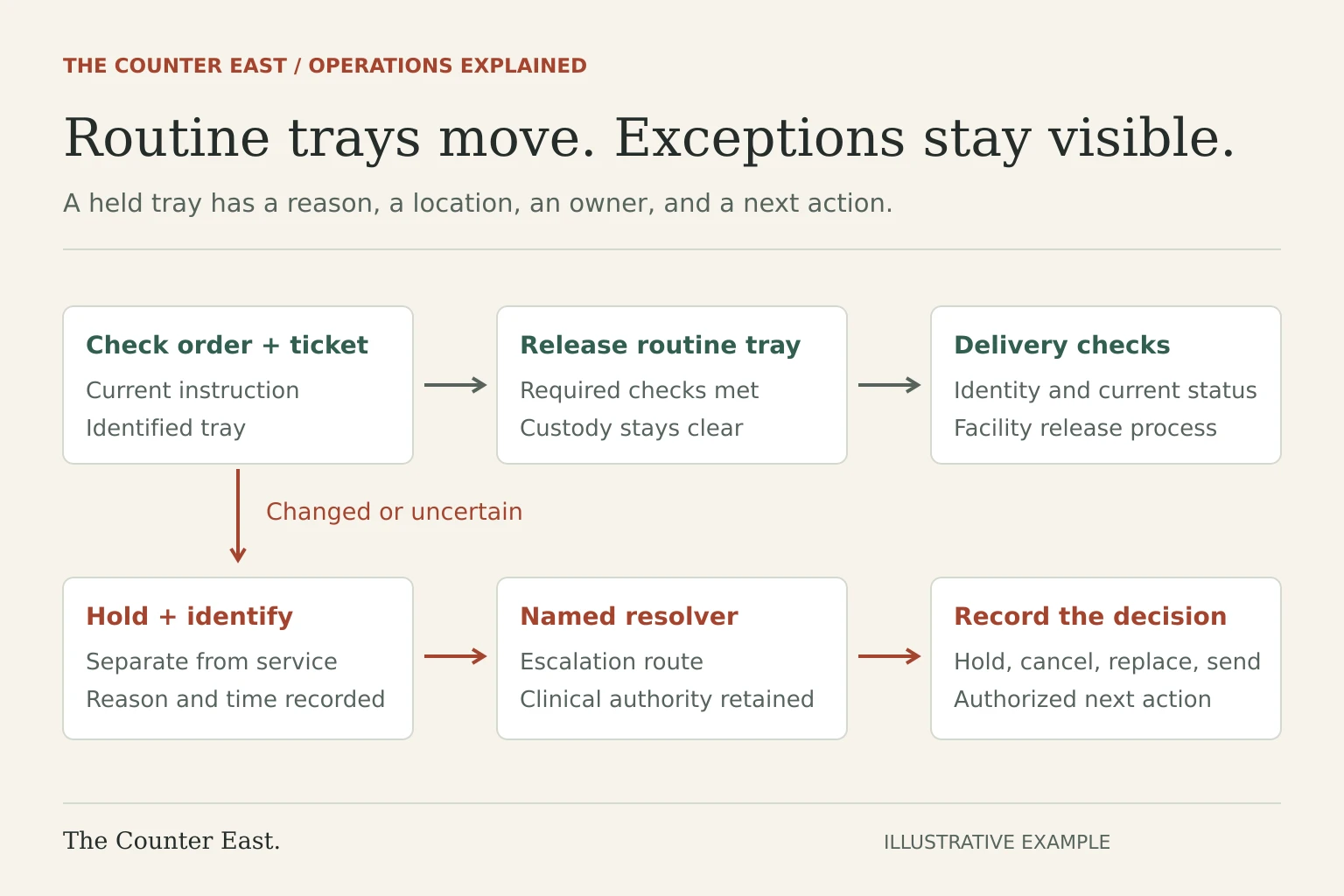
A hospital tray line has to keep routine meals moving while patient status changes.
A late diet order, a missing supplement, a substitute item, an unreadable ticket, or an isolation delivery can arrive after production has become assembly.
CMS guidance expects a system for diet ordering and patient-tray delivery, including policies for diet-order changes and early or late trays.
The operating goal is not maximum line speed. It is a current, identified meal at the bedside without turning one uncertain tray into an informal decision.
The exception lane provides that control.
It gives a changed or incomplete tray a named status, an owner, a holding location, a label, and an escalation route while the routine batch continues.
The routine line is moving because uncertain work has been made visible and separate, not because anyone has silently accepted it.
Establish a live correction route
A day ahead, the diet office can turn occupied beds, projected admissions and discharges, service pattern, and known special diets into a production forecast. That forecast is a starting quantity, not authority to serve.
It should retain the original forecast and the final adjusted count as two separate numbers, so the next cycle can distinguish a census error from a late clinical correction or recipe-yield variance.
Three hours out, an authorized diet workflow checks that an order is complete and current, assigns it to the facility diet manual, and issues the tray ticket or its electronic equivalent.
The handoff has two confirmations: the order has entered foodservice, and any change after the production cut-off has an explicit response.
A late nothing-by-mouth instruction, procedure delay, transfer, or discharge must be cancelled, held, replaced, or sent and recorded; it is not resolved by simply appearing in the clinical record.
That discipline matters because patient nutrition status can change outside the kitchen’s production rhythm.
One hospital case study identified meals sent to patients receiving enteral or parenteral nutrition as a source of avoidable provision.
The transferable control is not that study’s meal schedule. It is a usable, current signal from clinical status to foodservice.
Give the exception a status before it leaves the line
An hour and a half out, cooks turn the planned batch into identified trays by combining components with a diet ticket, beverage, supplement, utensil, and required identifier.
The ticket connects a current instruction to an actual tray. If the ticket is unreadable, duplicated, or inconsistent with the available menu, the line reaches a stop point.
No worker should silently reinterpret an unfamiliar abbreviation or select a plausible substitute.
Use a visible exception status such as held and escalated. Record the reason, the time, the named resolver, and the next action.
A missing supplement, texture modification, substitute item, isolation delivery, or late tray then has an active route instead of becoming an unmarked tray at the end of a bench.
The line supervisor can release the batch while the resolver decides whether to cancel, replace, hold, or send that individual tray.
This is a practical form of the rule structure used across institutional foodservice.
A meal commonly sits within five rule layers: program or statute, institutional conditions, nutrition or clinical standard, contract, and local work instruction.
At the service point, four controls make those rules usable: a current menu or diet source, an identity or eligibility check, an authorized substitution path, and a retained record.
The exception lane exists to keep those controls intact when the ordinary sequence breaks.
Separate the held tray from available food
The holding location should be a designated exception area, not a spare shelf, corridor position, or anonymous cart space.
A hold is food intentionally isolated pending a named decision; it is not available for use or sale.
The location needs a boundary that remains visible when the room is busy, a clear unavailable status, and custody that does not depend on the memory of the worker who put the tray there.
The facility’s ordinary storage rules still apply inside that area. A held tray is not stock, and the point is not to shelve it as though it were.
It is to avoid placing identified food where it cannot be kept clean, inspected, or distinguished from routine service.
The refrigerated separation between ready-to-eat and raw food, the dedicated position for allergen-containing items, and the non-food location for cleaning chemicals hold in an exception area exactly as they hold everywhere else.
A held tray or component must also retain enough identity, cover, and date information to be handled under the approved process.
Moving food to a clean-looking pan does not erase its earlier history.
Label the food and the decision
When food is opened, prepared, portioned, combined, or removed from its original package, an internal label records the food name, the date event, the controlling use or discard instruction, and a preparer or batch reference where the site uses one.
Those four decision fields let the tray line and the holding area speak the same language.
The exception record adds the owner, reason, time, and next action; the food label does not substitute for the clinical decision, and the clinical note does not substitute for food identity.
Refrigerated ready-to-eat food held beyond a stated period carries a date under the facility’s adopted rule, and a shorter manufacturer date can control instead.
The facility calculates the controlling disposition date from the strictest applicable source rather than applying a generic rule to every held tray.
Do not reset that date by rewrapping a pan, moving it to another shelf, or blending an older portion into a newer one.
When dates differ, the unit with the earliest controlling date belongs in the active path, and the reserve unit stays visible rather than creating hidden date layers.
Reconcile custody at the ward and after service
Arrival at the unit transfers a tray into a new custody decision.
Ward staff use the facility identification process, current treatment, position, ability to eat, and any new restriction to release the meal, hold it, or contact foodservice.
Foodservice has completed transport, but it cannot infer clinical clearance from an untouched or returned tray.
The ward’s reason for the hold, whether a procedure, an absence, a changed order, or an inability to eat, must accompany the next request.
The service window must also be designed around current care.
A public-hospital room-service study delivered meals within a short window of the order, but that result compares scheduled and on-demand models rather than setting a universal standard.
It shows why a scheduled tray operation needs a reliable late-tray and replacement route around procedures, medication, and ward staffing instead of assuming the original tray run remains valid.
Two hours after service, close the loop on the cart return, ward message, plate-waste observation, and diet-office changes. Reconcile meals ordered, produced, delivered, held, cancelled, and returned.
Published multi-site audits put daily hospital foodservice waste in the hundreds of kilograms, across plate, trayline, and packaging. That is not a benchmark for another hospital.
It is a reason to attach a reason code to a return rather than let it disappear into undifferentiated waste.
The as-served record should show what was actually made and sent, including approved substitutions. The BOP Food Service Manual uses an as-served menu to document unplanned changes and review planned servings.
A hospital has different clinical controls, but the record principle is the same: the planned ticket and the final tray are not interchangeable evidence.
Keep the exception lane from becoming a parking place
The counter-failure is an exception lane that preserves the line by abandoning the exception.
A tray with no owner, no decision time, no resolver, and no next action is not safely held; it is merely out of sight.
The resulting delay is inequitable because a single patient can lose a meal without anyone being responsible for the decision.
The response is not to stop every tray whenever a question appears. Nor is it to force the line worker to guess.
Use two kinds of verification: a live check that permits or stops the next action, and later review that identifies repeated drift.
Repeated late diet changes may indicate a timing or communication problem; repeated missing supplements may indicate a production, stocking, or ticket-design problem.
Retraining alone cannot fix a correction route that is unusable during peak assembly.
The strongest routine is quiet at the bedside. A patient receives a current, identified tray at a usable time.
A routine tray does not wait behind an unrelated question. A changed tray does not become anonymous in storage. The measures that make that possible are straightforward:
- retain the original forecast and final adjusted count;
- confirm both entry into foodservice and the response to a late change;
- mark incomplete trays as held and escalated with a named resolver;
- keep held food separated, labelled, date-controlled, and ordered by its controlling date;
- reconcile ordered, produced, delivered, held, cancelled, and returned meals with a reason for every exception.