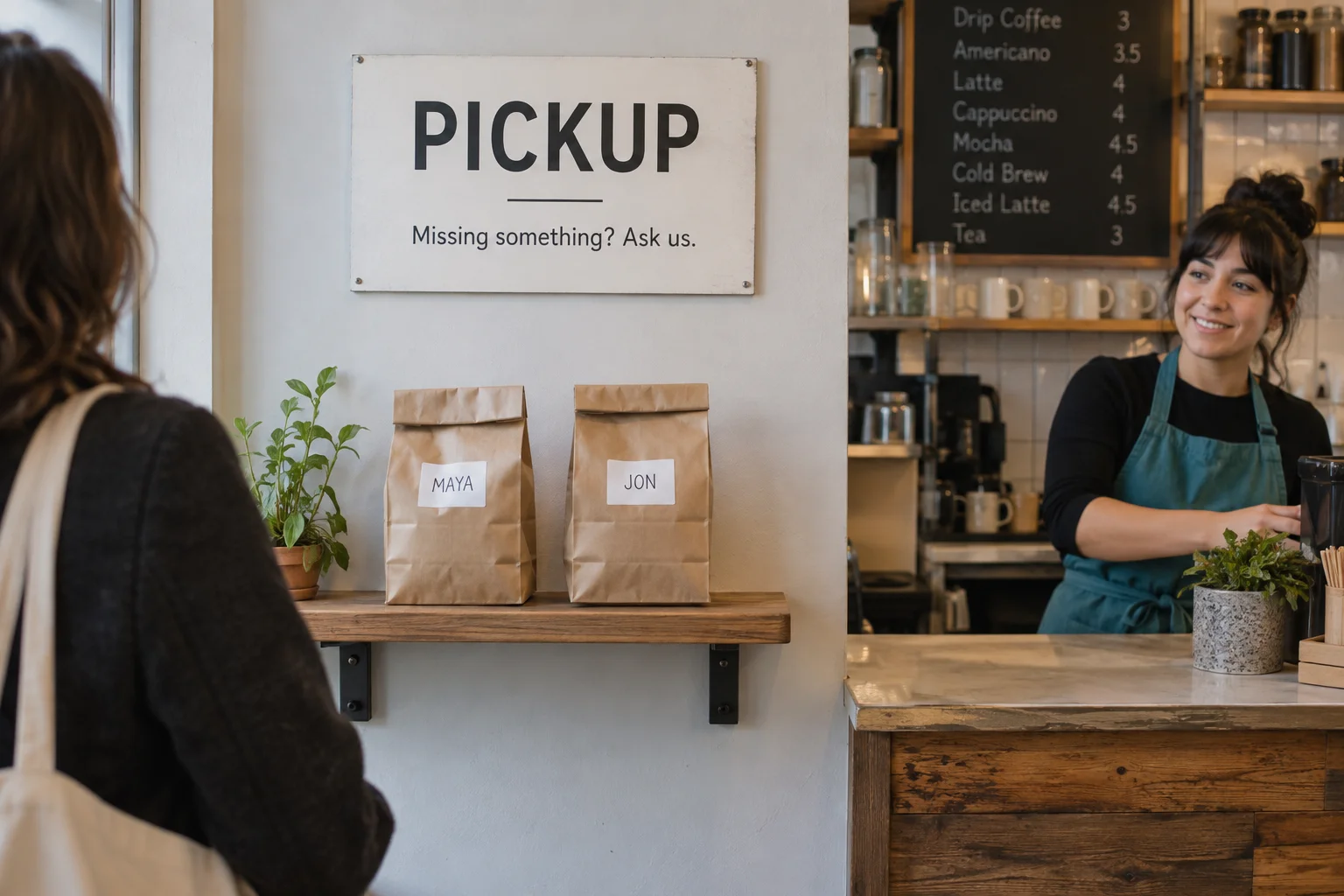
There is a moment in every coffee shop when the pickup shelf ceases to be furniture.
It becomes a small country.
There are borders.
There are rumours.
There is one oat latte, ordered eight minutes ago, whose whereabouts have become a matter of public concern.
The person who ordered it is not doing anything wrong.
They have paid.
Their phone has made a reassuring little sound.
It has given them a time.
The phone did all this with the solemn confidence of a royal messenger delivering a scroll.
But the phone is not standing beside your espresso machine.
It cannot see the counter drinks already gathered on the shelf.
It cannot see the milk station.
It cannot see the person looking for a lid as though the lid has taken a personal day.
How a Shelf Acquires a Crowd
So the person arrives at the shelf.
The shelf contains cups.
A cup bears a first name.
Another bears an order number.
A label has curled at the corner and now looks like it knows a secret.
The person looks at the cups.
The cups look back with the steady, unhelpful gaze of cups.
And then somebody else arrives.
Then another.
Nobody is impatient yet.
They are merely standing in the same small patch of floor, consulting their phones with the absorbed gravity of people awaiting news from a distant province.
That’s how a shelf acquires a crowd.
Not because people are difficult.
Because the shelf has declined to say what happens next.
Mobile ordering removes a conversation at the till.
It does not remove the handoff.
It moves the handoff to the end, where a hot cup, a cold cup, a name, a number, an app, a barista, and a person with somewhere to be must all meet without becoming a committee.
A Paid Order Is Not One Thing
It has at least four little lives.
Captured.
Released.
In production.
Ready.
A latte can be captured well before anyone touches a portafilter.
Paid for. Named. Promised a location. Placed in your shop’s future.
It is not yet a latte.
It is a very persuasive idea of a latte.
The distinction has offended nobody.
It has also kept several very real lattes from entering the bar at once like a touring orchestra.
Print every paid order the instant it lands and the shelf may stay tranquil for a while.
Behind the counter, though, a second queue is quietly growing.
Hold every order until the customer is visible and the bar stays calm while the shelf begins staging its own outdoor festival.
Neither is a rule you can leave a guest to work out.
Give the Order One Visible State
Not four states shouted at once.
One.
The phone can say it is being prepared.
The shelf can say it is ready.
The counter can make plain where a person goes if something has gone sideways.
Your bar does not need a new ambassador every time somebody arrives early.
And the person choosing what proceeds isn’t ruling on which customer deserves coffee more.
They’re looking for a credible path through the espresso and the milk work.
An espresso shot is a matter of seconds.
That is a reference figure, not a prophecy about when a latte will be in a hand.
Grinding, milk, finishing, and resetting are all still waiting in the wings, adjusting their cuffs.
A fast grinder can make a dose sound almost instantaneous on paper.
Paper has never washed a pitcher.
Paper has never assembled an iced drink.
Paper has never decided whether two dairy lattes can share a steaming sequence while a dairy-free drink follows your allergy method.
Paper has never answered, with genuine kindness, whether the order on the far shelf is a Jordan or a Jorden.
A two-group machine can have more than one extraction under way.
It cannot persuade a missing lid to become present.
It cannot steam milk, call a name, replace a drink made with the wrong milk, and explain the collection rule while also being a machine.
The Cup Must Carry Its Passport
Size. Temperature. Milk. Syrup. Shots. Identifier. Destination.
Those details may have crossed payment, routing, and production without alarming anyone.
That is their proper job.
The first name is for the person.
The order number is for the record.
The size and milk are for the drink.
The destination is for the place where all these modest citizens are meant to reunite.
Nobody ordering a latte should have to know that the word “oat” must survive three transfers before it reaches the pitcher.
Payment creates the request.
Routing sends it to the bar.
The label brings it to the pitcher.
They should only receive an oat latte.
Which is why an unlabeled latte isn’t an innocent little beige object.
It is an unowned object.
It has been separated from its history.
It may be a perfectly good drink, in the same sense that an unmarked suitcase is a perfectly good suitcase.
Nobody should have to make a confident decision about it.
Let the Shelf Speak One Language
First names, if first names are the agreement.
Order numbers, if order numbers are the agreement.
Not a museum of both, plus an abandoned receipt, plus a cup announced by an app but hidden behind the napkins.
Your finishing person checks three things before lidding.
Ticket. Cup. Drink.
Your handoff person checks the cup and calls the agreed name or number.
Because a drink does not become ready when paper touches a flat surface.
It becomes ready when its person can identify it, take it without rummaging among neighbours, and find a correction route if it is wrong.
That is an extremely modest ambition.
It is also the entire difference between a shelf and a low-stakes customs hall.
Give the Exception Its Own Doorway
Not a grand department of grievances.
Just a person, or a point, that says: this order cannot be found, this name does not match, this drink is wrong, this collection route does not work for me.
The ordinary line keeps collecting.
The bar keeps making.
The attendant makes the checks.
The record. The pickup zone. The lead. And, where the channel allows it, the guest.
That is better than a barista investigating a vanished cup while holding a pitcher and other people’s hopes.
It matters most for the drink that has been sitting there ten minutes.
It may belong to a late person.
It may have a name mismatch.
It may be hidden.
It may be an order whose readiness was never actually announced.
The automatic remake has great dramatic energy.
It also makes a second drink, doubles the work, and leaves the first standing there like an understudy nobody told the show had begun.
Look first.
Then decide.
Two Identical Drinks Are Often Not
Two cups that look the same can carry different milk, sizes, or notes.
Even the order in which those choices were made can stop the system combining them into one line.
The shelf does not need to recite this history to anyone.
It merely needs not to erase it.
The same goes for the cost of a broken promise.
A drink remade after the wrong milk takes coffee, milk, a cup, time, and shelf space all over again.
Even the milk in one twelve-ounce latte is not a fixed quantity until you have said what you mean by use: poured, served, or gone from stock.
That is not a sermon about milk.
It is a reminder that a mysterious little cup at the shelf has a biography.
So record the journey.
Captured time.
Release time.
Ready time.
Handoff time.
Remake.
Refund.
Unclaimed drink.
When the rush loosens, those are the breadcrumbs.
They can tell you whether the promise ran ahead of the bar, the milk station stalled, orders arrived in a bunch, or the shelf simply forgot how to introduce an order to its person.
But Do Not Sweep the People Off the Shelf
There is a limit.
The shelf must not become so clean and silent that a person with a name problem, an access need, a correction, or an absent drink has nowhere human to go.
The cup may be ready.
The system is not.
The best pickup shelf makes the next action obvious.
The drink is being made.
The drink is ready.
The name or number is here.
The exception is over there.
Then people take their cups and leave the little country without ever having to know who governs it.
Which is probably for the best.