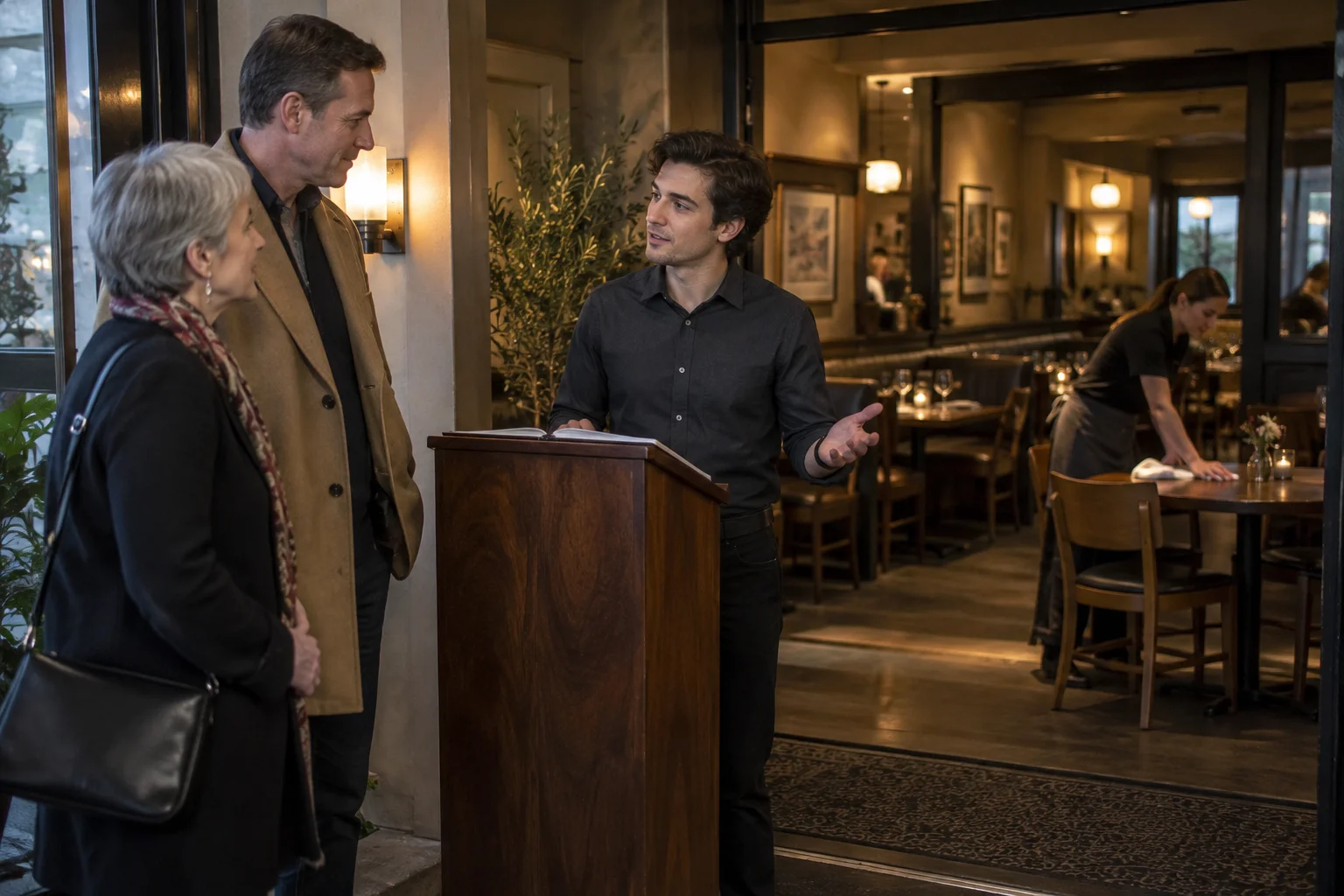
There is a particular sort of wait that begins with a perfectly ordinary sentence.
“It will be a little while.”
The sentence is placed gently in the world.
It has a coat on.
It has a job.
For a while, it does splendidly.
The Sentence Ages Badly
A party arrives a few minutes early for its reservation.
They are not angry.
They are early enough to be pleased with themselves, which is a tender and temporary condition.
The host looks at the room.
Their four-top is still occupied.
Another table is paid, cleared, and being reset.
Seven minutes later, that table becomes available and the party is seated.
Nobody has to learn the names of the small kingdoms that briefly stood between them and a chair.
That is the ideal arrangement.
But the useful trick isn’t the moment they sat down.
The useful trick is that somebody knew what had to happen before that moment could be promised.
People are unusually patient with a changed promise when the change comes to meet them.
They are much less patient when they have to come and hunt you down for it.
That is not a flaw in people.
It is a flaw in waiting rooms, airport gates, parcel tracking, and restaurants.
The old estimate sits there in a little paper crown while the actual world walks away from it.
Your First Gift Is Not a Chair
It is a present tense.
Arrived.
Waiting.
Seated.
Those are the three useful states at the door.
“Here soon” is not one of them.
Neither is “somewhere nearby, possibly examining a bookstore.”
So record when the party arrived, what wait was quoted, and what change is expected next.
It sounds comically small.
So does a bookmark.
Without one, the story becomes a fight with the page.
A Wait Is Made of Somebody Else’s Dinner
The party at the door is waiting on a table.
The table is waiting on a check.
The check is waiting on a dessert that has been ordered with real enthusiasm.
None of that is anyone’s fault.
It is simply the reason the door cannot promise from the door alone.
A wait you quote from the length of the queue is a guess about furniture.
A quoted wait built from a particular table, in a particular state, with a particular party at it, is a guess about dinner.
The second one is worth saying out loud.
The first is the one you keep to yourself.
Say What Changed Before It Turns Sour
Suppose a table is moving more slowly than the room had hoped.
The guests pay.
Four minutes later they leave.
The table is vacant.
It is not, in a burst of municipal enthusiasm, suddenly ready.
It still has to be cleared and reset before anyone can release it.
The sensible message doesn’t say “Soon!” and then change its hat.
It has three parts.
The table has not yet been reset.
The estimate has changed.
Somebody will look again at a stated point.
The guest is not being handed the floor plan, the staff rota, and a small brass key to the linen cupboard.
The guest is being given the terms of the wait before the wait becomes a surprise.
That is enough.
Often it is more than enough.
The Offer Is a Promise, Not a Smoke Signal
The waitlist has its own small diplomacy.
A party cancels the day before.
The host finds a compatible party that asked for a window the opening now sits inside.
The offer goes out.
This is not the same as sending a joyous little signal reading, “A thing has happened!”
The offer needs the table time.
The deadline for answering.
The party size it can hold.
And any term that has changed from what the party originally asked for.
Until somebody accepts, the opening is available.
It is not promised again.
That distinction is not paperwork having a marvellous evening with itself.
It is how a host avoids promising the same chair to two groups whose evenings both contain trousers.
When the party accepts, it gets a real confirmation.
Not “you are in,” which sounds as though a secret society has mistaken dinner for an initiation.
A new reservation, with its own time and its own record.
An Empty-Looking Table Is Not Everyone’s Table
The fact that a party of three can take a newly released table does not mean every waiting party can.
A four-top may be the right next home for one group.
It may be a future component of a larger table for another.
Chairs are not being difficult on purpose.
They simply have loyalties.
Which is why a wait message needs an owner.
The system may send the note.
A person still has to know whether the room has changed again.
If a table slips, the message needs the changed fact, the revised interval where one can be confirmed, and the next check point.
Not an apology made of vapor.
And not a dazzlingly exact minute assembled from hope and the fact that the guests at the next table have looked at their coats twice.
False precision is worse than a range.
It feels like the restaurant has brought a ruler to a weather report.
But Do Not Turn the Update Into Its Own Waiting Room
There is a proper limit to all this cheerful notification.
“Still waiting?”
“Still waiting.”
“Great news: still waiting.”
An update is useful only while it says something your guest can act on.
And once your promised range has failed, a reachable host matters more than a clever alert.
A person can look at the party, the table, the changed condition, and whatever recovery is actually available.
That is not a failure of the system.
That is the system remembering that hospitality includes a person.
And the recovery has to be a real one.
A drink while the table finishes.
A seat at your bar, offered as a place rather than a consolation.
An honest choice between waiting longer and coming back on a night you can actually hold them.
What it must not be is a sympathetic face with nothing behind it.
A party that has been told three times that it is nearly there has been managed, not hosted.
Then Read the List Honestly
After service, resist the idea that every name on the list was the same kind of success.
Three questions do most of the work for you.
Did your offers go out at all when openings were released?
Were they accepted?
Did the accepted ones arrive?
If few offers went out, the matching information is probably weak.
If offers go unanswered, the time may be wrong or the response window too thin.
If accepted offers do not arrive, the reminder or the policy is asking for attention.
A long list is not a victory parade.
It is merely a long list.
Nobody Should Have to Become an Oracle
The room is neither a wishing well nor a grievance tribunal.
It is a place where tables move through states, and where your guests deserve to know when the state affecting them has changed.
The best update does not announce its machinery.
It doesn’t boast that table status, party mix, cancellations, and resets have all been recomputed behind one plain sentence.
It simply arrives before the old promise turns sour.
The party sees that the wait has changed.
The party sees what the change means.
The party sees when somebody will look again.
None of which requires them to understand your room.
Then, if all goes well, they sit down.
And you never have to pretend you could see the future.