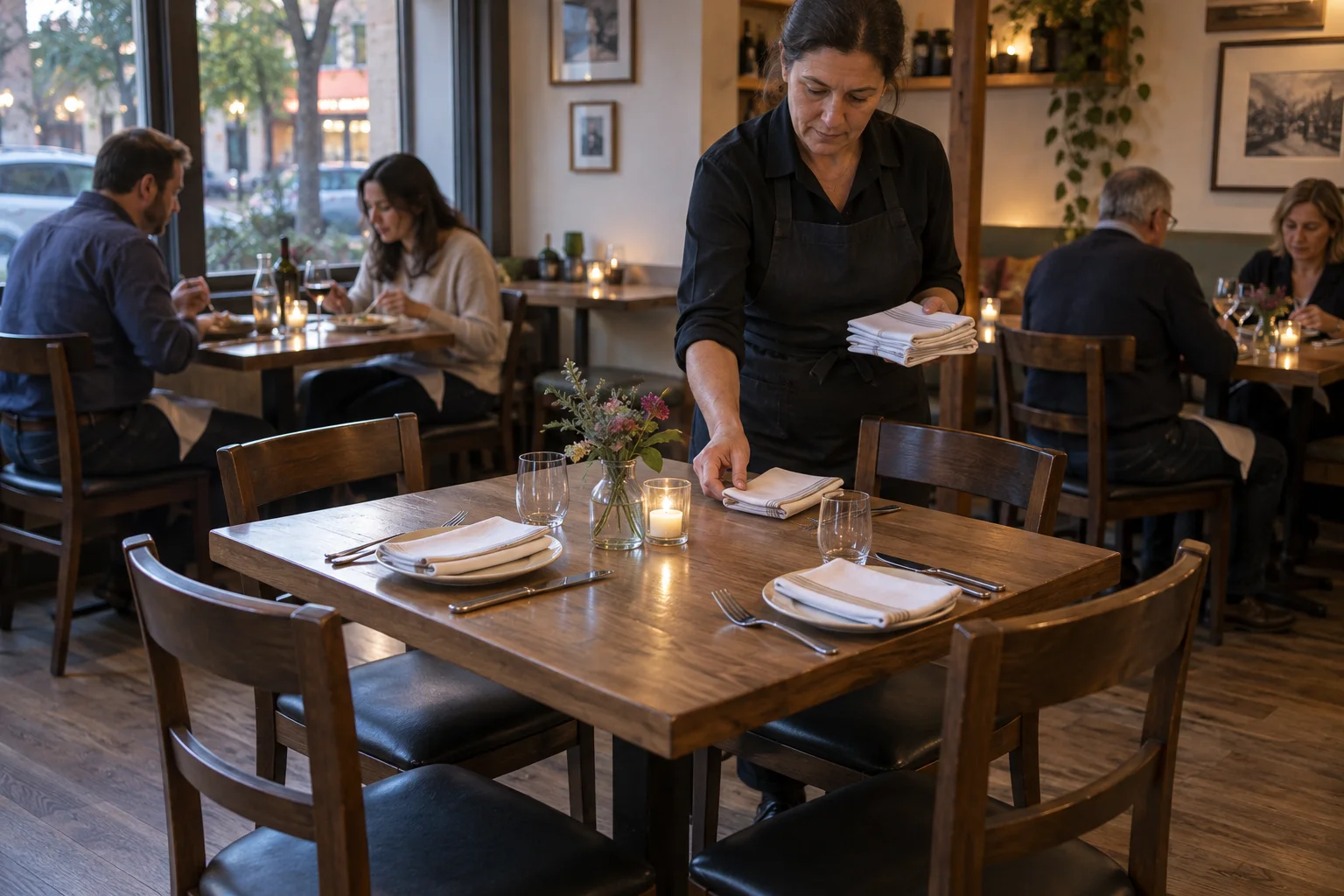
There is a particular species of injustice that appears on a Saturday evening.
It has chairs.
It has napkins folded into patient little triangles.
It may have a candle, doing its best to look available.
And it is empty.
Meanwhile a party of four is standing at the host stand.
Fully assembled. Wearing coats.
Wearing, also, the expression of people who have located a chair-based conspiracy.
The table is right there.
The table has not yet learned to be subtle.
Is That One Available
It is a completely reasonable question.
It’s the only reasonable question available to a person who can see an entire unoccupied republic of cutlery.
But the answer is often not yes or no.
The answer is a small weather system.
Half an hour before a rush, somebody walks the room.
And discovers that the cheerful little floor plan has been lying.
A table has stacked chairs.
A table has a blocked route.
A table needs a high chair that is currently attending to another family.
A table has no server assigned.
A table is clear, but not reset.
A table is ready, but held.
It is held for a near arrival whose requirements have the irritating quality of being real.
For the next hour, the room is not made of chairs.
It is made of parties, sizes, occasions, arrivals, routes, and a kitchen that has opinions.
Your map of it has several states.
Unavailable. Dirty. Resetting. Ready. Held. Released.
To the guest, all six are called “that empty table.”
That is not the guest failing an exam.
It is the table concealing its paperwork.
The Furniture Has Commitments
An empty four-top may be a bridge component.
It may need to meet its neighbour shortly and become a seven-person kingdom.
Or it may be the next sensible place for a party of five.
One of whom uses a wheelchair.
Which turns the apparently simple number five into a different furniture problem.
So ask in the first minute.
Size, arrival, whether everyone is present, a child seat or access need, and anything the party volunteers.
Not because a meal should begin with an intake form.
Because five people can mean several different rooms.
Then comes the famous four-top.
A party of four has waited nearly twenty minutes.
A pair is also waiting, and a two-top is likely to open next.
The four-top is ready now.
In this small constitutional crisis, the four ought to receive it.
Unless that four-top must become half of a seven due shortly.
Then it may be held.
Not because you enjoy the sight of a waiting party.
Because seating the four makes the seven impossible a few minutes later.
Furniture is very bad at explaining this about itself.
It just sits there in public, looking smug.
The Empty Chair Is Not a Verdict
The rule is not “never seat a pair at a four-top.”
The rule is not “make every chair earn its keep this instant.”
A pair at a six-top for eighty minutes leaves four chairs unused for eighty minutes.
Multiply the two and you get three hundred and twenty seat-minutes of very quiet capacity.
Sometimes that is exactly right.
Perhaps the room is quiet.
Perhaps that table is the accessible one.
Perhaps no party of six is coming.
The number is a raised eyebrow, not a jail sentence.
Your room needs the next quarter hour as much as it needs this one.
That is the table’s secret career.
It is a buffer.
Not a private club for napkins.
The Book Is in on It
The reservation book is also in this conspiracy, although it has better handwriting.
Three weeks out, it offers only the arrival times it can promise.
Not every chair that currently exists in the building.
A party requests seven o’clock for four.
You may accept half past six.
Those are not the same fact wearing different watches.
The request says where the party wanted to be.
The acceptance says what the room dared promise.
Keep both.
Later that party might drop from four covers to three.
The old four should not vanish as though it had been a dream involving a reservation button.
The change gets a time and a channel.
It gets the old size, the new size, and an actual event in the record.
Only then is one cover free to invite elsewhere.
A cancellation the day before is not simply rubbed out with a thumb.
It can become an offer to a party that asked for a window you could not fill.
Until that party says yes, the opening is released but not promised again.
This is the difference between an empty chair and an available future.
It is delicate work.
Do Not Call a Party Absent Because the Map Is Sweating
A party is marked arrived when you have actually identified it.
Not when an “on my way” text sends a small electronic pigeon across town.
After your own published release point, a late or absent record can free the table.
Before that, taking it away is not efficiency.
It is a broken promise with menus.
What the Person in the Lobby Actually Needs
They do not need the interior architecture of any of this.
They need a promise that can survive contact with the dining room.
“About twenty to thirty minutes; the next table for four has just asked for its check.”
That sentence has a floor underneath it.
“Soon” is a balloon.
So for every waiting party, keep six things.
The arrival time.
The lower and upper end of the quote.
The updates.
The actual seating time.
The party size.
And the condition of the table likely to serve them.
That’s a great deal of record-keeping for something involving a buzzer and a banquette.
It is also what stops the buzzer from becoming a tiny electronic liar.
A party told twenty to thirty and seated at twenty-eight has received what it was promised.
Seated at thirty-eight, it is eight minutes late.
But if you gave a credible new estimate at twenty-two, the evening hasn’t been abandoned to the furniture gods.
Look at the queue every ten minutes or so.
Look again whenever the room changes.
A large walk-in. A late departure. A closed section. A missing colleague. A kitchen that has slowed.
Update before the old promise reaches its upper edge.
That is not glamorous.
Neither is changing a tire.
Both are better done before the motorway is involved.
The Table Has a Five-Act Life
From sitting down to hello.
From hello to order.
From order to being ready to leave.
From ready to leave to leaving.
From leaving to ready for the next party.
Those are the five intervals hiding inside a turn.
The whole thing runs from seated to ready.
But it matters which gate has a goat standing in it.
Take two rooms with the same median turn of seventy-two minutes.
In one, the slowest tenth of tables runs past two hours.
In the other, the slowest tenth is done in under ninety minutes.
Those two rooms are not telling you the same bedtime story.
One has a much longer tail wandering through the hedges.
It is harder to promise against.
And it needs reading by daypart, party size, table type, section, service team, and condition.
One dinner average can contain brisk pairs, ordinary fours, and unhurried sixes.
All attempting to wear one trench coat.
The average is not lying.
It is just not enough company for dinner.
Seatings Arrive in Quarter-Hour Storms
Neither is the final number of diners.
Eighteen covers spread through three sections and several stages may be a breeze.
The same eighteen as three tables of six, in one section, is different weather.
Plates, menus, greetings, and orders all remembering the same appointment.
So watch table stages every few minutes.
Put greet times, order fires, kitchen tickets, and payment requests on the same little map.
If your usual greeting jumps from two minutes to seven right after each burst, the burst has found your culprit.
If it was already seven before the burst, the culprit was downstairs sharpening a pencil much earlier.
This is why an empty table sometimes waits.
It is not being saved from a guest.
It is being saved for a room that has not happened yet.
But Do Not Let the Buffer Become a Monument
There is a point where all this becomes unbearable.
Hold a usable table with no near-term fit to protect, and the buffer turns into an empty monument.
Let a quoted wait outlive the constraint that caused it, and you have converted caution into exclusion.
Protect a section so completely that guests can’t see a path into it, and that isn’t pacing.
It is a very quiet refusal.
The remedy is not a lecture about chairs.
It is a real update.
It is releasing the table the moment its condition disappears.
And after a difficult peak, it is checking your seating decisions against the map.
Who waited. What fit. Which section could receive them. What was promised. What greeting followed.
Three wrong states in sixty checks is a good night with a rough patch.
Three wrong states in five checks is a small disaster wearing a percentage sign.
Then the Book Gets Its Own Reckoning
In one seven o’clock band, eighteen booked covers can become several things at once.
Three timely cancellations.
Three waitlist conversions.
No absences.
And eighteen people who actually walked in.
That is not merely a full room.
It is a record of how the room became full.
And the waitlist earns its place by three rates.
Not by collecting names like a guestbook at a haunted manor.
Offers sent from released openings.
Acceptances from offers.
Arrivals from acceptances.
An offer that arrives in time and fits the party has done more than fill a chair.
It has let one cancelled future meet one actual dinner.
Without either of them running into the dinner already under way.
And the Candle Says Nothing
Perhaps the party at the host stand is seated a few minutes later.
The server says hello before the menus have had time to become emotionally complicated.
The next party is not stranded because a seven-top vanished into history.
The candle never explains any of this.
It simply continues its little flame.