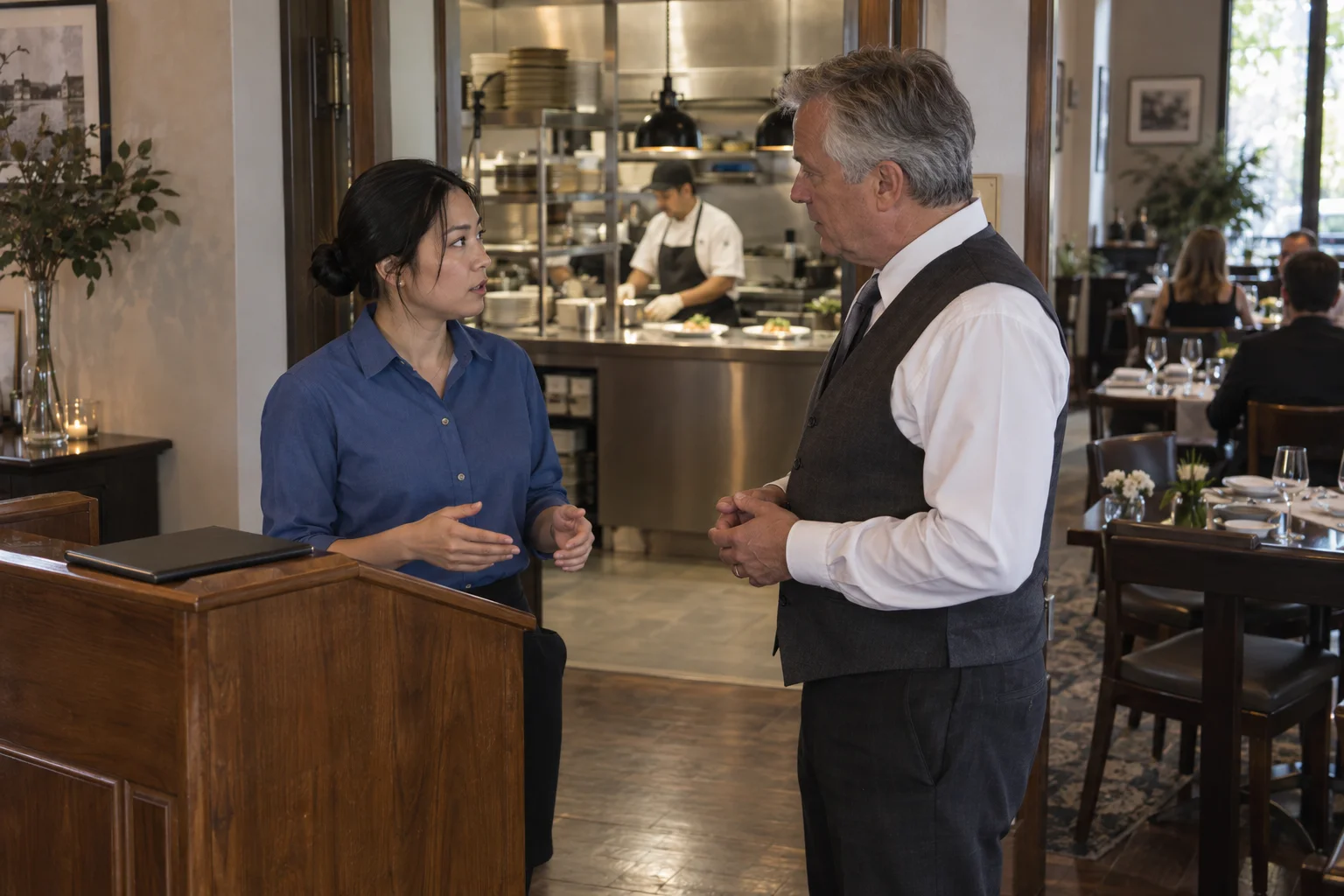
There is a particular kind of empty chair that can make a person feel personally insulted.
It is right there.
It has a napkin.
It has the faint air of someone who has been waiting all evening to be useful.
And yet the person at the door says it will be a few minutes.
The chair, meanwhile, is conducting itself like an upholstered betrayal.
This Is Unfair to the Chair
The chair has been given a job it cannot do.
A chair can receive a bottom.
It cannot receive a round of drinks.
Or questions about the menu.
Or a request for a high chair.
Or a sudden cloud of modified orders.
Or the exact moment when every other table decides it would like the bill.
Those things require people.
And a small, fiercely defended patch of time.
What Stands Between a Check and a New Party
A party arrives a few minutes early for its reservation.
Its planned table is occupied.
Another table nearby is paid and vacated.
It still needs clearing and resetting.
So on your map, four states stand between that check and the new party.
Paid. Vacated. Reset. Released.
That is the kind of information that makes a floor plan look like it has acquired a secret second floor.
You are not looking for a chair.
You are looking for a table that can be released without turning its new occupants into an administrative weather event.
Then the alternate table is truly available.
Menus are collected.
The party confirms it is ready.
The table is marked seated.
And the person serving that area is told that four guests have arrived in section B.
One of them needs a high chair.
The reservation has moved.
There may be a promise about time.
The server acknowledges all of it.
That last detail is not romance.
It’s how a room avoids the ancient tragedy of a table that exists on the map but has not yet been discovered by a human being.
Two minutes later the table is greeted.
Two minutes is nothing in geology.
It is quite a lot when four people are deciding whether you have accidentally seated them in a museum exhibit.
They order two cocktails, a soft drink, and an appetizer.
Now the chair has done its work.
The Next Creature in the Story Is the Order
An order has five lives.
First it exists.
Then a named cook has seen it and accepted it.
Then someone begins the cooking that cannot be politely undone.
Then it is ready to be put together.
Then, and only then, it has been physically received by the person who carries it onward.
An order sitting on a ledge by itself is not done.
It is a small orphan in a very hot neighbourhood.
You do not need a meeting about any of this.
You need one live signal.
Can the people receiving the next table receive its first little parade of orders?
Not eventually.
Now.
Arrivals Are Not the Same Dinner With a Different Hairstyle
A forty-seat room can receive twenty-four diners in a gentle, evenly spaced drift.
The same twenty-four arriving inside twenty minutes are a different evening entirely.
Greetings arriving together.
Drinks arriving together.
Orders arriving together.
Plates arriving together, like a civic delegation that has chosen the worst possible hour to call.
Which is why you sometimes look at an open table as though it has a prior appointment.
The table may be clean.
The room may look calm.
But the place where plates are checked and handed over may be holding partly made dinners, an older order that has stopped moving, and a station whose little square of room has been full for a quarter of an hour.
That station is not merely busy.
It is making a case.
A Bottleneck Has to Prove Itself
The case needs three pieces of evidence.
Work building up in front of it.
Near-continuous use.
And somebody downstream waiting because nothing can get past.
Otherwise everybody just points at the most dramatic pile and hopes it feels ashamed.
So during the rush, somebody glances every couple of minutes.
The oldest accepted order.
The crowded station.
The plates that have begun but cannot yet become dinners.
The next large table.
The next altered request.
It isn’t a conference.
Nobody brings a flip chart.
It’s the kitchen checking its own weather before you send in another storm cloud.
Hold Has to Mean Something
So does send.
This is the part that needs an actual signal, rather than a chef raising one eyebrow toward the door.
That is a beautiful form of communication.
It is unreliable across several walls.
A useful message has three fields.
The section. The constraint. The next look.
“Section B: fryer backed up, five baskets waiting, check again in two minutes.”
That lets you decide something.
“Kitchen is slammed” does not.
It is an emotional condition rather than a usable fact.
And it leaves your guests outside while the room performs an avant-garde piece about empty furniture.
With a real signal you can tell the party their table is being prepared, and mean it.
You can release them into another section, if that section is ready to greet them.
Or you can wait until the queue has somewhere to breathe.
The important thing is that the door and the kitchen are discussing the same dinner.
Not two adjacent dinners with a shared address.
Corrections Get Expensive Very Quickly
A correction made in the first few seconds after an order is entered is still a correction.
The same correction discovered after cooking is a remake.
That is a much more expensive form of handwriting.
Which is why an odd request needs to reach the person who can act on it.
Not the memory of a server who is simultaneously greeting a new table, explaining a drink substitution, and locating a missing fork.
The first order from a newly seated table is not just a new line on a screen.
It is a new family of promises.
Before service, the kitchen makes its own preparations.
Portions. Tools. Labels. Clean landing places. Display. The person who will receive finished plates.
None of that makes it possible to seat the entire city at once.
Nothing does.
It does mean a cook is less likely to abandon a live station in search of a pan while you are welcoming another perfectly innocent party of four.
But Do Not Let the Kitchen Acquire a Moat
That is the counter-failure, and a vague signal builds it.
Guests can see the drawbridge up.
They cannot see why.
An apparently open room held behind “not yet” with no explanation isn’t pacing.
It is gatekeeping with cutlery.
The answer is not to march every waiting party into the nearest chair.
Nor is it to make the chair a public monument to mysterious operational wisdom.
It is to make the signal specific enough that you can offer a real next step.
Then Check Whether the System Told the Truth
For a sample of orders, keep five marks on one clock.
Accepted. First seen by a station. Begun. Ready at the counter. Physically taken onward.
From those you get the wait to be accepted, the time spent making it, the time it sat at the counter, and the whole journey.
The usual middle number matters.
So does the long tail, where the older, stranger delays are living under the furniture.
Compare like with like.
The same lunch window on three similar weekdays.
Not one quiet Tuesday against a promotional Saturday that arrived wearing a brass band.
Keep the people assigned, anything unavailable, equipment changes, unusual events, and the kind of order involved.
Otherwise a delayed vegetarian plate, a multi-course table, and a delivery bag become one large, inaccurate vegetable.
And a change is not successful because somebody says the kitchen felt quicker.
It works only if flow improves or holds, mistakes do not rise, and nobody has acquired a new dangerous reach, collision, or skipped control.
Give it at least two comparable services before it receives a tiny crown.
No crown is permanent.
Another table can move the trouble from the grill to the counter, where it will sit quietly pretending to be a different problem.
Nobody Sees It When It Works
This is why the host stand cannot promise a seat the kitchen has not made ready.
Not because your guests are impatient.
They’re hungry.
That is a perfectly reasonable state of being.
And not because the kitchen needs protecting from them.
The kitchen is trying to receive them.
The chair is held until a person who can greet, a place that can make, and a person who can carry all agree to meet the order at the same time.
When that agreement works, nobody sees it.
The host smiles.
The table is sat.
The drinks arrive.
The appetizer arrives.
And the chair, which has done absolutely nothing but wait, receives the credit it has always believed it deserved.