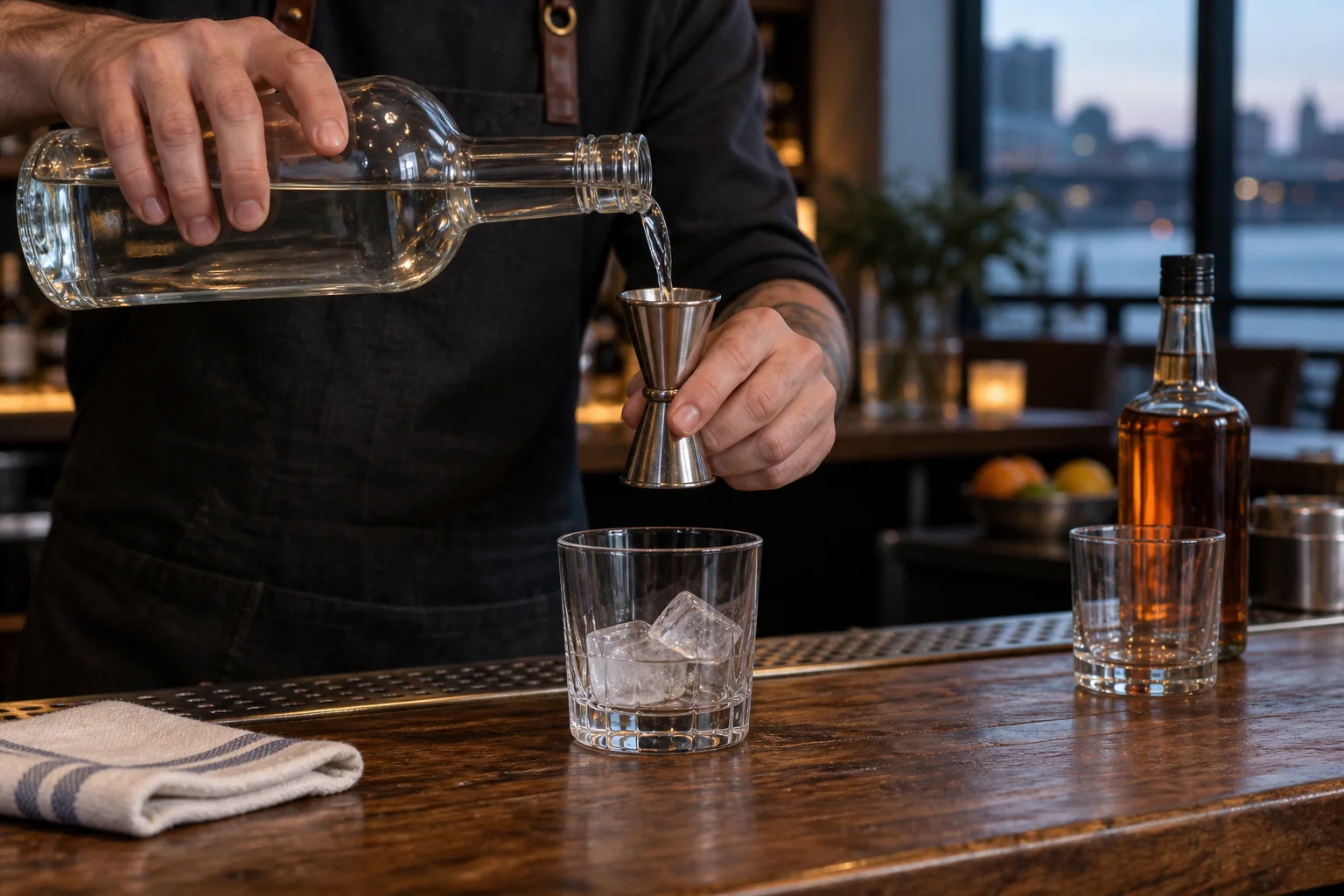
There is a first question at a bar that looks as innocent as a napkin.
“What are we drinking?”
Behind it stands the entire back bar.
There are bottles in ranks.
There are bottles in ranks behind the first ranks.
There are bottles turned toward the room with the solemnity of minor ambassadors.
And there is a person who has just sat down.
They have looked at all this glass diplomacy.
They have discovered that thirst did not prepare them for an oral examination.
The Fast Question Is a Small Mercy
“A house gin and tonic?”
Now there is a first stone in the river.
Your guest can step on it, or choose something else entirely.
That is the useful kind of default.
It doesn’t suggest they failed a quiz about gin.
It doesn’t conceal the named bottle they were about to ask for.
It merely gives the evening somewhere to begin.
The Well Is a Promise, Not a Hole in the Ground
The word sounds as though the bottle has been lowered into the earth on a rope.
It is a practical promise.
This is the brand your house pours when nobody names another one.
It has to be available.
It has to be honestly priced.
It has to be defensible as the drink it says it is.
Otherwise your first question is a trapdoor with a lime wedge on it.
And there is a real difference between “gin and tonic?” and a guest saying “Tanqueray and tonic.”
The second sentence has named its bottle.
The bottle is no longer scenery.
It is the order.
That distinction is supposed to be made before anything is poured.
A generic key can let any of four vodkas pass as “vodka soda.”
It spares somebody a few taps.
It also creates a drink whose own history cannot be found later.
Make the opening suggestion clear, because clarity is generous.
Make the record clear, because the truth is useful when the lights come up.
Then the Economics Arrive, Wearing a Coaster
Which is a grand phrase for a person saying, quite pleasantly, “Would a house gin and tonic suit?”
Say your well gin costs a dollar and change.
It goes out in a nine dollar gin and tonic.
Now the guest says no thank you.
They ask for the named gin instead.
That pour costs more.
The drink sells for eleven.
The spirit share has become less tidy.
The sale has not become worse.
Before everything else the drink costs you, the well leaves a little under eight dollars.
The call leaves a little over nine.
Percentages are very fond of arriving in small jackets and announcing themselves as the whole story.
They are not.
The dollars left over have work to do.
People. Rent. Glassware. Ice. And the fragile civic order of a busy Saturday.
None of which means marching every guest, smiling, toward the bottle with the best-looking return.
That is a sales pitch wearing an apron.
The Well Is Designed, Not Cheap
It is not the cheapest liquid available.
It is a bottle you can buy reliably.
And serve without inventing a new conversation every time somebody asks what the house uses.
A call drink can contribute more even with a higher percentage.
The well can be the better first answer when it is the right answer.
Both facts are allowed to sit at the same bar.
Your guest never sees the arithmetic arrive.
They see a drink that sounds good.
That is how it should be.
A Spoken Default Moves Faster Than a Printed One
Which is exactly why it deserves a notebook.
Not a romantic notebook.
An extremely unromantic one, kept beside the charm.
If you change the house suggestion, write down what it was before and after.
The price.
The cost you were using.
Whether the drink was actually available.
Which drinks it could have replaced.
And whatever weather was moving through the business that month.
Because the interesting question is not whether the suggested drink sold more.
It is whether the drinks beside it sold less.
If the target picks up a few hundred dollars while its category quietly loses a chunk of the same, the first drink hasn’t won a parade.
It has opened a question.
And a drink cannot prove it was unwanted if nobody could have chosen it.
Off the menu. Out of stock. Or simply invisible at the moment the question was asked.
The Room Has Measurements Before It Has Opinions
Before the room starts making requests at conversational speed, somebody has to know what can be honoured.
Which wells. Which calls. Mixers, ice, garnishes, glassware, tools, recipes.
The ice chest has a size.
So does the speed rail.
So does the sink.
None of them is negotiable at half past eight.
Your speed rail is not a shelf where the prettiest labels enjoy the view.
It is a map.
Frequent spirits hold stable places on it.
Two matched wells need the same left-to-right map.
Or a published reason for the difference.
Otherwise, during the rush, a bottle becomes a small fugitive.
There is no glamour in searching.
Lose a few seconds reaching for a frequent call bottle.
Do it a hundred-odd times in one shift.
You have manufactured a quarter of an hour of reaching.
The guest experiences this as a delay, if they experience it at all.
The bartender experiences it as one more tiny journey across a crowded counter.
You experience it as a choice you made while arranging bottles.
Speed Is Not Permission to Guess
A jigger makes a portion repeatable.
So does a measured spout, a dispenser, or an approved batch.
“Experienced bartender” is not a unit of measure, however magnificent the wrist action.
And the call bottle has to stay the call bottle.
From the question all the way to the glass.
After Close, the Party Becomes Paperwork
Opening counts. Receipts. Transfers. Waste. Closing counts. Itemized sales.
What you opened with.
Plus what arrived.
Minus what remains.
That is what physically left.
Your recipes and your sales will predict a different amount.
The distance between the two is not a detective novel with an employee already cast as the villain.
It may be a spill.
A remake. A bad count. A bottle that moved to the other bar. An over-pour. Or a key that promised one thing while the rail supplied another.
A gap of three points on ten thousand dollars of sales is three hundred dollars.
It is an invitation to look.
Not a permission to accuse.
But Do Not Let the Welcome Become a Shove
The whole apparatus can be generous.
It can also become clever in the bad way.
The bad way hides the good alternative behind a fog of names.
The bad way pours a different call because the requested bottle is awkward to reach.
The bad way hears “I like something dry.”
And somehow answers with the bar’s favourite expensive sweetness.
Then your friendly first question has become a shove.
Nobody enjoys being managed by a sentence pretending to be a welcome.
The Better Bar Does Less Theatre
It offers the house drink as a useful starting point.
It keeps the alternatives legible.
It honours the name a guest gives it.
It measures what changed without declaring that the change was destiny.
And somewhere in the soft administrative miracle of a good opening round, a guest says yes to the gin and tonic.
Takes a sip.
And is never asked to admire the system.
Which is ideal.
They have a drink.