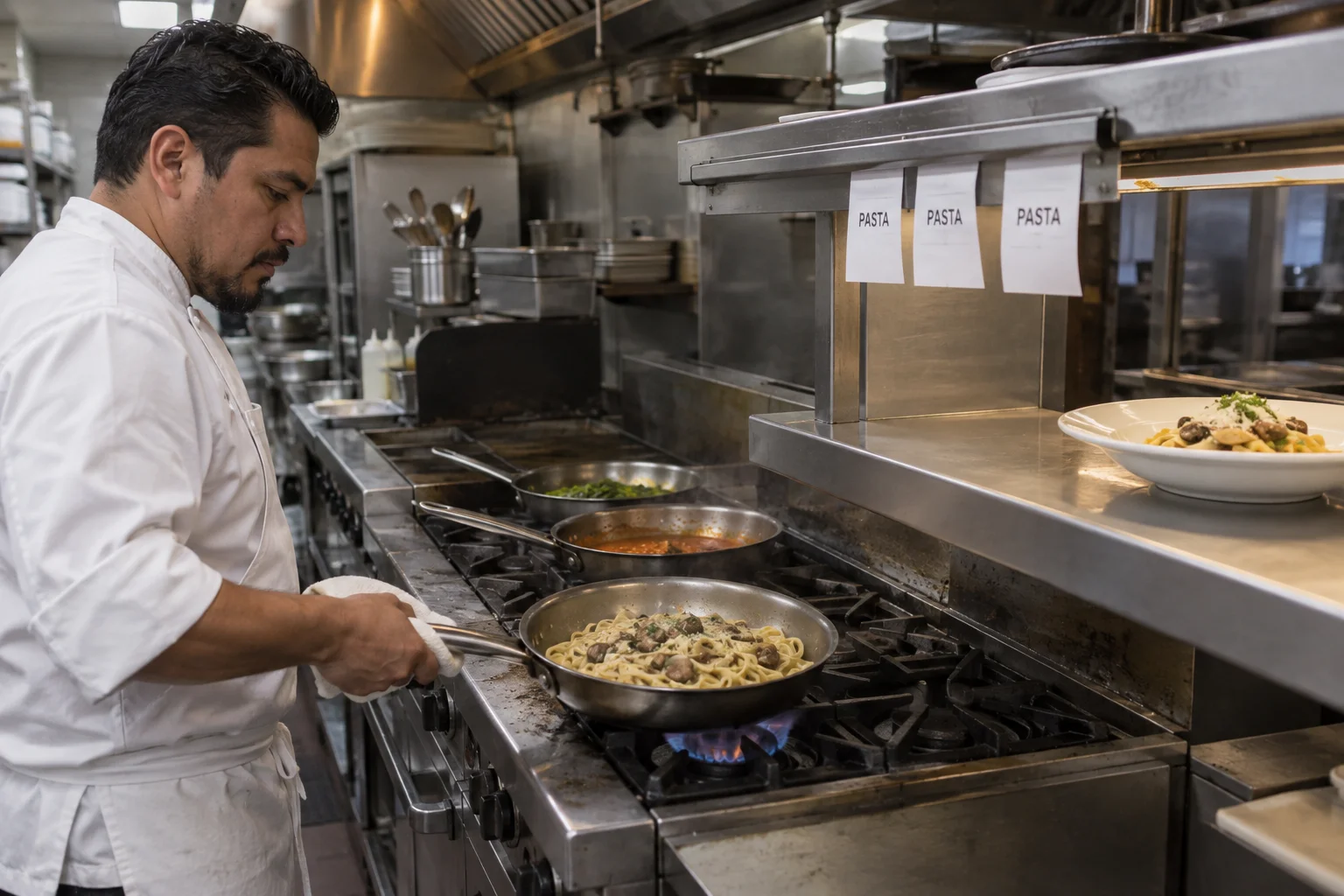
A featured dish can be commercially successful and operationally unreliable at the same time. Menu placement changes what guests notice and choose.
The kitchen then receives the resulting order mix as a production condition, not as a design exercise.
If the feature concentrates demand on a dish with an unproven portion, garnish, equipment, or availability assumption, a sales increase can arrive with inconsistent output and a weaker guest experience.
The goal is not to avoid featuring a dish. It is to test the feature as a change to both the guest opportunity set and the service system.
The decision should show whether the featured item improves contribution and choice quality while the approved recipe remains reproducible at the actual station.
A feature is not complete when the sales report moves; it is complete when the record can explain the movement and the kitchen can keep making the promised output.
Define the feature as a treatment
A featured position may clarify a good choice, but it also changes the observation later called popularity.
The feature should therefore be named as a treatment in the test record, with the menu version and the guest channel in which it appears.
Measure the item within a comparable category, on two axes: menu-mix share and unit contribution margin.
A reported sales count without its category denominator cannot establish whether a feature changed guest choice among substitutes.
Keep exposure beside the share.
A dish absent for a third of the period, hidden in a delivery channel, or available only in a short daypart has not received the same opportunity as an all-day item.
Units per available service is the useful companion figure. It does not replace menu mix, but it prevents an availability failure from being described as a demand verdict.
Read contribution in currency as well as food-cost percentage, because the item with the tidier percentage can leave fewer dollars behind.
The feature test should retain price, cost version, unit contribution, and total contribution, so a change in sales does not obscure the commercial result.
Record the comparison before changing exposure
Every feature requires a before-and-after ledger.
It records baseline and post dates, item and category results, menu version, price, cost version, availability, the treatment, likely substitutes, and external conditions.
For a four-week description test, comparable day-of-week distributions are used where practical.
A shift from 6.0% to 8.5% is a 2.5-percentage-point change, and the record retains the unit counts and category denominator rather than presenting a percentage increase by itself.
Inspect at least the target item’s mix, its total contribution, comparison-category contribution, movement in named substitutes, and availability or guest-friction indicators.
If target contribution rises while category contribution falls, the result is not an unqualified win. It may support another defined objective, but the displacement must be visible.
Where practical, a treatment staged by daypart, channel, or location has a contemporaneous comparison rather than relying on two different calendar periods.
Inspect the menu that guests actually use as well.
A check at full mobile zoom, at printed proof size, and on the real ordering device confirms that the item name, dietary statement, price, modifier, description, photograph where used, and order button all point to the same offer.
A narrow mobile viewport can disclose a price or order control that a desktop proof hides.
A feature cannot be evaluated as a clean test if the offer is incomplete or inconsistent at the point of choice.
Validate the live recipe before increasing demand
The recipe standard begins with one sellable output: a plated dish, a takeout version, a sauce, or a base component.
The card identifies its intended yield, owner, current menu description, parent or component status, and the inputs in preparation order.
A feature may change the number of orders arriving together, but it does not make an ambiguous recipe more definite.
The standard must already state the ingredient form, preparation state, pan or vessel, equipment setting, sequence, and service output.
Test the recipe at the scale and with the equipment that will produce the featured dish.
A formula that succeeds in a small saucepan can fail in a large kettle, because surface area, heating rate, mixing, and reduction all differ.
The trial log records recipe revision, date, operator, ingredient lots or supplier formulation where meaningful, equipment, raw input, ready-to-cook amount, finished batch weight, usable portions, and unserved remainder.
Taste and appearance alone do not prove that the expected output will survive a concentrated run of orders.
Compare the actual finished yield with the approved yield, in weight and as a percentage, so that a shortfall becomes a question rather than a shrug.
The service layer needs the finished portion weight, count or volume; exact utensil; vessel; component order; garnish identity and count; sauce location; and pass rejection criteria.
A dine-in plate and a takeout version may share a batch card while requiring different service cards, because a bowl and a plate do not necessarily carry the same arrangement or sauce placement.
Measure the production consequence during service
Promoted volume should trigger observations at the station, not only a post-period sales report.
For each portioned component, take a sample of portions at the beginning of service, a second during peak use, and a third when a new batch or employee takes over.
Record the mass of every sample, the tool, the level or packed fill condition, product condition, operator, mean, and range.
A tool that works at opening may deliver differently after a product settles or warms.
Inspect the individual portion and the batch separately. The individual check catches an out-of-range serving before it reaches a guest.
The batch check asks whether mean portion and expected number of portions agree with actual yield. When both drift, inspect the scale, tool, batch viscosity, and primary measure.
When one operator drifts, retraining uses the actual tool and approved reference. A short batch is not corrected by quietly directing later cooks to make smaller portions.
Check the featured plate at the actual pass or packaging point.
The visual scorecard uses six binary checks where relevant: correct vessel, correct protein or principal component, correct portion, correct component position, correct garnish count, and clean presentation.
A pass or rework decision is more useful than an artistic ranking.
Reason codes such as missing garnish, wrong vessel, misplaced component, over-portion, under-portion, and rim condition turn a failed plate into a repairable production question.
Audit the card as a connected record, not as a document that happens to be available.
The audit checks seven links: current revision, parent-to-component reference, ingredient specification, approved supplier or substitute, yield, service control, and allergen source.
The reviewer traces one plate component through its component card to a current purchased item or supplier statement.
A new vendor formulation, repeated portion exception, unavailable vessel, equipment change, guest-facing complaint pattern, menu change, or package change triggers review rather than an informal shift adjustment.
Decide with the whole result
Use the result to classify both the menu treatment and the recipe evidence. A clear menu signal has consistent item, category, and exposure evidence.
An uncertain signal is near a boundary, affected by a simultaneous change, or contradicted by substitute movement.
An insufficiently observed signal means the dish did not receive a meaningful chance to be chosen.
Recipe evidence is accepted when it fits the approved tolerance and visual standard, corrected when a local identified error is fixed and recorded, and revalidation required when input, equipment, process, yield, allergen source, or expected output no longer matches the card.
Do not let promotion become self-defeating.
A feature that buries an equally suitable choice, makes the item intermittently unavailable, or produces repeated portion and plate failures has stopped clarifying the menu.
It is instead transferring a design choice to the guest as delay, inconsistency, or a remake.
The appropriate response may be to alter the feature, recipe, equipment plan, substitute status, service card, or release evidence. It is not to call every additional order a win.
The strongest feature remains quiet.
It gives a guest a clear choice without concealing another suitable one.
It gives the kitchen one current recipe, a usable tool, a current plate reference, and a record of what changed. Its review keeps the same measures together:
- target-item mix and availability;
- unit and category contribution;
- named substitute movement;
- recipe version, station-capacity evidence, yield, portions, and service tool;
- plate failures, locally defined remake rate, and guest-friction indicators; and
- the decision state and next review date.
When those measures move together, the restaurant can promote a dish with confidence. When they do not, the feature has supplied useful evidence before the inconsistency becomes the guest’s problem.