There is a moment, somewhere between the first glance and the first sentence, when the menu takes over.
The server has not arrived.
The water has not arrived.
The little bread basket, with its brief and vulnerable optimism, has not arrived.
But the page has.
It lies there pretending to be a list.
This is an old and accomplished lie.
Begin With the Page
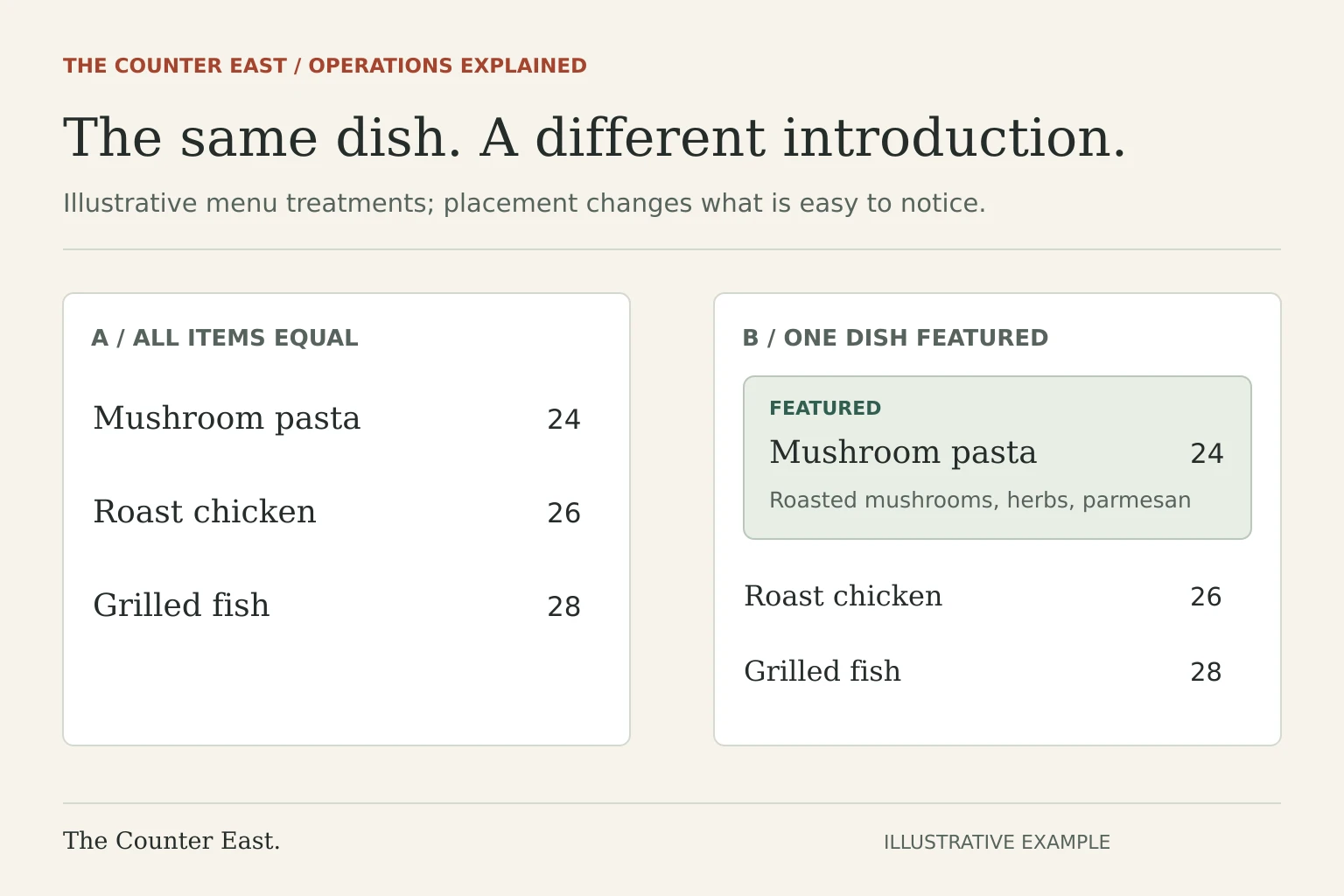
The page has a featured corner.
It has a grand avenue of white space.
It has a photograph that has been given diplomatic immunity.
One dish gets a lavish paragraph.
Its neighbour gets a name, a price, and a small wooden chair in the back.
Nobody is foolish for beginning where the page points.
Everybody begins where the page points.
That’s what pages are for.
Put a dish where the eye lands.
It has an audience before the server says a word.
Put the same dish in a thicket of type.
Now it must fight its way out carrying a parsley sprig.
The two dishes may be equally delicious.
They have not been equally introduced.
So the menu is not a diary of what diners wanted.
It is part of the weather in which wanting occurs.
Two Hills on the Map
There are two little hills on your map.
One is how often a comparable choice gets picked.
The other is what remains after the cost of making it has gone home.
A twenty-four dollar entrée with a nine dollar cost leaves fifteen dollars.
A sixteen-fifty entrée with a four-fifty cost leaves twelve.
The second dish has the tidier percentage.
The first dish leaves more actual dollars.
Dollars pay for the room.
They pay for the people in it.
They pay for the mysterious electricity required to make a lemon look expensive.
This isn’t an argument that the bigger number is king.
It is an argument that percentages and dollars are cousins, not twins.
Your menu is full of relatives who arrive wearing similar hats.
They cannot, on that basis, be trusted with the family finances.
Nor should the dessert be made to wrestle the entrée.
An eight dollar dessert and a twenty-eight dollar entrée are not competing for the same place in a person’s evening.
They are different provinces.
Compare the things that can actually replace one another.
One entrée beside another.
One cocktail beside another.
Otherwise the numbers stand in a field, waving at each other from very far away.
Popular Needs a Chaperone
Even the word “popular” needs one.
Say eighty-four chicken entrées leave the kitchen.
Out of six hundred entrée selections, that is fourteen percent of the choice.
That’s a fact with a denominator.
Without the six hundred, the eighty-four is a lonely little drumbeat.
It cannot tell you whether chicken was often chosen by the people offered chicken.
It certainly cannot tell you whether the chicken was there.
A dish absent for nine days of a month is not losing a fair election.
For nine days it was behind a curtain.
A dish that appears only at lunch has met fewer hungry citizens than an all-day dish.
The page is doing its work before any count begins.
So is the stockroom.
So is the hour.
So is that glowing photograph, which has made one pasta look as though it were raised by extremely attentive wolves.
The Feature Is a Treatment
Suppose a featured spot moves a dish from seven percent of its category to ten.
The page deserves some credit.
It doesn’t deserve a coronation.
Price, availability, staffing, and season have all been wandering around the same story.
They may have fingerprints on the pasta.
So keep a small notebook beside your triumph.
Write down when your test started.
When it ended.
Which version of the menu.
The price.
The cost.
How many services the dish was actually available for.
Which dishes it could have replaced.
And whatever else was happening in the world that month.
A share that moves from six percent to eight and a half has moved two and a half points.
That’s not a trumpet blast.
It does not announce that the dish has become forty percent more beloved by humanity.
Humanity may have merely found it.
Then the Room Has to Live With It
The page, naturally, is innocent-looking throughout.
It will not admit that it has been rearranging your field of vision.
It never sends a note saying, “The dish in the box has been given a head start.”
That would be gauche.
Instead it waits for the first wave of orders.
And then the room has to live with them.
Here the menu and the host stand meet.
The meeting is so quiet it could be mistaken for furniture.
The menu has made certain choices easier to notice.
The host has been saving a small reserve of time for the consequences.
Half an hour before your peak, look at the room honestly.
Not the glowing floor plan.
The floor plan has never met a stacked chair.
Or a blocked route.
Or a missing high chair.
Or a table whose server has become an idea rather than a person.
Look at the room you actually have.
Look at the next hour of parties, sizes, occasions, arrivals.
A table is really ready only once it has been reset.
A section is ready only if the person serving it can greet the people about to land there.
An empty table is not a summons.
It is a possibility with administrative paperwork.
Five Doors in the Life of a Table
There are five small passages between sitting down and starting again.
Sitting down to first acknowledgement.
Acknowledgement to order.
Order to readiness for departure.
That readiness to actual departure.
Departure to readiness for the next party.
Five doors.
The complete journey is from seated to ready.
But the slow door is where the story hides.
An average of the whole trip will never point at it.
Two rooms can post the same middling turn time and behave nothing alike.
One keeps a long tail of tables that go badly.
The other doesn’t.
Both print the same reassuring number on the report.
Only one makes a host’s promise feel like a small act of fiction.
The Orders Convene
Now the featured pasta, the confident steak, and the dish that lingers over “slow-roasted” all begin arriving at once.
Not because diners have done anything wrong.
Because diners have read the menu.
Group your seatings into quarter-hour weather systems.
Eighteen covers scattered across three sections are a light rain.
The same eighteen arriving as three tables of six, in one section, are a parade.
A flood.
A perfectly innocent regional emergency.
The server has not become slower.
The orders have simply convened.
If greeting times stretch right after each quarter-hour invasion, the arriving table is not the problem.
The problem arrived in a group.
If greeting was already slow before the burst, the trouble began earlier.
Look at staffing, or at who was given which section.
This is why a host sometimes studies an empty four-top as though it has made a complicated political statement.
A party of four has been waiting a while.
A pair could use the two-top about to open.
But that four-top may need to join its neighbour for a seven due shortly.
The chairs are not merely chairs.
They are tiny treaty obligations.
Seat a pair at a six-top for an hour and four seats go unused for all of it.
That is stranded capacity, and it is worth counting.
It isn’t automatically a crime.
Perhaps the room is empty.
Perhaps that table is the right accessible place.
Perhaps the person who needs it has not arrived.
The number is a clue. It is not a gavel.
None of this is the guest’s problem to solve.
The guest ordered from a page.
The page was persuasive.
The consequence is furniture, and furniture is your department.
That little reserve of time is not a trick played on diners.
It buys the first greeting.
It buys it before anyone has begun to wonder whether you have mistaken them for a decorative fern.
But Do Not Start Managing the Eye
There is a point where all this elegant nudging becomes the thing it was meant to prevent.
Feature a dish until the good-fit choice vanishes into the shrubbery.
Now the page has stopped helping.
Seat so carefully that a genuinely ready table becomes a public monument to mysterious delay.
Now the room has stopped helping too.
Your goal is not to make every diner order the same thing.
Nor is it to hold people outside while the dining room rehearses for an emptiness convention.
It is to make a clear, generous choice easy to see.
And to let the people who make it be met by a room that can receive them.
The Best Steering Is Almost Invisible
The best page does not announce that it has guided an eye.
The best host does not announce that a section has been protected.
The server arrives.
The pasta arrives.
The table next door is not suddenly trying to order, pay, leave, and be wiped at the same exact moment.
And somewhere a diner chooses the dish that sounded good.
Notices that it is good.
And never has to know that the room spent the previous half hour making that ordinary little victory possible.