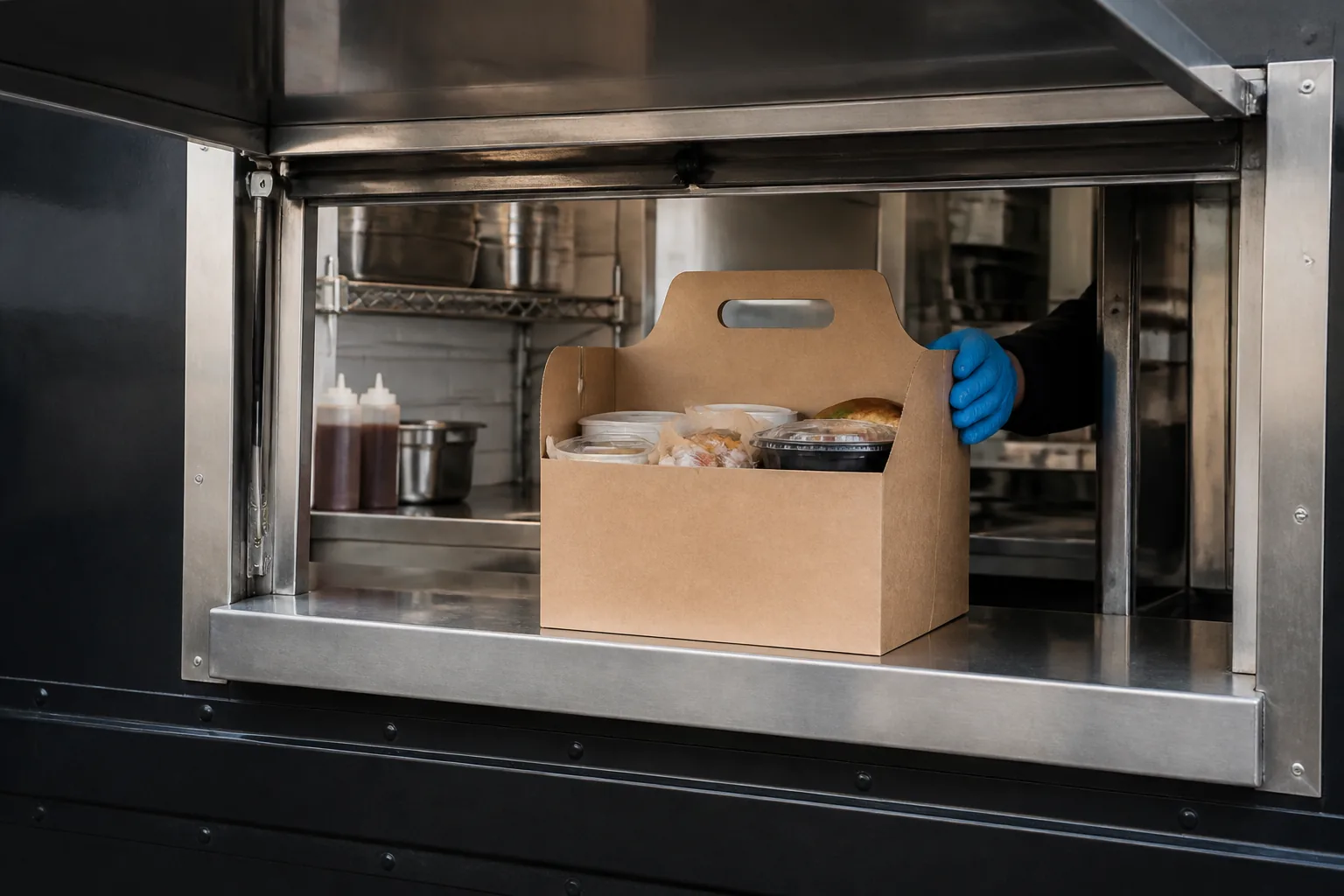
There is a moment in the life of every food truck when the menu board begins making promises with somebody else’s knees.
The board is upright.
The queue is hopeful.
The grill is already carrying three small, sizzling biographies.
And then the board says: burgers, fries, bowls, tacos, wraps, breakfast, dessert, three sauces, four modifications, a special, and something called the Loaded Situation.
The people in line are not unreasonable for wanting it.
The board offered it.
That is the whole social contract of the board.
Every Cheerful Noun Has Brought Luggage
A burger arrives with a cold place, a hot place, a wrapping place, and a handover place.
It also brings a moment when somebody has to find the onions.
While another person is attempting to become one with the fryer.
The Loaded Situation has arrived with relations.
Its own containers. Its own spoons. Its own cold storage.
And its own little diplomatic corridor.
Through a vehicle where an aisle can vanish the instant a door and a rack decide they have plans.
The board, naturally, has never seen a rack.
It does not know that a busy hot corner may hold three people at once.
Each of them holding a pan, a ticket, a towel, or the profound belief that the other one will move first.
The board has only one gift.
Possibility.
Your truck has to turn possibility into lunch.
A Short Menu Is Not an Apology Nailed to a Vehicle
It is a queue design.
The good version says: here are the things this tiny republic can make properly.
While a line forms.
While a generator hums.
While the water keeps its own accounts.
And while a person on an entirely fair lunch break watches every delay happen in public.
That person doesn’t need a lesson in your internal affairs.
They need a clear choice.
And a lunch that arrives while it is still recognisably lunch.
Make Every Item Confess
Before the beautiful lettering.
Before the heroic photograph of a sandwich leaning against a brick wall.
One page per proposed item.
Where does it come from?
Where does it wait?
Where is it prepared, heated, held, packed, and sent off into the afternoon?
The confession is not glamorous.
Nobody has ever framed a process map above the fireplace.
But it reveals things.
That an innocent “add fries” needs another cooking path.
Another basket of time.
Another landing place.
Another package.
And another question from the person at the window who was told it would be ready soon.
Your short menu begins there.
Not with deprivation.
With introductions.
Finish a few items from prepared ingredients and you ask less of your onboard kingdom.
Cook, cool, store, reheat, and improvise an empire from scratch and you ask a great deal more.
That is not a criticism of ambition.
Ambition is how the Loaded Situation got its name.
It is only worth noticing what one item costs the vehicle.
Three components. Three corners of the truck. All before it reaches a pair of hands at the window.
One sale to the customer.
Not one job to the vehicle.
Lunch Does Not Arrive in an Average
“We will sell a lot at lunch” is a sentence with no trousers on.
Lunch occurs in bursts.
For a sharp service, look at it in quarter-hours.
For a longer cycle, half-hours may do.
The question isn’t whether forty-eight orders sound encouraging from across a spreadsheet.
The question is how many of them want the same hot surface.
The same final spoonful.
The same person, at the same moment.
Here the board stops being a list and becomes a scheduling device in a jaunty hat.
It has pointed a crowd toward a production path.
It has elected your next bottleneck.
Four Minutes Is a Five-Part Treaty
Payment has to move.
The appliance has to recover.
The food needs somewhere to wait.
The packaging has to be within reach.
And the pickup shelf must not already be hosting a small family reunion.
If any one of those has filled up, your four minutes are a folk tale.
Told by a board, to a very patient crowd.
The crowd isn’t at fault for believing it.
The board said it.
There are four queues out there now.
People. Orders. Food. Pickup.
They are not enemies.
They are a relay team who have somehow been issued different maps.
Your menu’s first duty is to give them a race they can finish.
Design Backward From the Rush
Which can sound like an argument for making everything plain.
One sandwich.
One fry.
One cup of unseasoned resolve.
Hospitality has more imagination than that.
The trick is simply to work backward from the rush rather than forward from your fondest midnight ideas.
If thirty-six plates are released in a quarter of an hour, surfaces and hands have to receive thirty-six plates then.
Not philosophically, over the next hour.
Add a replenishment, a cleaning task, and ordinary staff movement to that same stretch.
Now the truck begins telling the truth.
Somebody waits because a trolley has claimed the route.
Somebody cannot reach the sink.
Somebody has made a finished meal.
And has nowhere lawful, clean, or calm to set it down for the five seconds before handoff.
The vehicle is not being difficult.
It is finally being asked the question the menu has been asking it all along.
How Far Does the Food Have to Travel
For a loop you repeat all day, a couple of metres and a few steps is the ambition.
Not because cooks are delicate woodland creatures who cannot survive a longer walk.
Because a two-metre trip made a hundred times is two hundred metres of busy feet, shoulders, hot pans, and lost glances.
A nine-metre trip made twice may be the quieter citizen.
Distance has companions.
Frequency.
Load.
Crossings.
That last one is where a tiny vehicle develops geopolitics.
The ready food wants to go out.
The dirty thing wants to come back.
The stock wants to arrive.
The refuse wants to leave with all the dignity it can still muster.
On the route your finished food takes, count the uncontrolled crossings.
Raw food, dirty ware, refuse, deliveries.
The right number is none.
Zero is not a moral achievement.
It is simply a blessedly quiet path.
And if two people need the same aisle more than once a minute at the rush, that aisle has stopped being an aisle.
It is a meeting.
The fix may be a different storage spot.
A timed handoff.
A small barrier.
A changed sequence.
Or an item that does not demand that particular border dispute every time somebody orders it.
It is not “try harder.”
Nobody enjoys being told to try harder while holding a tray of hot food in a truck.
Least of all the person in the queue, who can watch the entire constitutional crisis through the service window.
The Utilities Are Not Impressed by a Clever Name
Power does not care that your special is popular.
Water does not admire the house sauce.
Cold storage has never once been persuaded by a really good caption.
They care about what runs at the same time.
Water. Electrical service. Drainage. The hood. A storage shelf. A fuel source.
All of them take their turn in the same rush.
You do not have “enough” of these in the abstract.
You have enough, or not enough, for the combination that arrives together.
Which is why a sensible plan keeps a little room unclaimed.
Not because empty space is virtuous.
Because a late delivery is a very poor moment to discover that the menu has spent every last inch of the kingdom.
So is a bulky box.
So is a spike in orders.
And the last safe order is not always the last portion of food.
It may arrive when the packages are gone.
Or when waste capacity has had enough of the day.
Or when the fuel cannot bring the equipment back.
Or when the sequence has become a stack of promises with no way through.
That isn’t stinginess.
It is a truck declining to lie to the next person in line.
The Menu Lives in Three Places
There is a wider map waiting beyond the windshield.
The truck may be ready.
The site may not be.
And the base is the unglamorous third member of the group.
Waiting with storage, cleaning, water, waste disposal, and the keys after a late event.
Your menu lives in all three.
It is not merely painted on one of them.
But Do Not Let the Short Menu Become Its Own Bad Joke
Take it too far and the board becomes a small, stern kingdom of one acceptable meal.
Remove a dietary or price choice somebody actually needed.
Make every guest negotiate a secret maze of off-menu changes.
Hide the difficult work instead of removing it.
Now the shorter menu hasn’t made the queue kinder.
It has moved the queue inside the truck, where it can brood beside the pickles.
The aim is not to make everybody choose the same thing.
It is to make each available choice plausible.
Plausible for the guest with ten minutes.
Plausible for the person cooking it.
Plausible for the vehicle that must carry, cool, heat, wash, store, serve, and then go home again.
The Best Board Never Announces Its Sacrifice
It does not say, “Behold our careful restraint.”
It gives a hungry person a few good things, describes them clearly, and lets the line keep moving.
Somewhere inside, a person takes two steps instead of six.
The package is where the hand needs it.
The food reaches the window.
And the Loaded Situation, having been politely denied citizenship, does not hold up lunch.