Banquet timing is often treated as a service-day concern. In practice, the ballroom is calm only when menu, room, staffing, and authority decisions have been made before the doors open.
Guests arrive together, change seats, ask for another coffee, and expect the room to respond without a conference at the service door.
The goal is not to make the BEO more important than the event.
The goal is to move ordinary decisions into the event order early enough that the captain can make the guest-facing experience feel immediate.
The BEO supplies the baseline; the live record supplies the controlled way to depart from it.
Test the whole hotel before accepting the function
A banquet is not only a sale of ballroom hours.
A dated request for a 120-cover lunch also consumes a kitchen production window, service staff, furniture, linen, loading route, corridors, and potentially breakfast or dinner capacity.
The sales or catering manager therefore tests those resources before contract rather than expecting the BEO to resolve a conflict after a promise has been made.
Timing makes that test concrete.
A lunch served at 12:30 may need a room clear at 11:00, while another group’s coffee break uses the same pre-function area at 12:15.
If both functions can proceed, the hotel records the sequence, resources, and owners. If not, it changes the room, time, menu, or commercial term before the guest receives an unworkable promise.
Outlet demand belongs in the same capacity conversation. Occupied rooms are not assumed restaurant covers, and a rise in resident-dinner capture produces additional diner occasions only under a stated assumption about eligible diners per room.
The manager still has to establish whether those covers use spare capacity or trigger another labour, cookery, table, or wait threshold.
Group value also has to remain separate from production facts. A revenue-per-group-room-night measure can help compare bids.
It does not tell the kitchen how many meals to produce or the captain when to release a course.
Convert the agreement into one current instruction
The signed agreement sets the commercial framework: price, deposit, cancellation treatment, F&B minimum, guarantee deadline, taxes or service charges where applicable, and who may authorise changes.
It does not tell a chef when to plate, a room attendant where to place a table, or a captain how to handle a late speaker.
The BEO supplies those execution details.
It carries the event name and date, room, setup, start and end times, guarantee and attendance expectation, menu, beverages, dietary instructions, run-of-show, billing direction, and named internal departments.
The Events Industry Council describes the BEO as a hotel form giving personnel details about a specific F&B function or event-room setup; it is an execution record, not a sales summary.
The quantities must remain distinct.
“120 expected; 118 guaranteed at 10:00 two business days before service” identifies a forecast, a commitment, a deadline, and an owner.
It is more usable than a single count because production can release from the guarantee while the team still watches the attendance expectation.
A later request becomes an amendment with a stated effect: additional meals, a changed floor plan, a different time, a revised charge, or an inability to accept it.
Special requests need the same specificity.
A vegetarian meal, no-pork requirement, wheelchair-accessible route, and presentation delay do not belong in one undifferentiated note.
Each has a recipient and action: the chef needs the meal and recipe implication; service needs place markers and delivery order; setup needs the route; front office needs group movement; finance needs the account instruction.
Build the release plan backward from service
The BEO becomes useful when it is translated into a time-back plan.
For a 12:30 plated lunch, the banquet manager works backward through plate-up, final cooking or holding, staff briefing, table set, room release, and equipment delivery.
Every stage receives a time and an owner. Without that sequence, “lunch 12:30” leaves each department to assume that a different department has allowed the lead time.
At the daily function meeting, the team compares all BEOs rather than reading each function alone.
The relevant question is what will compete for the same room, corridor, cookery, stewarding equipment, or manager in the same 30-minute interval.
The result is a shared production and setup sequence, with one named person owning every unresolved dependency.
Staffing follows the service path and the peak within it.
A 120-guest plated event planned at 1 server per 10-12 guests starts with 10 servers, before captain, runners, bar staff, prep, driver, and strike labour.
The ratio is a planning baseline, not a universal rule. A buffet may use fewer servers, but it still needs attendants to replenish, bus, and prevent a depleted station.
The paid time is larger than the visible service window. A server’s 6-hour call can include only 3 hours in front of guests.
The plan therefore accounts for briefing, setup, service, strike, return, and cleaning, as well as the narrow plated-service peak when many plates must land together.
Cutting the team after looking only at dining-room hours can produce cold plates, slow bar queues, overtime, or a client concession.
Brief the team before the room begins to ask questions
Before guest arrival, the banquet manager confirms room release, BEO diagram, furniture, equipment, and safe access.
The kitchen confirms menu, dietary meals, holding plan, serviceware, and the time food must leave the pass.
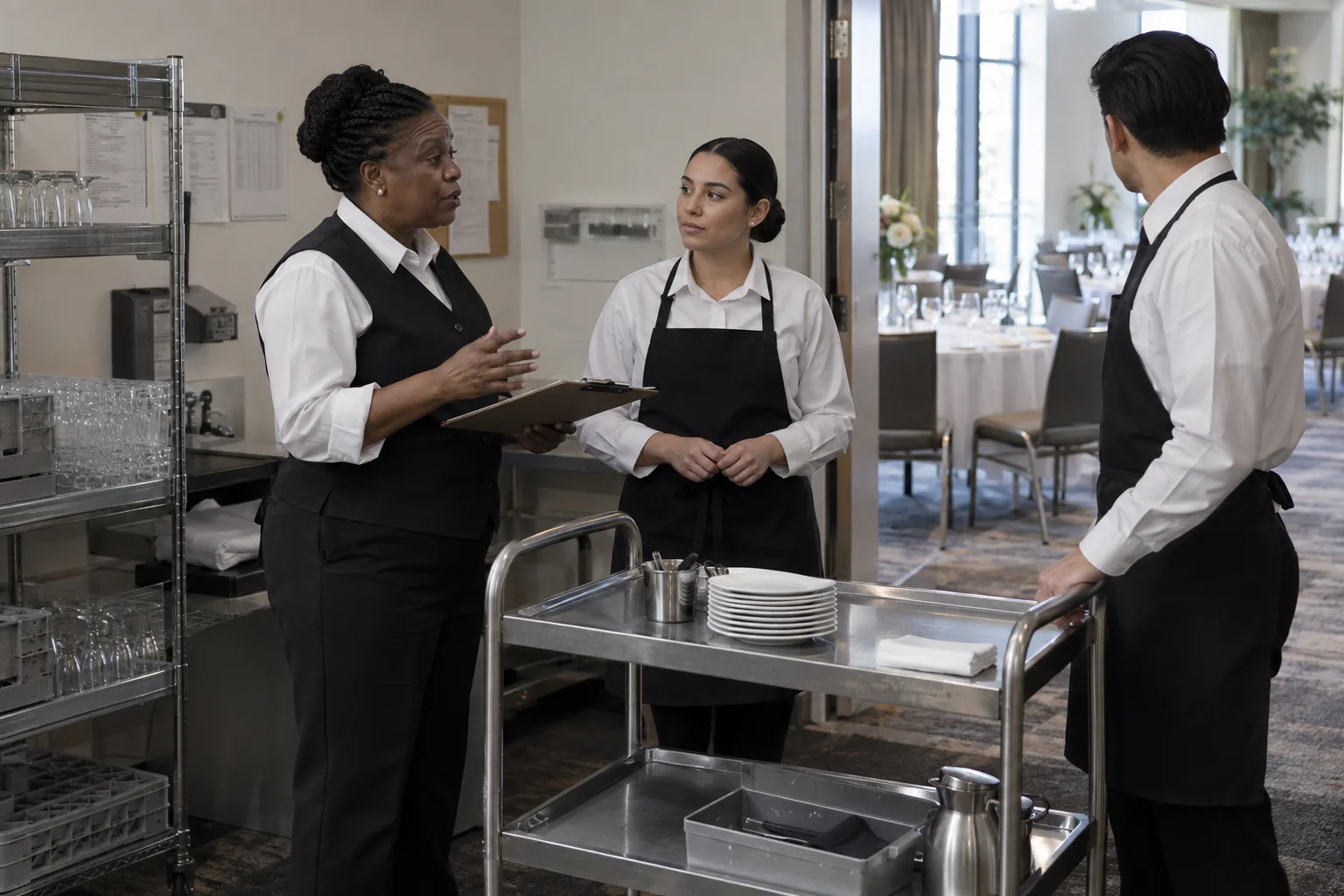
The captain then briefs table or station assignments, the event sequence, dietary-meal route, client contact, service signal, bar protocol, spill or injury escalation, and the person authorised to promise an adjustment.
This is where service permissions become useful. A guest who changes seats should not cause an unlabelled special meal to circulate while the team asks who can approve a replacement.
A late rental, blocked outlet, or missing item should already have a workaround.
The captain’s brief gives staff a route for a normal request and an owner for an exception before either becomes visible to the ballroom.
Food timing needs the same discipline.
The food enters the guest-facing room near the time it will be served, not merely when setup looks complete.
Cooked time/temperature-control-for-safety food follows the established holding and cooling process under the locally adopted rule, and the operational record carries the temperature, time, and corrective action.
Release the service together and record changes once
At guest arrival, the captain checks the host, actual attendance, first service cue, and duty-manager visibility. Service follows the BEO sequence while remaining responsive to the live agenda.
If a speaker is 15 minutes late, individual servers do not choose separate responses.
The captain obtains one decision, whether that is hold, serve, change the course order, or offer a revised break, and informs kitchen, bar, and service together.
The captain also compares the planned count with the live room: attendees present, meals served, special meals remaining, beverages issued, table progress, and staff availability.
If 126 guests are served against a guarantee of 118, the event record states how the count was obtained, whether extra meals were authorised, and who accepted the billing consequence.
The record does not convert the new attendance into a false replacement for the original guarantee.
The BEO remains the baseline, but it cannot be a reason to ignore a real condition.
A temperature, holding, equipment, or safety exception requires the captain to isolate the affected food or service point, record it, and refer disposition to the authorised person.
A replacement, different menu item, slower release, or end to service from that unit may be appropriate. Visible food is not necessarily cleared food.
One captain’s log or approved live event record keeps timing changes, additional consumption, damage or safety incidents, host approvals, and unresolved billing facts in one place.
A text thread, spoken message, and altered printout create competing histories.
The record is not bureaucracy for its own sake; it lets the kitchen, ballroom, and finance team act from the same current decision.
Protect scope without confusing it with hospitality
Scope controls begin before the event.
In catering, a deposit reserves capacity and can support planning or supplier commitments; it is not proof that the job has earned its margin.
The balance remaining after a booking payment still sits ahead of changes, tax, and other extras.
Late additions, overtime, damage, rental changes, and changes to the guarantee need their own approval path.
A change may be accepted as a client-approved extra, absorbed as a company contingency, or dealt with under another agreed arrangement.
The commercial response should be visible before the service team is asked to supply it.
That protects the guest from a public negotiation and protects the staff from having to invent authority at the door.
The counter-failure is rigidity.
A complete BEO is not permission to let a changed room condition, a live dietary need, or a delayed agenda become a guest problem.
Conversely, continual informal changes can consume capacity that was never authorised. The practical balance is a stable baseline, a named exception owner, one shared record, and prompt communication of the decision.
Close the function against what actually happened
After service, the banquet manager compares the BEO, guarantee, actual count, added consumption, and authorised charges before posting the designated account.
Closeout reconciles 4 objects: the agreed function, what was delivered, the resulting charge, and any remaining issue. That separation distinguishes a food-quality complaint from an extra-cover dispute or a posting error.
For off-premise work, the closeout begins after the agreed end and includes the reverse count of rentals, equipment, unopened goods, waste, and damaged serviceware.
A 24-hour closeout target keeps actual guest count, authorised extras, shortages, client comments, incidents, and disputed charges close to the event rather than dependent on recollection.
The measures are straightforward:
- Test ballroom demand against room, outlet, kitchen, corridor, labour, and equipment capacity before contract.
- State the forecast, guarantee, deadline, owner, and change effect in one current BEO.
- Work backward from the service time and staff the peak concurrent work, not only the visible dining period.
- Brief service permissions and exception ownership before doors open; release changes through one live record.
- Reconcile the agreed function, actual delivery, charge, and unresolved issue after service.
When those measures are complete, the ballroom does not display the planning.
A guest sees a welcome, a meal arriving at the right point in the agenda, and a request answered without delay. The operating decisions have already happened, which is the intended result.